Version en Español Scrolling Hacia Abajo
Performing Decolonialism vs. Being on the Right Side of History
“Performativity must be understood not as a singular or deliberate ‘act’ but rather as the reiterative and citational practice by which discourse produces the effects that it names” – Judith Butler.

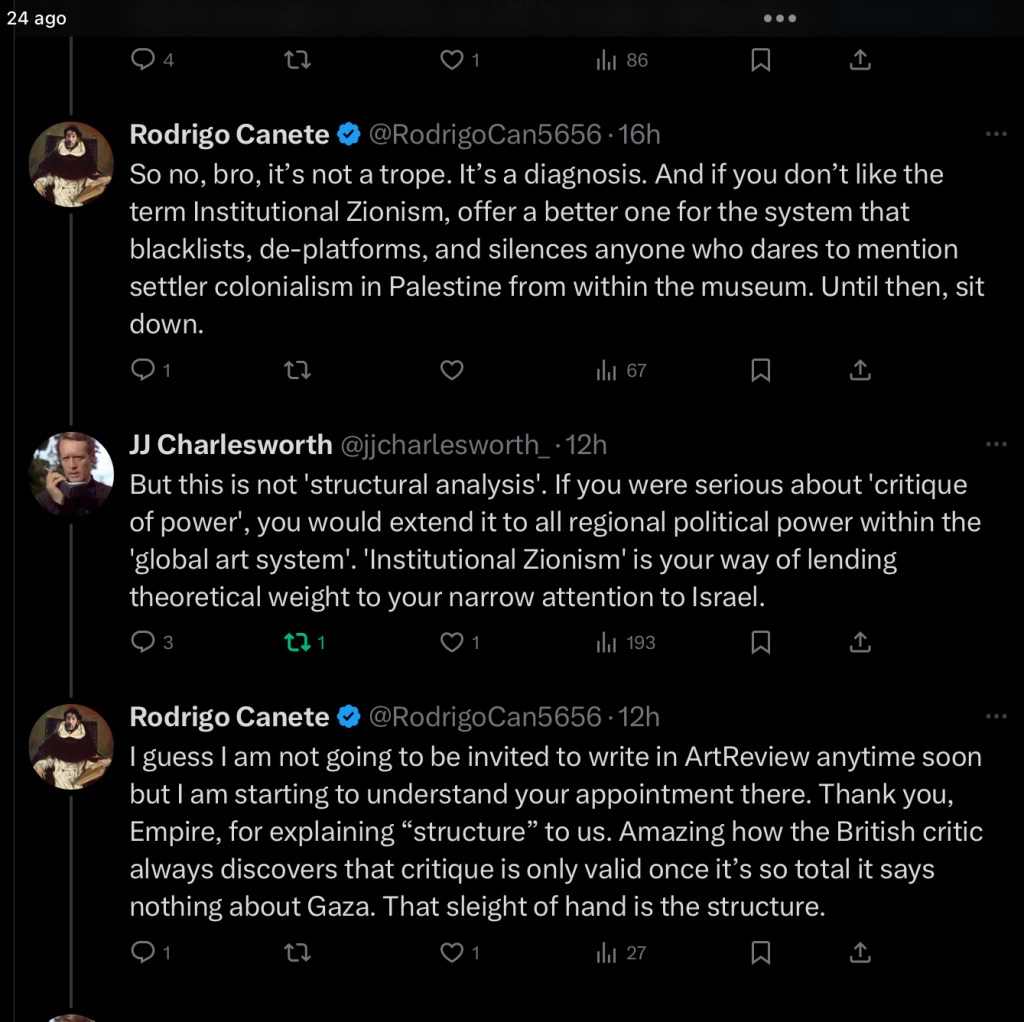


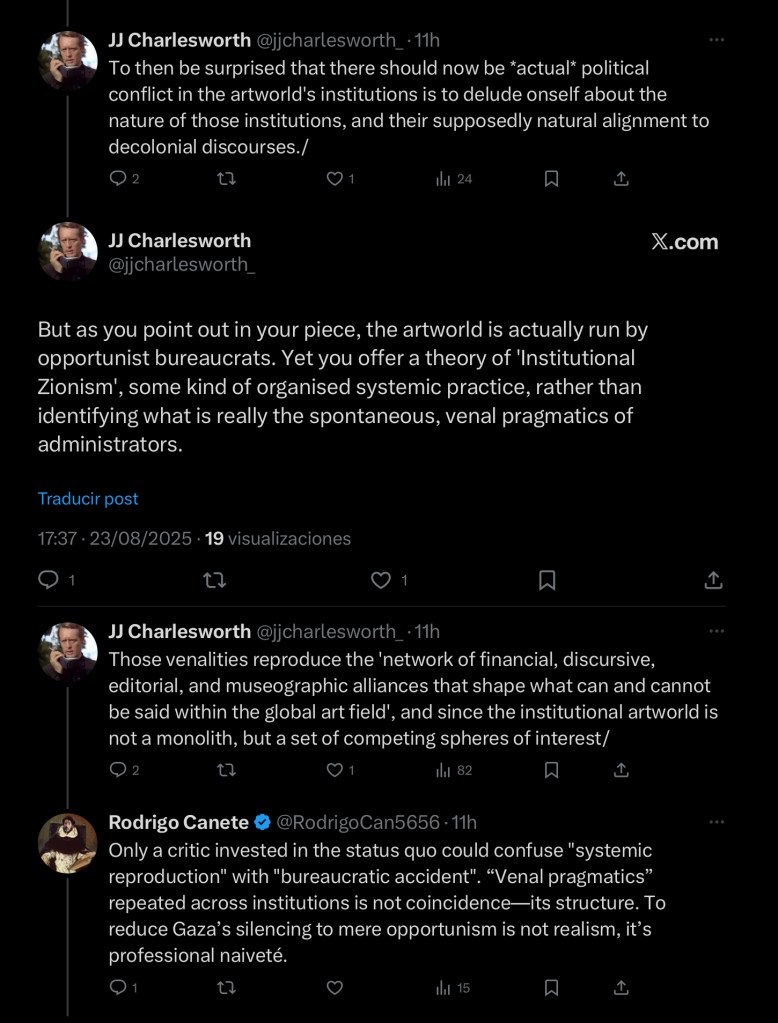
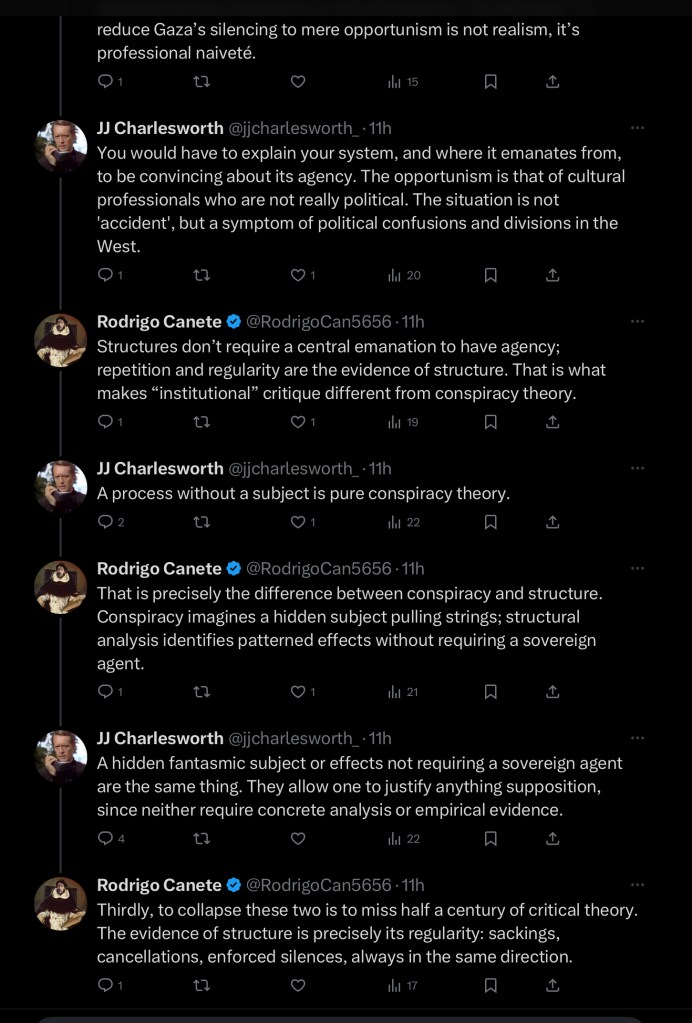
Etc…
Judith Butler’s insight into performativity reminds us that words and actions, repeated often enough, can create the appearance of truth or virtue. However, as we shall see, simply performing a discourse – flaunting one’s rhetorical alignment with decolonial or ethical ideas – is not the same as actually being on the right side of history. Butler’s theory was meant to illuminate how identities and norms are enacted, but it also inadvertently highlights a pitfall: what happens when someone iterates the language of progressive politics as mere posture, without genuine commitment or insight? This reflection sets the stage for examining a recent intellectual clash and the broader dynamics at play in the art world. We begin by looking at the protagonist of this exchange, a figure whose academic pedigree and writing credentials did not prevent him from falling into exactly that trap of performative pseudo-intellectualism
Butler’s theory was meant to illuminate how identities and norms are enacted, but it also inadvertently highlights a pitfall: what happens when someone iterates the language of progressive politics as mere posture,
Tweet
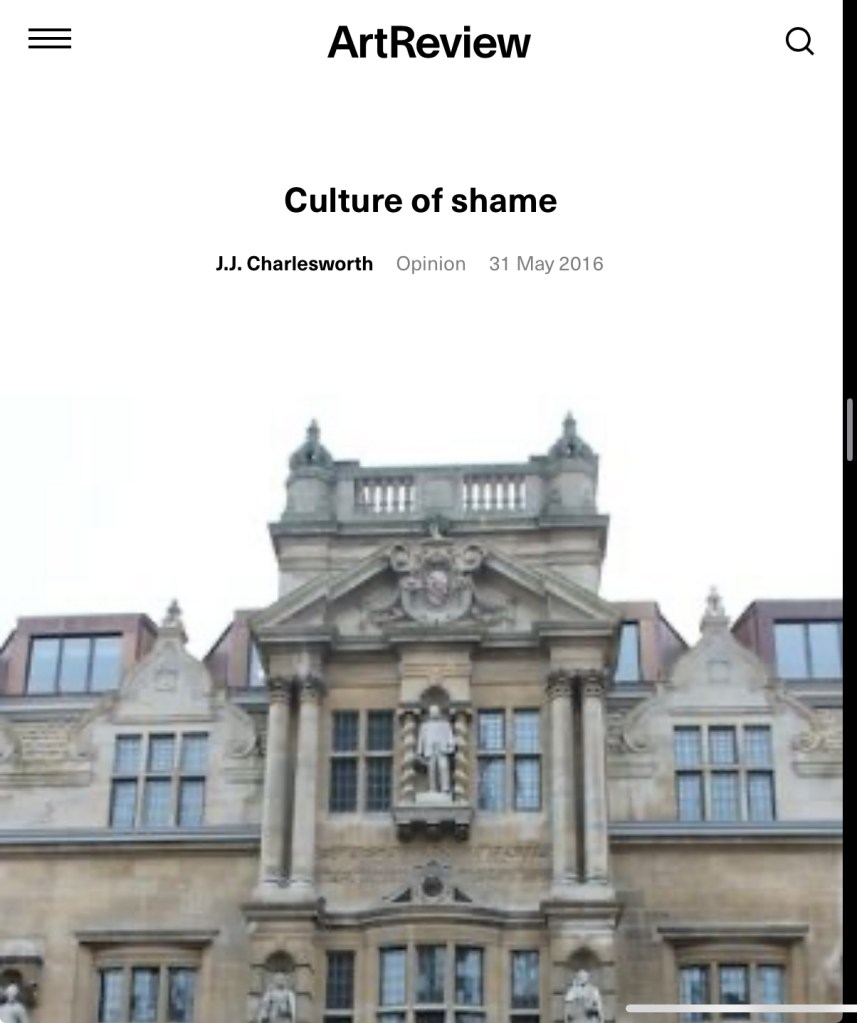
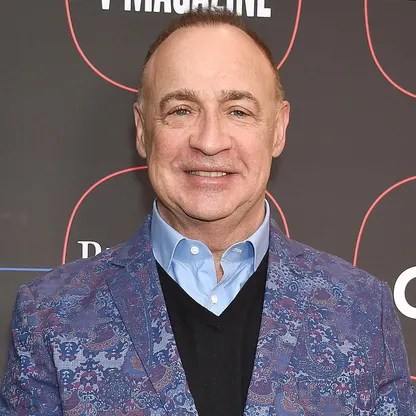
Who Is JJ Charlesworth?
JJ Charlesworth is a British art critic and editor known in art circles – a man with impeccable establishment credentials on paper. He studied Fine Art at Goldsmiths College (London) in the mid-1990s and later earned a PhD in art history from the Royal College of Art . Now a senior editor at ArtReview magazine, he frequently writes about art’s engagement with politics and the institutional dynamics of the art world . Charlesworth has written for high-profile outlets ranging from Art Monthly to the Daily Telegraph, even contributing to contrarian platforms like spiked . In 2024, he published a scholarly book Criticism, Art and Theory in 1970s Britain: The Critical War , cementing his image as a serious intellectual voice.
JJ Charlesworth is a British art critic and editor known in art circles – a man with impeccable establishment credentials on paper. Now a senior editor at ArtReview magazine, he frequently writes about art’s engagement with politics for the Daily Telegraph.
Tweet
On the surface, Charlesworth appears to be well-versed in political and “decolonial” discourse – the very kind of discourse that has become fashionable in the contemporary art world. He has commented on major art events like Documenta (the prestigious quinquennial exhibition in Germany) and controversial topics like cultural boycotts. Indeed, in his review of Documenta 15 (2022), he duly noted how that edition – led by the Indonesian collective ruangrupa – upended Eurocentric norms by centering non-Western collectives, including a Palestinian art network from Gaza . He observed that the Gazan artist group Eltiqa persevered “amid the grim constraints of life in Gaza under Israeli control,” yet necessarily depended on contact with the outside world for support . Such observations suggest that Charlesworth understands, at least at an intellectual level, the lingua franca of global art activism and decolonial critique. He recognizes the gestures Documenta 15 made toward egalitarianism and “righting historic exclusions.”
Charlesworth understands, at least at an intellectual level, the lingua franca of global art activism and decolonial critique. He recognizes the gestures Documenta 15 made toward egalitarianism
Tweet
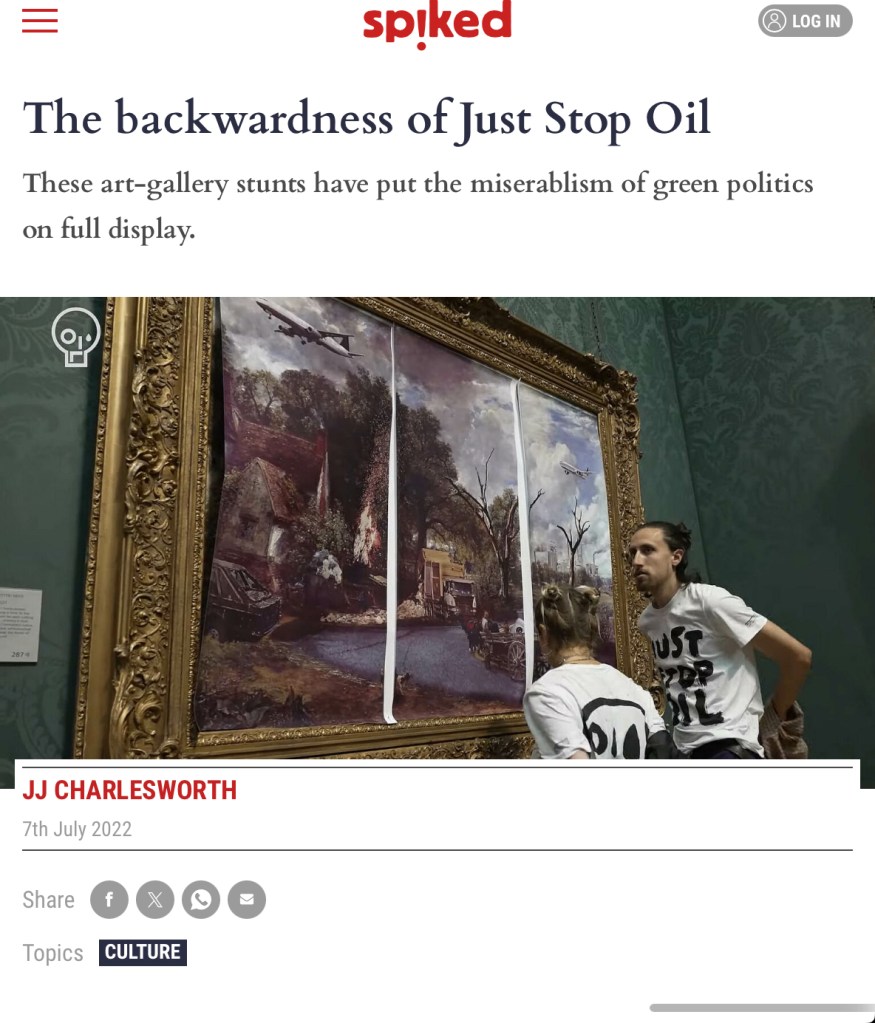
However, recognizing a discourse is not the same as truly believing in or understanding it. Charlesworth’s writing often carries a skeptical, almost cynical tone toward these very gestures. For instance, in that same Documenta review, after acknowledging the progressive intent, he hastened to point out the paradoxes: that “decentring Documenta to the Global South” still ultimately weaves those collectives into the existing global art market circuits, and that no collective is ever truly independent of the institution hosting it . In other words, he flattens the complexity of the decolonial experiment into a kind of gotcha! – suggesting that the attempt to redistribute power and voice in the art world is mostly rhetorical since it all feeds back into the system. This world-weary dismissal of decolonial efforts is characteristic of Charlesworth’s stance: he often positions himself as the clear-eyed contrarian, poking holes in what he perceives as naïve idealism or “fashionable” political stances among artists.
A dismissal of decolonial efforts is characteristic of Charlesworth’s stance: he often positions himself as the clear-eyed contrarian, poking holes in what he perceives as naïve idealism or “fashionable” political stances among artists.
Tweet
Crucially, Charlesworth has not shied away from attacking what he calls the art world’s moral posturing, especially on issues related to Palestine. In 2015, when over 1,000 British cultural figures signed a public pledge to boycott Israeli state-sponsored cultural institutions in solidarity with Palestinians, Charlesworth penned a broadside titled “The Cultural Boycott of Israel Isn’t Solidarity, It’s Condescension.” He accused those artists of “moral condescension” and dismissed their pledge as the work of the “self-righteous and self-regarding” . In his view, such solidarity actions were less about principled anti-colonial struggle and more about performers “adopting a fashionable posture” to feel righteous . He even argued that if these artists were truly serious, they would “raise money, send weapons, go fight even” – a ludicrous straw man that prompted critics to note his “morass of soft thinking and loose argument” on the issue . Charlesworth’s rhetoric here was overtly insulting: he painted conscientious artists as preening hypocrites, while sidestepping the actual asymmetry of power between Israel and Palestinians.
Charlesworth has not shied away from attacking what he calls the art world’s moral posturing, especially on issues related to Palestine. When over 1,000 British cultural figures boycott Israeli cultural institutions, he accused them of “self-righteous and self-regarding”
Tweet
Charlesworth doubled down on this viewpoint in a 2021 piece, where he lamented “the politicisation of culture” and what he saw as an epidemic of “cultural workers” trying to shut down art to punish those they disagree with . He mocked author Sally Rooney’s refusal to license a Hebrew translation (part of her support for BDS) as an act of elite vanity, saying such moves “have the veneer of political radicalism” but are really just ways for “privileged minorities” (artists) to lecture others and “exercise their intolerance” . In a striking phrase, he declared that these boycotters, though claiming to act for the oppressed, are in fact “privileged minorities telling everyone else what to think” . The irony of a white British male art critic leveling this charge seemed lost on him; Charlesworth spoke from the very center of imperial cultural privilege, yet presumed to scold others for alleged paternalism. He went so far as to frame such activism as “condescension towards the public,” suggesting that artists who boycott or protest are somehow betraying “the audience” and the purity of art . In his narrative, moral outrage in art = contempt for the common folk.
Charlesworth doubled down on this viewpoint in a 2021 piece, where he lamented “the politicisation of culture” and what he saw as an epidemic of “cultural workers” trying to shut down art to punish those they disagree with
Tweet
This is classic imperial turnabout rhetoric – portraying the colonized or oppressed (and their allies) as the real bullies, and the status quo as the real victim. It’s a discursive move with deep colonial roots, repackaged in the idiom of contrarian art criticism. Charlesworth, armed with his British accent of authority and institutional clout, was effectively telling colonized people and their supporters: “How dare you presume to judge or ‘lecture’ – focus on your own faults instead.” He even argued that British artists should clean up Britain’s messes before “wagging fingers” at Israel , a whataboutism that, taken to its logical end, would preclude any solidarity with any struggle abroad. (By that logic, one must attain moral perfection at home before one can empathize with others – an absurd and perversely isolationist stance.)
The irony of a white British male art critic leveling this charge seemed lost on him; Charlesworth spoke from the very center of imperial cultural privilege, yet presumed to scold others for alleged paternalism.
Tweet
In sum, JJ Charlesworth is a product of the very professionalized art world he critiques. He benefited from elite education and platforms, and he often speaks in the lofty yet world-weary tone of imperial Britain, where sounding reasonable and authoritative can mask fallacies and dismissals. He performs intellectualism and even a kind of contrarian “decolonial” analysis (in the sense of scrutinizing postcolonial initiatives for hypocrisy), but as we will see, this performance collapses under scrutiny. The question then becomes: when Charlesworth turned his insults and fallacies on me in a recent exchange, how could one effectively deconstruct his rhetoric? The answer: by systematically unraveling the circular, tautological narrative he was trapped in – a narrative that reveals how the “empire” (old attitudes of colonial entitlement) can no longer claim ethical superiority by mere attitude or academic posturing.
Charlesworth’s circular, tautological narrative he was trapped in – a narrative that reveals how the “empire” (old attitudes of colonial entitlement) can no longer claim ethical superiority by mere attitude or academic posturing.
Tweet
Professionalization, Silence, and Belonging in the Art World
Before diving into the specifics of our exchange, it’s important to sketch the backdrop: a contemporary art world caught between political conscience and professional self-preservation. As the art world has become increasingly professionalized – with artists, curators, and critics dependent on institutional jobs, funding, and networks – there is a pervasive pressure to conform and stay silent on controversial issues. Speaking out too loudly, whether in support of Palestine or any polarizing cause, can risk one’s belonging in this rarefied ecosystem. As one observer acidly noted, “the art world is counting on your collective silence.” In other words, the unwritten contract for many cultural professionals is: toe the line, don’t make too much noise, and you will be rewarded with inclusion (exhibitions, grants, tenure on committees, etc.). Silence, in this sense, becomes a mode of belonging – a way to signal that one is a “team player” within the institutional art world.
Speaking out too loudly, whether in support of Palestine or any polarizing cause, can risk one’s belonging in this rarefied ecosystem. As one observer acidly noted, “the art world is counting on your collective silence.”
Tweet

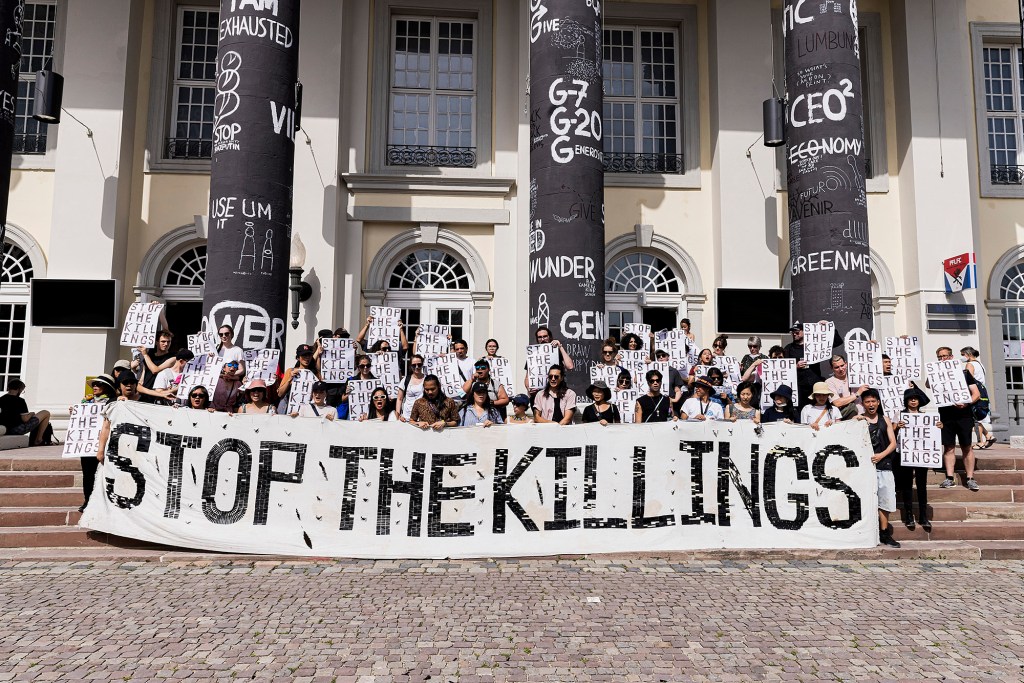
This dynamic became especially evident in recent events surrounding Gaza and Documenta. The Israel–Hamas war of 2023 and its horrific toll on Gaza sent shockwaves through global culture, and many artists felt compelled to protest or demand institutional responses. Yet the response from major art institutions was often muted or fraught with internal resignations and controversies. In Germany, for instance, members of Documenta’s own curatorial committee resigned over the expectation that they condemn pro-Palestinian expressions as anti-Semitic . The previous edition, Documenta 15, had already seen Palestinian voices attacked and a ferocious debate over alleged anti-Semitic content, leading to vows that such “events of summer 2022 must not be repeated” . In short, Documenta – historically known as an avant-garde, politically edgy exhibition – found itself policed by the very power dynamics it was supposed to challenge. The message many took away: certain solidarities (with Palestinians, for example) would be harshly penalized or censored in the high art arena.
Documenta – historically known as an avant-garde, politically edgy exhibition – found itself policed by the very power dynamics it was supposed to challenge. Certain solidarities (with Palestinians, for example) would be censored in the high art arena.
Tweet
This produced a palpable climate of fear and self-censorship. As activists drily put it, “the silence from the art world has been incredibly loud.” Museums and galleries, reliant on donors and fearful of political backlash, often chose “opulence and cowardice” over moral courage . For artists and intellectuals within these institutions, the safest course was to say nothing – to remain conspicuously neutral (or even absent) on issues like Gaza. Silence became a strategy: by not speaking, one could continue to belong, to enjoy the fruits of professionalization (jobs, shows, praise) without rocking the boat. This is not a new phenomenon (artists under repressive regimes have long learned to read the room), but in the West it’s a relatively new kind of chill, one exacerbated by the professional art world’s entanglement with corporate and state interests.
For artists and intellectuals within these institutions, the safest course was to say nothing – to remain conspicuously neutral (or even absent) on issues like Gaza.
Tweet
JJ Charlesworth, ever the contrarian, actually celebrates or demands this silence under the guise of defending “the audience” and “art’s autonomy.” In his criticism of cultural boycotts and artist protests, he essentially argues that artists should shut up about politics – that art should remain available to all and unsullied by “punitive” moral stands . He paints vocal artists as a “privileged… chattering class” enforcing groupthink, and extols the ideal of an audience that can freely consume art without didactic interference . Stripped of its pretenses, this is a call for artists to remain silent and compliant – to let the status quo proceed unchallenged, all in the name of a faux-populist notion of “freedom.” It’s a clever reframing: silence isn’t cowardice, in Charlesworth’s telling, but rather respect for artistic purity and the common folk. And speaking out – say, refusing to participate in a state-funded event – is recast as elitist arrogance. By this logic, resistance is oppression, and silence is virtue.
JJ Charlesworth, ever the contrarian, actually celebrates or demands this silence under the guise of defending “art’s autonomy.” In his criticism of artist protests, he essentially argues that they should shut up about politics
Tweet
Such arguments dovetail neatly with the interests of those in power (no surprise, then, that they find a home in a conservative paper like the Telegraph). They also resonate with many art professionals who feel, deep down, that their careers might suffer if they don’t stay silent. Thus, Charlesworth’s stance offers a kind of intellectual justification for passivity: an articulate excuse for doing nothing in the face of injustice, dressed up as a defense of art’s sanctity. This is the context in which our personal exchange occurred – an art world moment where the pressure to be silent collided with the urgency of the utterance.
This is the context in which our personal exchange occurred – an art world moment where the pressure to be silent collided with the urgency of the utterance.
Tweet
Imperial Fallacies and Pseudo-Decolonialism Unmasked
When JJ Charlesworth decided to aim his barbs at me, he likely assumed that his usual arsenal of debate tactics – fallacies delivered in an authoritative tone – would leave me cowed or at least publicly embarrassed. After all, he had the home-court advantage of imperial discourse: the polished accent of a British intellectual, the subtle invocation of having studied at venerable institutions, the confidence of someone who had sparred in print with prominent artists. His approach, true to form, was not to engage with the substance of my arguments, but to deploy a series of rhetorical maneuvers meant to discredit and derail. It was a performance he’d perfected in essays and editorials, now carried into a direct dialogue.
Let’s deconstruct his key insults and strategies, one step at a time, and see how each unraveled:
1. Ad Hominem and Credentialism: Charlesworth opened with thinly veiled insults about my intellect and background. He insinuated that I didn’t fully grasp the complexities of the situation – implying that his education and immersion in the British university system gave him a superior grasp. This is a classic appeal to authority (or credentials) mixed with a personal slight. The subtext was: “I went to Goldsmiths and have a PhD; who are you to challenge me?” By attempting to pull rank, he was leaning on one of “the few excellent things about Britishness,” as the joke goes – its storied university pedigree – to lend imperial weight to his stance. My response was to call out this tactic explicitly. I reminded him (and our audience) that truth isn’t determined by Oxbridge accents or PhDs, and that appealing to one’s own authority is a logical fallacy when devoid of factual rebuttal. I may not have a Wikipedia page or a Routledge book (as a matter of fact, I said no to them), but arguments stand or fall on evidence and reason, not on the speaker’s resume. By foregrounding this point, I neutralized the intended effect of his credentialism. The conversation, I insisted, must stick to content, not CVs.
The conversation, I insisted, must stick to content, not CVs.
Tweet
2. Straw Man Arguments: Charlesworth then pivoted to a familiar straw man: mischaracterizing my position to make it easier to attack. For example, because I voiced support for Palestinian rights and had critiqued institutional silence, he leapt to accuse me of advocating a simplistic “us vs. them” stance or of participating in a “deeply conformist,” knee-jerk trend. (In his writings he has literally accused pro-Palestine artists of “falling over themselves to adopt a fashionable posture.” ) He essentially tried to put words in my mouth: that I believed the UK (or West) was 100% evil and others 100% virtuous – a caricature of decolonial critique that I never asserted. This straw man was easy for him to mock, painting me as an unserious radical. I dismantled this by clarifying my actual stance at every turn. I drew a distinction between systemic critique and totalizing blame. One can critique British imperialism or Israeli apartheid specifically without claiming one’s own society is entirely villainous in all things. I pointed out that Charlesworth was arguing with a phantom, projecting extreme positions onto me that I never held. By forcing the conversation back to what I actually said (for instance, that institutions should uphold human rights consistently), I refused to let him knock down a straw man in place of my real arguments.
Charlesworth argued that it was hypocritical for any Brit (or Westerner) to criticize Israel or any other state’s actions . This is both a red herring (distracting from the issue at hand) and a false equivalence.
Tweet
3. Whataboutism and False Equivalence: As expected, he trotted out the “what about your own country’s sins” refrain. Citing Britain’s involvement in Iraq, Afghanistan, etc., he argued that it was hypocritical for any Brit (or Westerner) to criticize Israel or any other state’s actions . This is both a red herring (distracting from the issue at hand) and a false equivalence. I responded by agreeing that yes, Britain’s imperial misdeeds (past and present) are abhorrent – and that I, like many activists, also criticize those. But, crucially, injustice isn’t a zero-sum game. “Why not ‘as well’ instead of ‘first’?” I asked, echoing what others have pointed out . We can and must address multiple injustices in parallel. The existence of one crime doesn’t erase another. By his logic, no one could ever object to anything unless their own house were pristine – a convenient argument that results in permanent inaction. I highlighted how this logic only serves the status quo. It’s a tautology of deflection: the empire (or any power) can always say “clean your house first,” knowing full well that no house is ever perfectly clean. Thus no critique is ever valid – except of course his critiques of activists. Exposing this self-serving loop helped the audience see it for what it was: a clever-sounding non-argument that protects power from accountability.
Charlesworth grew agitated as I deflected his diversions, and he resorted to painting himself (and by extension the establishment) as the victim. This is where his rhetoric truly betrayed its imperial DNA.
Tweet
4. Inversion of Victim and Perpetrator: Charlesworth grew agitated as I deflected his diversions, and he resorted to painting himself (and by extension the establishment) as the victim. This is where his rhetoric truly betrayed its imperial DNA. He claimed that voices like mine were part of a “censorious,” “intolerant” mob silencing people like him. The irony was rich: here was a man with columns in national media and a top editorial post, claiming to be silenced by activists who have comparatively little power. I calmly enumerated the platforms and influence he enjoys versus the very limited power grassroots artists or students have. Who actually gets disinvited, fired, or shunned in the art world? It’s almost never the well-connected critics; it’s the young curator who tweets #FreePalestine or the artist who speaks out too loudly that courts real career risk. By listing real examples (a curator dropped from an exhibition for pro-Palestine comments, artists being censored – plenty of recent cases exist), I demonstrated that the institutional weight of silence falls on dissenters, not on defenders of the status quo. Charlesworth’s claim of persecution flipped reality on its head. When confronted with facts, his inversion crumbled, revealing itself as the imperial reflex to cast oneself as the beleaguered civilizer beset by unruly natives – a trope as old as the colonial narratives of the 19th century.
5. Circular Reasoning (Tautology): Finally, with his main gambits exhausted, Charlesworth lapsed into a circular narrative that was as frustrating as it was telling. He basically argued, in so many words, that the art world’s job is to focus on art (read: stay apolitical), and that politicizing art is bad because art should not be politicized. This tautology – politics is bad in art because art should be non-political – merely restates his premise as a conclusion. I pressed him on why art should be exempt from moral responsibility, or why an artist refusing a state sponsorship is more egregious than a state bombing civilians. In response, he returned to the same phrases: “it’s condescension… it’s intolerance… it’s not the artist’s role.” But these were assertions, not arguments backed by anything except his personal comfort with the status quo. By pointing out the tautology, I made it evident that he was running in circles. He had no answer to the basic ethical proposition that artists, like anyone, have the right (and some would say duty) to act according to conscience. His only response was essentially, “because I said so” in flowery terms. At this juncture, the dialogue laid bare that his position wasn’t grounded in principle so much as in preference – a preference for the way things have been (empire, quietly repentant perhaps but unchallenged) over the messy, uncomfortable demands of change.
Charlesworth lapsed into a circular narrative that was as frustrating as it was telling. He basically argued, in so many words, that the art world’s job is to focus on art (read: stay apolitical).
Tweet
Throughout this back-and-forth, a larger pattern became clear. Charlesworth was performing – performing the role of the rational, bemused intellectual who must gently correct the hysterics of activists. It is a flattened, pseudo-decolonial intellectualism: he uses the language of critique (speaking of power structures, of not being “condescending” or replicating “colonial” style lecturing) but empties it of genuine anti-imperial intent, turning it instead against those who actually challenge imperialism. It’s a bit like a magician’s trick: misdirection. He iterates the discourse of anti-conformism and intellectual freedom, but only to uphold a very familiar hierarchy. In doing so, he inadvertently proved the very point I started with: the empire (in this case a mindset as much as a nation) has lost its capacity to claim ethical superiority by mere attitude. You cannot simply act superior – by dint of accent, education, or eloquent cynicism – and thereby be right. At one time, perhaps, a certain colonial paternalistic tone could pass for moral authority. No longer. Charlesworth’s attitude, his performance of knowing-better, is not enough; it collapses when confronted with patient, persistent truth-telling.
Charlesworth was performing – performing the role of the rational, bemused intellectual who must gently correct the hysterics of activists
Tweet
Imperial Art Criticism Has No Clothes:
By the end of our dialogue, Charlesworth had been, to put it bluntly, intellectually cornered. The imperial armor of prestige and rhetoric was stripped away, revealing circular logic and unexamined biases. This outcome was more than just a personal triumph in debate; it carries a broader lesson for the art world and beyond. In an era when issues like Gaza force even the most insulated cultural institutions to take a stand (or else twist themselves in knots avoiding doing so), it becomes clear that performative allyship or performative neutrality is insufficient. As one prominent thinker famously asked, “Which side are you on?” – history does demand an answer.
By the end of our dialogue, Charlesworth had been, to put it bluntly, intellectually cornered. This outcome was more than just a personal triumph in debate; it carries a broader lesson for the art world and beyond.
Tweet
Judith Butler’s theoretical framework gave us the term “performativity,” and indeed we saw in vivid detail how discourse can be iterated as a performance of virtue or of intellectualism. But if there is a critique to be made of Butler (and those who follow her too mechanically), it is that focusing on performance without insisting on accountability can lead to hollow politics. Butler herself, to her credit, has taken stands – she has been an advocate for Palestinian rights, aware that discourse must meet reality. The problem is when others think that discourse alone – the mere flourish of saying the right words or citing the right theories – absolves them from the hard work of ethical alignment. Charlesworth shows us the stark difference: one can talk about decolonization, perform skepticism of Western institutions, even quote radical ideas, yet still align oneself against genuine decolonial change by one’s actions and allegiances.
In the end, it is not enough to flaunt the iteration of a discourse or a performance. It is not enough to quote Fanon while undermining liberation movements; not enough to speak of “ethics” while standing on the wrong side of an ethical crisis. The empire – literal and figurative – can no longer claim the moral high ground by default, with a haughty smirk and a Latin aphorism. Ethical superiority, if it exists at all, must be earned through consistent thought and action. Those like JJ Charlesworth who rely on attitude and rhetoric find themselves increasingly exposed when challenged by those armed with clarity and conscience.

The professional art world, with all its pressures to remain silent and “professional,” is at a crossroads. The lesson of this exchange is a hopeful one: even a deeply entrenched voice of the establishment can be challenged and unmasked through reason and principle. When silence is the norm, speaking truth can sound radical. When performance is everywhere, thinking (truly thinking through a position and its real consequences) becomes a revolutionary act.
To circle back to Butler one last time: discourse produces effects, yes – but discourse wedded to sincere conviction and action produces change, whereas discourse that is merely performative produces only spectacle. The goal, for artists, critics, and all of us, should be to ensure our words are not empty, our performances not just for show. Decolonization, justice, human dignity – these are not branding exercises or trends to hop on, but commitments that should shape what we do when no one’s watching, not just what we say on a panel. The right side of history isn’t a badge one wears; it’s an ongoing practice of aligning one’s ethics with one’s deeds.
The goal, for artists, critics, and all of us, should be to ensure our words are not empty, our performances not just for show. Decolonization, justice, human dignity – these are not branding exercises or trends to hop on, but commitments
Tweet
Charlesworth, in his way, reminded me of this. By trying to use imperial-era debate tricks, he inadvertently galvanized a more profound understanding in me (and, I hope, in our audience) that the time for deference to such tricks is over. The empire’s voice quavers, exposed and unsure, when confronted by those who refuse to be overawed by mere performance. And in that quaver, in that exposure, lies the possibility of genuine dialogue and progress.
In conclusion, what began as a personal rebuttal to an insult became an illustration of a changing paradigm: knowledge and moral authority are no longer the preserve of those who simply sound confident, especially when that confidence serves an unjust status quo. The performative shell can be cracked, and when it does, something truthful and new can emerge. The hope is that more of us in the art world will have the courage to speak, to question, and to think – even if it means breaking the polite silence and risking the disapproval of gatekeepers. After all, as the saying goes (often attributed in spirit to the likes of Audre Lorde), your silence will not protect you. And as I would add, nor will it protect the art world’s soul. The only way forward is to match discourse with reality, performance with principle – and to always interrogate who benefits from our silence or our speech. That is how we ensure we’re not merely performing decolonialism, but actively participating in its realization.
The only way forward is to match discourse with reality, performance with principle – and to always interrogate who benefits from our silence or our speech.
Tweet
JJ Charlesworth y el Canto del Cisne de las Pretensiones Imperiales de la de arte Crítica Británica
Performar el decolonialismo vs. estar del lado correcto de la historia
“Uno de los rasgos esenciales de la performatividad es que no debe entenderse como un acto singular, sino como una práctica reiterada y referencial mediante la cual el discurso produce los efectos que nombra” – Judith Butler.
La intuición de Judith Butler sobre la performatividad nos recuerda que las palabras y las acciones, repetidas lo suficiente, pueden crear la apariencia de verdad o virtud. Sin embargo, como veremos, simplemente performar un discurso – ostentar una retórica alineada con ideas decoloniales o éticas – no es lo mismo que estar realmente del lado correcto de la historia. La teoría de Butler estaba pensada para iluminar cómo se construyen identidades y normas, pero también revela un peligro: ¿qué sucede cuando alguien reitera el lenguaje de la política progresista como mera pose, sin compromiso real ni reflexión profunda? Esta reflexión abre el escenario para examinar un choque intelectual reciente y las dinámicas más amplias que lo rodean. Empezamos con el protagonista de ese intercambio, alguien cuya formación académica y credenciales editoriales no le impidieron caer exactamente en esa trampa del pseudo-intelectualismo
La intuición de Judith Butler sobre la performatividad nos recuerda que las palabras y las acciones, repetidas lo suficiente, pueden crear la apariencia de verdad o virtud. Sin embargo, una retórica alineada con ideas decoloniales o éticas – no es lo mismo que estar realmente del lado correcto de la historia.
Tweet

¿Quién es JJ Charlesworth?
JJ Charlesworth es un crítico de arte británico, editor sénior en ArtReview y figura conocida en el medio. Estudió Bellas Artes en Goldsmiths College (Londres) en los años noventa y luego obtuvo un doctorado en historia del arte en el Royal College of Art . Ha escrito en medios como Art Monthly, Daily Telegraph, spiked , y en 2024 publicó el libro Criticism, Art and Theory in 1970s Britain: The Critical War .
JJ Charlesworth es un crítico de arte británico, editor sénior en ArtReview y figura conocida en el medio.
Tweet
En los papeles, Charlesworth parece dominar el lenguaje político y “decolonial” que circula en el arte contemporáneo. Ha venido comentando sobre Documenta (la célebre exposición quinquenal de Kassel, Alemania) y sobre boicots culturales. En su reseña de Documenta 15 (2022), reconoció que la muestra, dirigida por el colectivo indonesio ruangrupa, desplazó el centro eurocéntrico al incluir colectivos no-occidentales, entre ellos una red artística de Gaza . Observó que el grupo gazatí Eltiqa sobrevivía “entre las sombrías restricciones de la vida en Gaza bajo control israelí”.
En los papeles, Charlesworth parece dominar el lenguaje político y “decolonial” que circula en el arte contemporáneo. Ha venido comentando sobre Documenta (la célebre exposición quinquenal de Kassel, Alemania) y sobre boicots culturales.
Tweet
Sin embargo, reconocer un discurso no es lo mismo que creer en él. Su reseña rápidamente giró al escepticismo: señaló que descentralizar Documenta hacia el Sur Global seguía atrapando a esos colectivos en el mismo circuito del mercado global . Es decir, redujo el experimento decolonial a un “todo es retórica” (agrego yo, posmodernista). Este tono cínico es típico: Charlesworth ha adoptado en UK el lugar del critico anti-woke “lúcido”, dispuesto a señalar hipocresías y excesos, pero en el fondo reafirmando el escepticismo imperial.
Charlesworth ha adoptado en UK el lugar del critico anti-woke “lúcido”, dispuesto a señalar hipocresías y excesos, pero en el fondo reafirmando el escepticismo imperial.
Tweet
Este patrón se acentúa en su visión de Palestina. En 2015, cuando más de mil figuras culturales británicas firmaron un boicot a instituciones israelíes, Charlesworth escribió en el Telegraph: “El boicot cultural a Israel no es solidaridad, es condescendencia” . Tildó a esos artistas de “moralistas narcisistas” y acusó su gesto de “pose de moda” . Incluso deslizó que, si fueran serios, deberían “mandar armas o ir a pelear” . Una caricatura grotesca que revela más sobre su desprecio que sobre la causa.
El tema Palestina lo puso en el ojo de la tormenta. En 2015, cuando más de mil figuras culturales británicas firmaron un boicot a instituciones israelíes, él se rió . Tildó a esos artistas de “narcisistas” y los acusó de seguir una “moda” . Incluso deslizó que, si fueran serios, deberían “mandar armas o ir a pelear”.
Tweet
En 2021 volvió sobre lo mismo: criticó la “politización de la cultura” y a los “cultural workers” que ejercían supuesta censura . Se burló de Sally Rooney por negarse a licenciar una traducción al hebreo como apoyo al BDS, acusándola de elitismo . Y remató diciendo que esos artistas son “minorías privilegiadas que le dicen al resto qué pensar” . Que un hombre blanco británico, con tribuna establecida en medios globales, acuse a otros de privilegio por apoyar a Palestina es un ejemplo perfecto de retórica imperial invertida.
Que un hombre blanco británico, con tribuna establecida en medios globales, acuse a otros de privilegio por apoyar a Palestina es un ejemplo perfecto de retórica imperial invertida.
Tweet
En resumen, Charlesworth es producto del mismo sistema profesionalizado que critica. Goza de prestigio académico y editorial, pero su discurso reproduce un patrón: performar crítica para desactivar la crítica real. Reconoce las palabras de la emancipación, pero las usa para vaciarlas.
Profesionalización, silencio y pertenencia en el mundo del arte
El telón de fondo es un arte contemporáneo profundamente profesionalizado. Artistas, curadores y críticos dependen de empleos, financiamiento y redes institucionales. En ese ecosistema, el silencio es una estrategia de pertenencia: hablar demasiado fuerte puede costar un puesto, una beca, una invitación.
Con Gaza y Documenta 16 esto se hizo evidente. Documenta, nacida como ejercicio moral de la posguerra alemana, hoy funciona como escenario de tensiones políticas globales. El boicot a voces palestinas, las renuncias forzadas de curadores , y la presión de fundaciones y políticos demostraron que el límite de lo decible se llama Palestina.
Documenta, nacida como ejercicio moral de la posguerra alemana, hoy funciona como escenario de tensiones políticas globales. El boicot a voces palestinas, las renuncias forzadas , y la higienización pseudo-feminista de este año se llama Gaza.
Tweet
Aquí es donde Charlesworth aparece como un ideólogo de la neutralidad: exige silencio en nombre de la “autonomía del arte” . En su relato, callar es virtud, resistir es condescendencia. Su discurso se alinea perfectamente con la lógica de autopreservación de la burocracia artística.
Aquí es donde Charlesworth aparece como un ideólogo de la neutralidad: exige silencio en nombre de la “autonomía del arte” . En su relato, callar es virtud. Su discurso se alinea con la lógica de autopreservación de la burocracia artística.
Tweet
Insultos imperiales y pseudo-decolonialismo
En nuestro intercambio del Sábado 24 de Agosto, Charlesworth desplegó su arsenal típico: insultos y falacias envueltos en tono académico. Los repasemos:
- “Petulant”, “silly” → infantilización colonial: reducir al otro a un niño malcriado.
- “Enjoys the sound of his own voice” → control de modales: la etiqueta imperial que descarta el argumento porque el tono molesta.
- “Spinning” → desprecio por la teoría: reducir análisis a retórica vacía.
- “Pure incoherence” → proyección: llamar incoherente al otro cuando se niega a reconocer la coherencia de un patrón evidente.
Estos insultos son síntomas de inseguridad postimperial: cuando ya no se puede reclamar superioridad ética, se recurre a la descalificación personal.
Mi estrategia fue simple: desarmar cada falacia. Al apelativo de straw man (“vos decís que los sionistas gobiernan el arte”) respondí con claridad: hablo de alineamientos estructurales, no de conspiración. Al whataboutism (“¿y el Reino Unido en Irak?”), recordé que criticar una injusticia no impide criticar otra. Al argumento circular (“el arte debe ser apolítico porque no debe ser político”), mostré la tautología.
Profesionalización, silencio y pertenencia en el mundo del arte
Antes de entrar en los detalles de nuestro intercambio, es importante esbozar el telón de fondo: un mundo del arte contemporáneo atrapado entre la conciencia política y la autopreservación profesional. A medida que el arte se ha vuelto cada vez más profesionalizado –con artistas, curadores y críticos dependientes de empleos institucionales, financiamiento y redes– existe una presión constante para conformarse y guardar silencio sobre temas controvertidos. Hablar demasiado alto, ya sea en apoyo a Palestina o de cualquier otra causa polarizante, puede poner en riesgo la pertenencia en ese ecosistema tan exclusivo. Como señaló con acidez un observador: “el mundo del arte cuenta con tu silencio colectivo”. En otras palabras, el contrato no escrito para muchos profesionales culturales es: seguir la línea, no hacer demasiado ruido, y ser recompensado con inclusión (exposiciones, becas, cargos en comités, etc.). El silencio, en este sentido, se convierte en un modo de pertenencia: una forma de demostrar que uno es un “jugador de equipo” dentro del mundo institucional del arte.
Esta dinámica se hizo especialmente evidente en los acontecimientos recientes alrededor de Gaza y Documenta. La guerra entre Israel y Hamas de 2023 y su costo devastador en Gaza sacudieron la cultura global, y muchos artistas sintieron la necesidad de protestar o exigir respuestas institucionales. Sin embargo, la reacción de las principales instituciones de arte fue con frecuencia tibia o marcada por renuncias internas y controversias. En Alemania, por ejemplo, miembros del propio comité curatorial de Documenta renunciaron ante la expectativa de que condenaran expresiones pro-palestinas como antisemitas. La edición anterior, Documenta 15, ya había visto ataques a voces palestinas y un feroz debate sobre contenido presuntamente antisemita, con la promesa de que esos “eventos del verano de 2022 no debían repetirse”. En suma, Documenta –históricamente reconocida como exposición de vanguardia y políticamente incisiva– terminó siendo policiada por las mismas dinámicas de poder que supuestamente debía cuestionar. El mensaje que muchos recibieron fue claro: ciertas solidaridades (con los palestinos, por ejemplo) serían severamente castigadas o censuradas en el ámbito del arte.
Esto generó un palpable clima de miedo y autocensura. Como ironizaron algunos activistas, “el silencio del mundo del arte ha sido ensordecedor”. Museos y galerías, dependientes de donantes y temerosos de represalias políticas, a menudo optaron por la “opulencia y la cobardía” antes que por el coraje moral. Para los artistas e intelectuales dentro de estas instituciones, la ruta más segura fue no decir nada: permanecer ostensiblemente neutrales (o incluso ausentes) en torno a temas como Gaza. El silencio se convirtió en estrategia: no hablar permitía seguir perteneciendo y disfrutar de los frutos de la profesionalización (empleos, exposiciones, prestigio) sin agitar demasiado las aguas. Esto no es un fenómeno nuevo (los artistas bajo regímenes represivos siempre han aprendido a “leer la sala”), pero en Occidente es un tipo de enfriamiento relativamente nuevo, exacerbado por el entrelazamiento del arte profesional con intereses corporativos y estatales.
JJ Charlesworth, siempre en su papel de contrera, celebra o exige este silencio bajo la apariencia de defender “al público” y la “autonomía del arte”. En su crítica a los boicots culturales y a las protestas de artistas, en esencia argumenta que los artistas deberían callarse sobre política –que el arte debe seguir disponible para todos, impoluto frente a “poses morales punitivas”. Presenta a los artistas que hablan como una “clase parlanchina privilegiada” que impone pensamiento único, y exalta el ideal de un público que puede consumir arte sin interferencias didácticas. Despojado de sus pretensiones, este es un llamado a que los artistas permanezcan silenciosos y dóciles –a que el statu quo siga su curso sin cuestionamientos, todo en nombre de una noción seudopopulista de “libertad”. Es un encuadre astuto: en el relato de Charlesworth, el silencio no es cobardía, sino respeto por la pureza del arte y por el pueblo llano. Y hablar –rechazar, por ejemplo, participar en un evento financiado por el Estado– es recodificado como arrogancia elitista. Según esta lógica, la resistencia es opresión y el silencio es virtud.
Estos argumentos encajan perfectamente con los intereses del poder (no sorprende, entonces, que encuentren espacio en un medio conservador como el Telegraph). También resuenan en muchos profesionales del arte que, en el fondo, sienten que sus carreras podrían sufrir si no permanecen en silencio. Así, la postura de Charlesworth ofrece una especie de justificación intelectual para la pasividad: una excusa articulada para no hacer nada frente a la injusticia, disfrazada de defensa de la santidad del arte. Este es el contexto en el que ocurrió nuestro intercambio personal: un momento en el mundo del arte en el que la presión por callar chocó con la urgencia de hablar.
Falacias imperiales y pseudo-decolonialismo al descubierto
Cuando JJ Charlesworth decidió lanzarme sus dardos, probablemente asumió que su arsenal habitual de tácticas de debate –falacias pronunciadas en tono autoritario o desplazamientos semánticos– me dejaría intimidado o, al menos, públicamente avergonzado. Después de todo, contaba con la ventaja del discurso imperial: el acento pulido de un intelectual británico, la sutil invocación de haber estudiado en instituciones (ya no tan) venerables, la confianza de alguien acostumbrado a polemizar en prensa con artistas reconocidos. Su estrategia, fiel a su estilo, no fue comprometerse con el fondo de mis argumentos, sino desplegar maniobras retóricas diseñadas para desacreditar y desviar. Era una performance que había perfeccionado en ensayos y editoriales, ahora trasladada a un diálogo directo.
Cuando JJ decidió lanzarme sus dardos, probablemente asumió que su arsenal habitual de tácticas de debate –falacias pronunciadas en tono autoritario o desplazamientos semánticos– me dejaría intimidado. El cuenta con la legitimidad del discurso post-imperial: el acento pulido de un intelectual británico, la sutil invocación de haber estudiado en instituciones (ya no tan) venerables, la confianza de alguien acostumbrado a polemizar en prensa con artistas reconocidos.
Tweet
Veamos cómo se desplegaron y desarmaron sus principales insultos:
1. Ad hominem y credencialismo. Charlesworth abrió con insultos apenas velados sobre mi intelecto y formación. Insinuó que yo no comprendía del todo las complejidades de la situación –sugiriendo que su educación y su inmersión en el sistema universitario británico le daban una superioridad intelectual. Este es un clásico argumento de autoridad (o de credenciales) combinado con un desaire personal. El subtexto era: “Yo estudié en Goldsmiths y tengo un PhD; ¿quién sos vos para desafiarme?”. Al intentar esgrimir rango, se apoyaba en una de “las pocas cosas excelentes de lo británico”: su pedigrí universitario, como peso imperial en la discusión. Mi respuesta fue señalar la falacia explícitamente: la verdad no la determinan los acentos de Oxbridge ni los doctorados, y apelar a la autoridad es una falacia cuando carece de evidencia. Los argumentos valen por su razonamiento y pruebas, no por el CV del emisor.
Primer insulto: Ad hominem y credencialismo. Charlesworth abrió con insultos velados sobre mi intelecto y formación. Insinuó que yo no comprendía las complejidades de la situación –sugiriendo que su inmersión en el sistema universitario británico le daban una superioridad intelectual.
Tweet
2. El Argumento Hombres de paja. Luego pasó a un straw man clásico: tergiversar mi posición para atacarla más fácilmente. Porque yo apoyaba los derechos palestinos y criticaba el silencio institucional, me acusó de sostener un argumento simplista “ellos contra nosotros” o de caer en una moda “conformista y automática”. Así, peleaba contra un fantasma que nunca enuncié. Mi estrategia fue reencauzar el debate hacia lo que realmente dije: criticar estructuras no es lo mismo que demonizar a la sociedad entera.
Segundo Insulto: Luego esgrimió el Argumento “Hombre de paja”: tergiversar mi posición para atacarla más fácilmente. Porque yo apoyaba los derechos palestinos y criticaba el silencio institucional, me acusó de sostener un argumento simplista y maniqueo.
Tweet
3. Whataboutism y falsa equivalencia. Como era de esperar, sacó el argumento de “¿y cómo andamos en casa (entendiendo por casa, la que compartimos…UK?”. Citando Irak o Afganistán, sostuvo que era hipócrita que un británico criticara a Israel. Le respondí que sí, critico también esos crímenes –pero que la injusticia no es un juego de suma cero. No hay que elegir: se pueden denunciar todas. Su lógica conduce a la parálisis total, conveniente sólo para el statu quo.
Tercer Insulto: JJ sostuvo que era hipócrita que un británico criticara an Israel. Le respondí que sí, critico también esos crímenes –pero que la injusticia no es un juego de suma cero.
Tweet
4. Inversión de víctima y victimario. Cuando no pudo desviarme, se victimizó: dijo que voces como la mía formaban parte de una “movida censora” que lo silenciaba. El absurdo era evidente: un hombre con columnas en prensa nacional y un alto cargo editorial, clamando ser censurado por activistas con casi nulo poder real. Recordé que quienes sí pierden trabajos o exposiciones por hablar son curadores jóvenes o artistas precarizados, no los críticos instalados en el mainstream. Su narrativa se derrumbó frente a los hechos.
Cuarto Insulto: Luego, se victimizó: dijo que voces como la mía formaban parte de una “movida censora” que lo silenciaba cuando el que tiene columnas en prensa nacional y un alto cargo editorial, clamando ser censurado por activistas con casi nulo poder real es el, no yo.
Tweet
5. Razonamiento circular. Por último, agotados sus recursos, cayó en la tautología: “el arte debe ser apolítico porque no debe ser político”. Una afirmación que se muerde la cola. Le pregunté por qué un artista no podría negarse a un patrocinio estatal, o por qué eso sería más grave que un Estado bombardeando civiles. No tuvo respuesta más allá de repetir muletillas (“es condescendiente, no es su rol”). La tautología lo dejó expuesto: su posición no era un principio, sino una preferencia cómoda por el statu quo.
Quinto: El Pez por la boca muere. El razonamiento circular: agotados sus recursos, cayó en la tautología: “el arte debe ser apolítico porque no debe ser político”. Una afirmación que se muerde la cola.
Tweet
A lo largo de este ida y vuelta, el patrón se hizo evidente: Charlesworth performaba –jugaba el papel del intelectual británico racional y condescendiente, corrigiendo a los “histéricos” activistas. Un pseudo-decolonialismo plano: usar el lenguaje de la crítica (estructuras de poder, evitar condescendencia) para vaciarlo de sentido y volverlo contra quienes realmente desafían al imperio. En su performance, confirmó lo que señalé al principio: el imperio (como mentalidad, más que como nación) perdió la capacidad de reclamar superioridad ética con pura actitud. Ya no alcanza con el tono paternalista o la ironía académica. Frente a la persistencia de los hechos, ese gesto colapsa.
El resultado: JJ quedó atrapado en un relato circular y tautológico, incapaz de salir de la contradicción.
En su intercambio conmigo en X, JJ quedó atrapado en un relato circular y tautológico, incapaz de salir de la contradicción.
Tweet
Conclusión: La critica de arte imperial està desnuda
La lección es clara: el imperio ya no puede reclamar superioridad ética sólo con actitud. La pose cínica, el gesto académico, el “sé más que vos” – ya no alcanzan. Lo que queda expuesto es que no basta performar un discurso; hace falta pensar y arriesgar posición.
Judith Butler nos enseñó que el discurso produce efectos. Pero también debemos reconocer el límite: si el discurso no se traduce en compromiso, se vuelve espectáculo vacío. Charlesworth mostró la diferencia: se puede recitar el léxico decolonial, criticar modas, citar teoría, y aun así estar del lado equivocado de la historia.
Hoy, estar del lado correcto no es un asunto de retórica sino de riesgo. No se trata de repetir, sino de elegir. El silencio como modo de pertenencia ya no es neutralidad, es complicidad. Y eso, Gaza y Documenta 16 lo hicieron imposible de ocultar.

 Loveartnotpeople.blog
Deja una respuesta