Today I’m releasing one of the most important episodes I have ever made. This time, I’m not analysing a theory, an artwork or a cultural mood. I am analysing a document: an institutional piece of paper that attempted to rewrite my identity while I was unconscious.
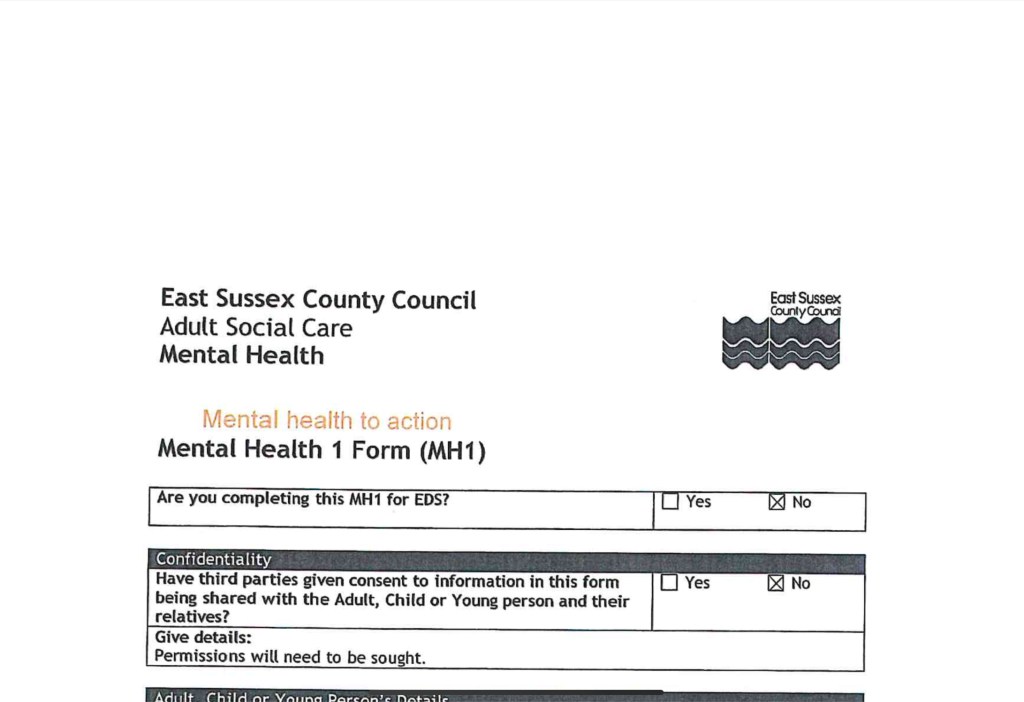
On 2 January 2024, between 05:40 and 10:00 AM, Adult Social Care in East Sussex produced an MH1 Mental Health Form about me. They drafted it while I was detained in police custody, sedated, disoriented, without legal representation, and unable to give consent. The form states this openly: “Consent to share information: NO.”
The problem is not only how it was created, but what it contains. The MH1 claims I have a “long-standing history of ketamine addiction.” This is entirely false. I have never used ketamine in the UK, and toxicology later showed zero drugs in my system. Yet this invented addiction was placed in an official record and then reproduced in the CPS’s original indictment, shaping the early narrative of the case.
The same document also includes my HIV status and past Hepatitis C treatment—information irrelevant to that day’s events. It was extracted from my confidential medical records and inserted into a police-linked form, next to invented addiction and sexualised language. That is not medicine; it is institutional stigma.
Months later, a new allegation appeared: a hospital guard “remembered”—over a year after the event—that I had tried to bite him. He couldn’t recall where. He couldn’t recall how. But the idea surfaced. Once you read the MH1, you understand how institutional contamination works: once a false version of you circulates internally, other people’s memories begin to populate with events that never happened.
This episode is not only about my story. It is about how institutions fabricate narratives, how those narratives become “truth,” and how quickly a human being can be reduced to a case file. It is also about resistance: documenting everything, confronting fiction with evidence, and refusing to become the character someone else invented.
The premiere is today at 9PM UK time / 6PM Argentina on my YouTube channel @caneteuk.
If you want to go deeper into visual analysis, visual culture, and art history, you can become a paid member of my channel. The new courses now available are El Greco and The Landscape Painting Tradition
“El documento que inventó quién era yo” (Estreno hoy a las 9PM UK / 6PM Argentina en mi canal de YouTube @caneteuk)
Hoy publico uno de los episodios más importantes que hice hasta ahora. Esta vez no analizo una obra de arte ni una teoría: analizo un documento. Un formulario institucional que intentó reescribir mi identidad mientras yo estaba inconsciente.
El 2 de enero de 2024, entre las 05:40 y las 10:00 de la mañana, Adult Social Care de East Sussex redactó un formulario MH1 Mental Health sobre mí. Lo hicieron mientras yo estaba detenido en custodia policial, sedado, desorientado, sin abogado y sin poder dar consentimiento. El propio formulario lo reconoce: “Consent to share information: NO”.
Lo grave no es sólo cómo se produjo, sino lo que escribieron. El MH1 afirma que tengo una “larga historia de adicción a la ketamina”, algo completamente falso. Nunca consumí ketamina en el Reino Unido y la toxicología mostró cero drogas en mi organismo. Aun así, esa adicción inventada terminó en un documento oficial y luego apareció reproducida en el indictment original de la fiscalía, moldeando la narrativa desde el inicio.
El mismo documento también incluye mi estado serológico (HIV positivo) y mi antecedente de Hepatitis C, algo clínicamente irrelevante para ese día. Esa información fue extraída de mis registros médicos confidenciales e insertada en un documento vinculado a la policía, junto a una adicción inventada y lenguaje sexualizante. Eso no es medicina: es estigma institucionalizado.
Meses más tarde surgió una nueva acusación: un guardia del hospital “recordó”, más de un año después, que yo había intentado morderlo. No recordaba dónde. No recordaba cómo. Pero la idea apareció. Cuando uno ve el MH1, entiende cómo se forma la contaminación institucional: una vez que una institución inventa una versión de vos, la memoria ajena empieza a llenarse de cosas que nunca ocurrieron.
Este episodio no es sólo sobre mi historia. Es sobre cómo las instituciones fabrican relatos y cómo esos relatos se vuelven “verdad”. También es sobre cómo resistir: documentar todo, confrontar ficción con evidencia y negarse a convertirse en el personaje que inventaron.
La premiere es hoy a las 9PM (hora UK) y 6PM (hora Argentina) en mi canal de YouTube @caneteuk.
Quienes quieran profundizar en análisis visual, cultura visual e historia del arte pueden hacerse miembros pagos de mi canal. Los cursos nuevos son: El Greco y La Pintura de Paisaje.
 Loveartnotpeople.blog
Deja una respuesta