Scroll Down for the English Version
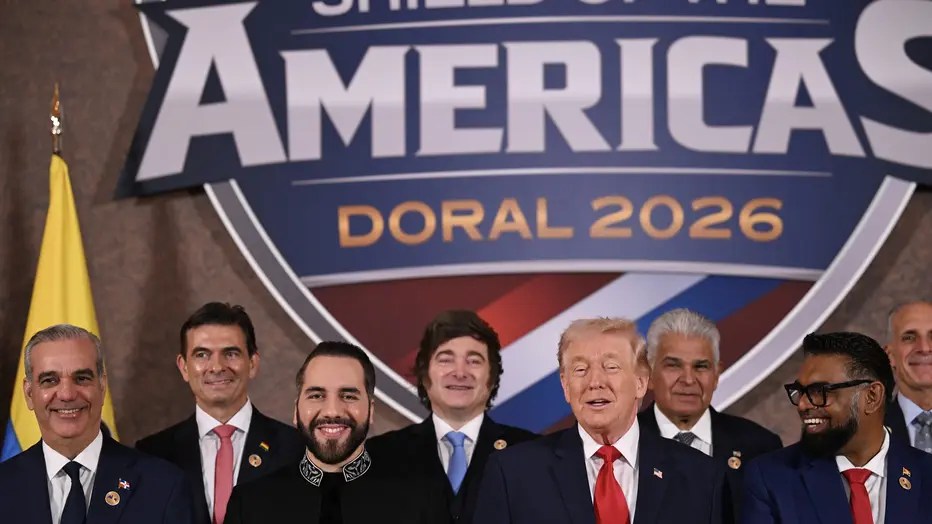
Doral fue un insulto en la cara del continente: Trump no convocó a América Latina a una cumbre, la hizo desfilar por su resort, dijo que no va a aprender su idioma y lanzó su versión personal de la Doctrina Monroe. Milei, mientras tanto, posa de virrey feliz.
Tweet
Mientras los trolls libertarios celebran en X que el presidente argentino finalmente “llegó al centro del poder mundial”, la escena que realmente ocurre en Florida tiene un aire mucho más antiguo. En Doral, el resort privado de Donald Trump, el anfitrión convoca a líderes latinoamericanos a una reunión llamada “Shields of America” que se parece menos a una cumbre hemisférica que a una audiencia en el club del dueño. Desde Buenos Aires se presenta como una victoria histórica del “fenómeno barrial” que ahora supuestamente influye en la política global. Desde Doral se parece bastante más a una escena clásica de la política hemisférica: el centro habla, la periferia escucha y algunos invitados celebran la oportunidad de estar cerca del micrófono.
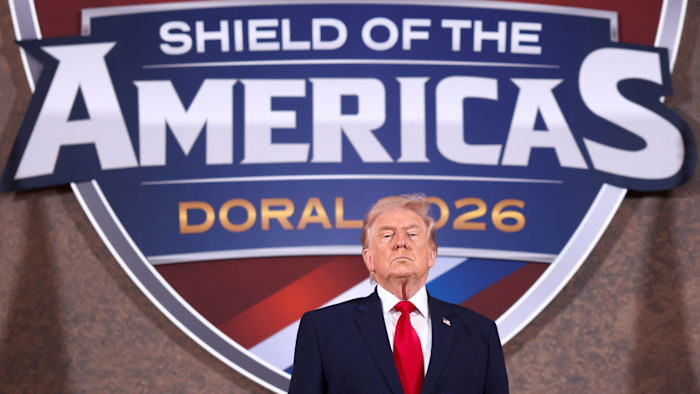
El escenario no es una institución del Estado estadounidense sino la propiedad personal del anfitrión, lo cual ya da una pista sobre la estructura simbólica del encuentro. Trump narra su poder militar con el tono de quien explica un truco particularmente impresionante a una audiencia cautiva. En un momento describe la capacidad de los misiles estadounidenses para entrar “right into the living room” (“directo en el living”), acompañando la descripción con gestos y sonidos que convierten la escena en una pequeña pieza de teatro bélico. La política exterior aparece así como espectáculo: el poder militar se narra en voz alta y el hemisferio funciona como platea.
Insulto en la cara, no alianza entre iguales: Trump recibe a Latinoamérica en su resort privado, desprecia su idioma, promete “arreglar Cuba” y su jefe del Pentágono dice “I only speak American”. En X, los trolls libertarios venden humillación como geopolítica.
Tweet
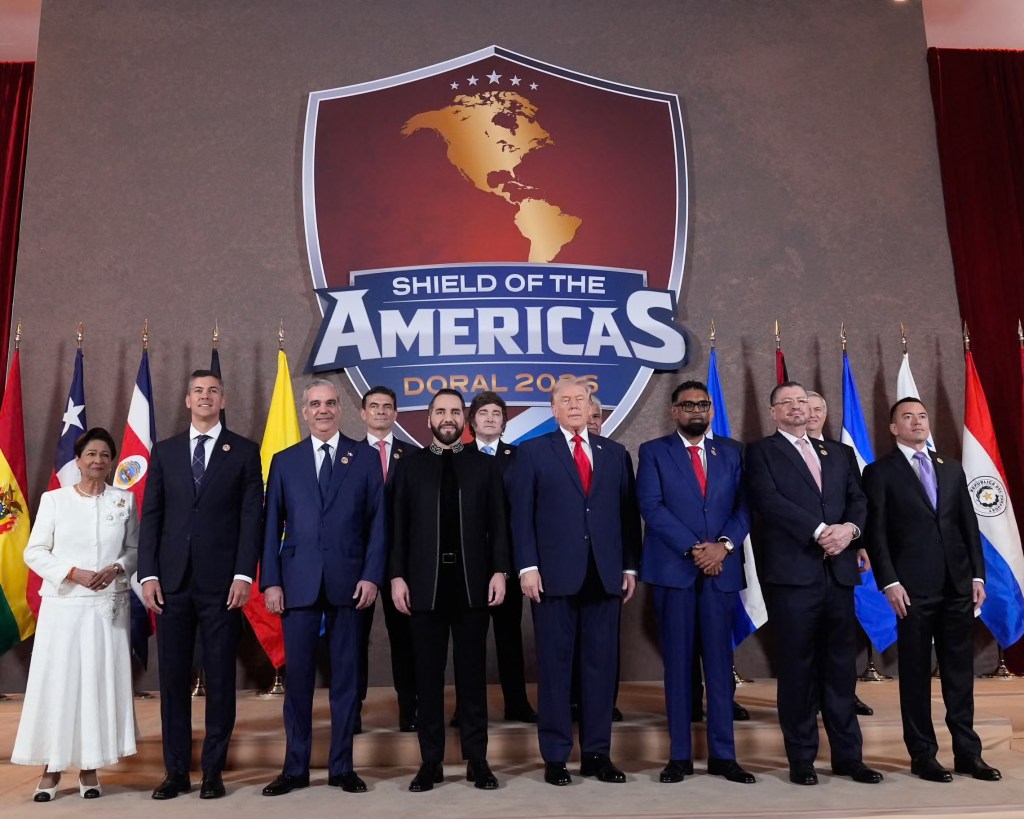
Lo de Doral no fue diplomacia: fue un insulto en la cara a América Latina. Trump habló de misiles entrando en livings, se burló del español frente a los presidentes invitados y anunció su Doctrina Monroe 2.0 mientras Milei aplaude como si fuera una medalla.
Tweet
El momento que realmente expone la jerarquía del encuentro, sin embargo, no es el de los misiles sino el del idioma. Trump comienza con una serie de comentarios condescendientes sobre cuánto le gustaría visitar “sus países”, y termina con una frase que condensa toda la escena: “And it’s so good that we got to know so many of you. I mean, we’re so many. And I’d love to get to your countries at some point. Marco loves going to your countries. He’s always at one of these countries. He likes your countries the best, okay? You know, where are you? I’m in Chile. Oh, good. How’s Chile doing? Good. He likes it. He feels like it. We all like him, right? It helps is that he’s got a language advantage over me. Because I’m not learning a damn language. I don’t have time. I am ok. Just give me a goddam interpreter. Interpreter, good. Language, no…” (“Y es tan bueno que hayamos llegado a conocer a tantos de ustedes. Quiero decir, somos tantos. Y me encantaría ir a sus países en algún momento. A Marco le encanta ir a sus países. Siempre está en uno de esos países. Esos países son los que más le gustan, ¿ok? A ver, ¿dónde estás? Estoy en Chile. Oh, bien. ¿Cómo anda Chile? Bien. A él le gusta. Lo siente así. Todos lo queremos, ¿no? Lo que ayuda es que él tiene una ventaja idiomática sobre mí. Porque yo no voy a aprender ni un maldito idioma. No tengo tiempo. Estoy bien así. Sólo consíganme un maldito intérprete. Intérprete, bien. Idioma, no…”).
La frase funciona casi como un pequeño tratado de política hemisférica. América Latina aparece reducida a una colección de “your countries” (“sus países”), destinos intercambiables del mapa regional, mientras el español queda degradado a un problema logístico que debe resolver un intérprete. En la diplomacia entre iguales se negocian lenguas y protocolos; en Doral la traducción aparece como servicio auxiliar del monólogo imperial.
Doral fue un insulto en la cara del continente: Trump no convocó a América Latina a una cumbre, la hizo desfilar por su resort, dijo que no va a aprender su idioma y lanzó su versión personal de la Doctrina Monroe. Milei, mientras tanto, posa de virrey feliz.
Tweet
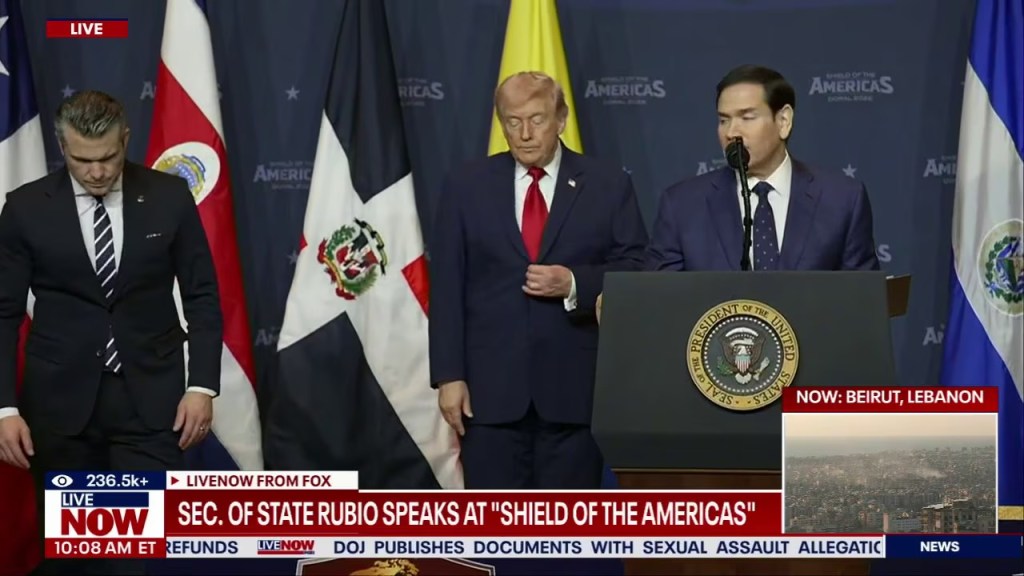
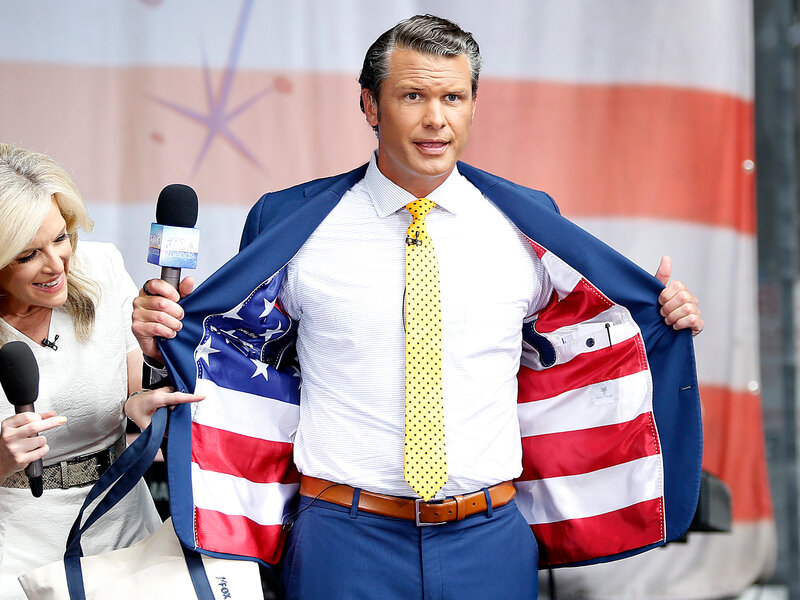
La escena se vuelve todavía más explícita cuando interviene Pete Hegseth, secretario de Defensa. Trump pregunta “Is he better in Spanish or in English? I think he’s better in Spanish, I think. It’s great. Pete, please.” (“¿Es mejor en español o en inglés? Creo que es mejor en español. Es genial. Pete, por favor.”) y Hegseth responde con una frase que parece escrita por un satirista pero que, en ese contexto, se pronuncia con absoluta naturalidad: “Mr. President, I only speak American.” (“Señor Presidente, yo sólo hablo americano.”). El chiste funciona porque revela la estructura mental que organiza el encuentro: el idioma del centro no es uno entre muchos, sino el idioma natural del mando.
Si la escena lingüística deja ver la jerarquía cultural del encuentro, la intervención posterior de Hegseth deja ver su arquitectura política. El secretario de Defensa explica la lógica del evento con una formulación sorprendentemente directa: “It’s an honor to be here and to establish in this hemisphere peace through strength. For far too long, our country’s gaze was only on borders in far-flung places, not our own border, not our own hemisphere, not the Western hemisphere. President Trump has established the Trump corollary of the Monroe Doctrine, the Donroe Doctrine, and the War Department is implementing it as fast as we can…” (“Es un honor estar aquí y establecer en este hemisferio la paz mediante la fuerza. Durante demasiado tiempo la mirada de nuestro país estuvo en fronteras lejanas, no en nuestra propia frontera, no en nuestro propio hemisferio, no en el hemisferio occidental. El presidente Trump ha establecido el corolario trumpista de la Doctrina Monroe, la Doctrina Donroe, y el Departamento de Guerra la está implementando tan rápido como podemos…”). Más allá del lapsus —“Donroe Doctrine”— el mensaje es claro: el hemisferio vuelve a ser presentado como espacio estratégico prioritario de Washington.
Trump completa la escena cuando habla de Cuba con la naturalidad de quien comenta una tarea pendiente en su agenda personal: “So for 50 years, I’ve been hearing as a little boy, I’ve been hearing about Cuba… Cuba is in its last moments of life the way it is… I would say, what will you do, take about two days off, Mark? No, well, maybe an hour. He’ll take one hour off and then he’ll finish up a deal on Cuba. That’ll be an easy one… Many of you have come today and they say, I hope you can take care of Cuba… could you do us a favor, take care of Cuba? I’ll take care of it, okay?” (“Durante 50 años vengo escuchando hablar de Cuba… Cuba está en sus últimos momentos de vida tal como está… ¿qué vas a hacer, tomarte dos días libres, Mark? No, quizá una hora. Se tomará una hora y cerrará un acuerdo sobre Cuba. Esa será fácil… Muchos de ustedes dicen que esperan que podamos ocuparnos de Cuba… ¿podrían hacernos el favor de encargarse de Cuba? Yo me ocuparé, ¿ok?”). Cuba aparece así no como un país soberano sino como una variable regional que puede resolverse entre una reunión y la siguiente.
En ese escenario aparece Javier Milei, celebrado en Argentina como si su presencia en el evento fuera una prueba de ascenso geopolítico. Lo que realmente se ve, sin embargo, es algo bastante más antiguo. Trump ocupa sin esfuerzo el lugar del centro que define la narrativa y anuncia su doctrina hemisférica. Milei aparece como el aliado que celebra la escena y la presenta como triunfo propio. En términos hegelianos, la relación se parece menos a una alianza entre iguales que a la vieja dialéctica entre amo y esclavo: el amo habla sin necesidad de aprender la lengua del otro; el esclavo se define por el reconocimiento que otorga al amo y por el esfuerzo constante de hablar como él.
El problema de esa mimesis es que la geopolítica no es teatro ideológico. Cuando Washington redefine su política hemisférica y habla de confrontación con Irán, los países que se alinean con entusiasmo no sólo obtienen visibilidad simbólica; también heredan riesgos. Argentina ya conoce ese escenario: durante el gobierno de Carlos Menem, en el momento de mayor alineamiento con Washington, el país sufrió los dos atentados más graves de su historia reciente, la Embajada de Israel en 1992 y la AMIA en 1994, ambos vinculados en distintas investigaciones a redes asociadas con Irán y Hezbollah.
Por eso la escena de Doral tiene algo de ironía histórica. Mientras en X se celebra que el “fenómeno barrial” ahora se mueve entre gigantes, lo que aparece en Florida es una escena mucho más conocida: el imperio habla, la doctrina se anuncia y el hemisferio escucha. Argentina no aparece allí como potencia emergente sino como el invitado más entusiasta del nuevo orden hemisférico. En otras palabras: no como estratega global, sino como patético virrey del insulto.
The “ Latinamerican Slaves” at the Failed Emperor’s Resort
While libertarian trolls on X celebrate that the Argentine president has finally “reached the center of world power,” the scene that actually unfolded in Florida looks far older and far more familiar. At Doral, Donald Trump’s private resort, the host gathered a group of Latin American leaders for an event called “Shields of America.” From Buenos Aires the moment is framed as a geopolitical breakthrough—the “neighborhood phenomenon” who emerged from television panels and livestream debates now supposedly shaping the global stage. From Doral, however, it looks much more like a classic scene in hemispheric politics: the imperial host speaks, the region listens, and a few guests celebrate the privilege of standing close to the microphone.
The setting itself already reveals the hierarchy. Doral is not the White House, not the State Department, not even a diplomatic venue that might sustain the fiction of a meeting among sovereign equals. It is a property owned by Trump, and the gathering—packaged with the grandiose branding of “Shields of America”—resembles less a hemispheric summit than an audience held in the owner’s private club. Within that setting Trump performs the style that defines him: power narrated theatrically, force described as spectacle. At one point he explains the precision of American missiles, describing how they can hit “right into the living room” (“directo en el living”) while mimicking the impact with sound effects, turning military destruction into a kind of stage performance designed to impress the regional audience.
Doral wasn’t diplomacy; it was an insult to Latin America to its face. Trump talked about missiles going “right into the living room,” mocked Spanish in front of the invited presidents, and announced his Monroe Doctrine 2.0 while Milei applauds as if it were a medal.
Tweet
The moment that most clearly exposes the structure of the encounter, however, is not the missile demonstration but the question of language. Trump begins with a series of patronizing remarks about how much he would like to visit “your countries,” and then delivers a line that functions almost as a miniature theory of imperial diplomacy: “And it’s so good that we got to know so many of you. I mean, we’re so many. And I’d love to get to your countries at some point. Marco loves going to your countries. He’s always at one of these countries. He likes your countries the best, okay? You know, where are you? I’m in Chile. Oh, good. How’s Chile doing? Good. He likes it. He feels like it. We all like him, right? It helps is that he’s got a language advantage over me. Because I’m not learning a damn language. I don’t have time. I am ok. Just give me a goddam interpreter. Interpreter, good. Language, no…” (“Y es tan bueno que hayamos llegado a conocer a tantos de ustedes… yo no voy a aprender ni un maldito idioma… sólo consíganme un maldito intérprete”). In a single paragraph Latin America is reduced to a collection of “your countries” (“sus países”), interchangeable destinations on the hemispheric map, while Spanish appears not as a language of diplomacy but as a logistical nuisance to be outsourced to an interpreter.
An insult to their faces, not an alliance among equals: Trump hosts Latin America at his private resort, despises its language, promises to “take care of Cuba,” and his Pentagon chief says, “I only speak American.” On X, libertarian trolls sell humiliation as geopolitics.
Tweet
The scene becomes even clearer when Pete Hegseth, the U.S. Secretary of Defense, joins the exchange. Trump asks, half-mockingly, “Is he better in Spanish or in English? I think he’s better in Spanish, I think. It’s great. Pete, please.” (“¿Es mejor en español o en inglés? Creo que es mejor en español… Pete, por favor.”) and Hegseth replies with a sentence that sounds almost satirical but was delivered with complete seriousness: “Mr. President, I only speak American.” (“Señor Presidente, yo sólo hablo americano.”). The line works precisely because it reveals the mental architecture behind the meeting: the language of the center is imagined not as one language among many but as the natural language of authority itself.
If that linguistic moment reveals the cultural hierarchy of the gathering, Hegseth’s subsequent remarks reveal its strategic architecture. The Pentagon chief outlined the logic of the event in unusually direct terms: “It’s an honor to be here and to establish in this hemisphere peace through strength. For far too long, our country’s gaze was only on borders in far-flung places, not our own border, not our own hemisphere, not the Western hemisphere. President Trump has established the Trump corollary of the Monroe Doctrine, the Donroe Doctrine, and the War Department is implementing it as fast as we can…” (“Es un honor estar aquí y establecer en este hemisferio la paz mediante la fuerza… el presidente Trump ha establecido el corolario trumpista de la Doctrina Monroe”). Beyond the comic slip—“Donroe Doctrine”—the meaning is unmistakable: Trump’s foreign policy is being framed as a revived, personalized version of the Monroe Doctrine, openly reasserting the Western Hemisphere as a strategic sphere of American priority.
Trump completes the picture when he turns to Cuba, discussing the island’s political future as if it were an item on his personal to-do list: “So for 50 years, I’ve been hearing as a little boy, I’ve been hearing about Cuba… Cuba is in its last moments of life the way it is… I would say, what will you do, take about two days off, Mark? No, well, maybe an hour. He’ll take one hour off and then he’ll finish up a deal on Cuba. That’ll be an easy one… Many of you have come today and they say, I hope you can take care of Cuba… could you do us a favor, take care of Cuba? I’ll take care of it, okay?” (“Durante 50 años vengo escuchando hablar de Cuba… está en sus últimos momentos… ¿tomarte dos días libres? No, una hora… cerrará un acuerdo sobre Cuba… yo me ocuparé”). Cuba appears not as a sovereign state but as a regional problem that the American president can “take care of” between other geopolitical matters.
Trump gathered Latin American leaders at his Doral resort to insult them to their faces: he said he won’t learn “a damn language,” asked for “a goddam interpreter,” and his Defense Secretary topped it off with “I only speak American.” In Argentina, it’s being celebrated as a victory.
Tweet
It is within this mixture of spectacle, doctrine and paternalism that Javier Milei’s position becomes intelligible. In Argentina, his proximity to Trump is celebrated online as if it marked the country’s arrival at the center of global power. What the Doral scene actually reveals is something much older. Trump occupies effortlessly the role of the imperial center that defines the narrative and announces the doctrine. Milei appears instead as the enthusiastic ally who applauds the scene and translates it into local triumph.
In Hegelian terms the relationship resembles less a partnership among equals than the classic dialectic of master and slave: the master does not need to learn the other’s language or justify his authority, while the slave defines himself through recognition of the master and the effort to speak in his voice. The danger of that mimicry is that geopolitics is not ideological theater. When Washington announces confrontation with Iran and reasserts hemispheric doctrine, the countries that align most visibly do not merely gain symbolic prestige; they also inherit strategic risk.
Argentina has seen this before. During the presidency of Carlos Menem, when Buenos Aires aligned itself fully with Washington, the country suffered the two deadliest terrorist attacks in its modern history: the bombing of the Israeli Embassy in 1992 and the AMIA Jewish community center in 1994, both linked in various investigations to networks associated with Iran and Hezbollah.
That is why the celebration surrounding Milei’s appearance in Doral carries a certain historical irony. While social media celebrates that the “neighborhood phenomenon” now moves among giants, the scene in Florida looks far more familiar. The empire speaks, the doctrine is announced, and the hemisphere listens. Argentina appears there not as an emerging power but as the most enthusiastic guest of the new hemispheric order—less a global strategist than a willing viceroy of the South.
Copyright — Rodrigo Cañete / Love Art Not People

 Loveartnotpeople.blog
Deja una respuesta