
‘The Return of Stupidity’
Yesterday I visited Typologien at the Fondazione—a show that proposes a radically different, not better or worse, approach to thinking art than what Pablo Rosales offers at Galería Aldo de Sousa, Buenos Aires. In an era where ironic detachment feels worn out, Rosales doubles down, staging a show anchored in simulacra and reference, with a telling title: ‘The Return of Stupidity’.

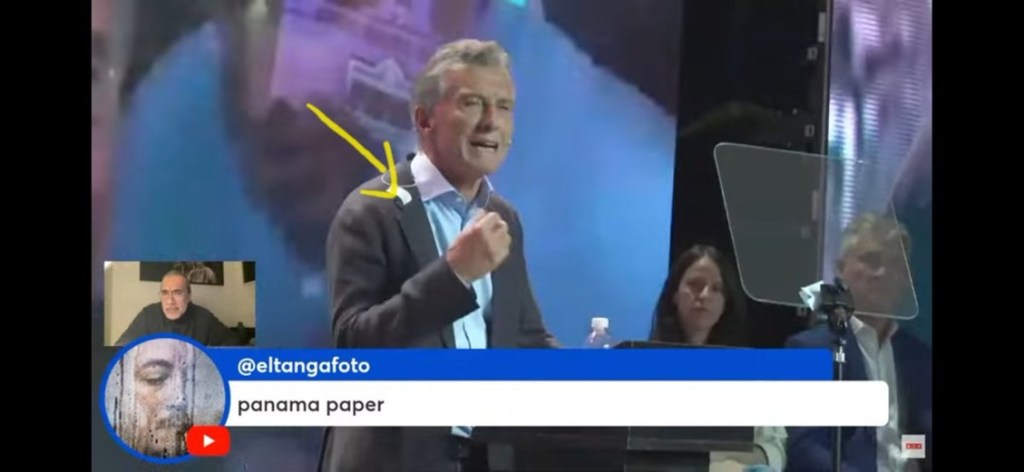
The first image circulating online is, as always, Federal Judge Gustavo Bruzzone (a local collector and art socialite) filming with his phone. That alone speaks volumes: a judge who became the living testimony and unofficial spokesperson of a segment of the Argentine art elite (the so-called counter-culture) that has long disguised continuity with violent institutional structures as rupture. His camera is a badge of belonging.
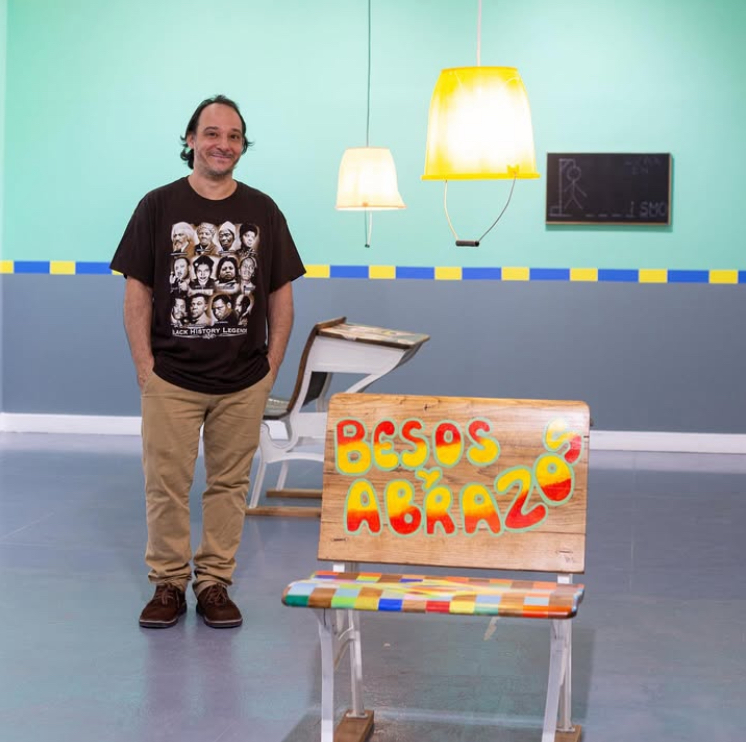
A pseudo-graffiti banner—really a removable wide piece of cloth—stretches across the entrance: “The ‘90s are not, the 2000s either.” Is it a lament, a declaration, or a preface for younger audiences? Bruzzone, who recently sold his collection at astronomical prices while still holding judicial office, instantly decodes it, comfortably situated among those who remember the references—not from books, but from insider proximity.
Rosalind Krauss’s Influence: Four Decades of Postmodernist Ironic Detachment in Argentine Art
Pablo Rosales parodies the art of the 1990s. These aren’t homages but hollowed-out simulations.
Tweet
Pablo Rosales’s works recycle 1990s visual cues—Gachi Hasper’s grids, Alberto Londaibere’s soda cans, school desks echoing the canonical Rojas’ Center artistic legacy—only to parody them. These aren’t homages but hollowed-out simulations. As Bruzzone claps, delighted to “get it,” Rosales drains these references of any remaining charge. His is an art of deactivated icons, in line with the postmodern logic Rosalind Krauss describes: ‘repetition without originality, irony without affect, history as décor.
The desk, the trash installation upstairs, the bucket-lights nodding to Schiliro: all function as part of this loop. The artist’s own collected garbage, paired with an ambient sound piece, suggests not critique but exhaustion. The work doesn’t push toward transformation—it mirrors our inability to imagine alternatives. What we get is ironic saturation: a world of references that collapse in on themselves.
Rosales’s text makes it explicit: he works 9 to 5, art is not his source of income. His tired body, mismatched clothes, and self-deprecating tone align him with a generation that was promised a future it never learned to demand. Post-Kirchnerism revealed the lie: that political art was often propaganda, and that the cultural field, whether financed by Techint or Papel Prensa, served state and market alike.
Slow Cancellation of the Future
The “absurd” here isn’t liberation—it’s the last refuge. Bruzzone praises the show: “two floors, well resolved.” What’s resolved, exactly? A formal problem? A tribute? Or the very failure of art to be anything but self-referential performance?
Rosales’s repetition of Gumier Maier’s imagery invites us back to Mark Fisher’s sense of hauntology—the “slow cancellation of the future.” His use of ‘90s references isn’t nostalgic; it’s melancholic. He’s not mourning a lost past, but a future that never arrived.
Pablo Rosales’s use of the artistic references to ‘90s isn’t nostalgic; it’s melancholic. He’s not mourning a lost past, but a future that never arrived.
Tweet
Upstairs, the combination of trash and ambient sound reinforces this cultural stagnation. There’s no critique, no rupture—just accumulation. The work becomes a monument to inertia, echoing the post-2001 survival economy: precarious, informal, depressive. This is not art about transformation—it’s art about the impossibility of it.
Rosales’s exhibition isn’t a tribute but an exorcism. He channels the ghost of the future—emptied of all power, just another object in the nostalgic recycling machine. What remains is a sense of cultural depression, and the lingering suspicion that this—exhaustion, irony, detachment—is all that’s left for art.
Pablo Rosales’ work crystallizes Fisher’s diagnosis: a culture unable to produce futures, only mimicries of past forms. And perhaps Rosales’s bleakest insight is the suggestion that even parody has lost its edge—it no longer bites, it just repeats. So what’s left? The judge, still filming. The artist, still hanging trash. The system, still self-regulating. And the future? As always, it wasn’t.
 Loveartnotpeople.blog
Deja una respuesta