The case of Eduardo Costantini starkly exposes—uncomfortably so—the entanglement of financial capital, contemporary art, and environmental dispossession in contemporary Argentina. Founder of MALBA and mastermind behind the mega real estate project Puertos, Costantini is not just an entrepreneur with aesthetic sensibility; he is the emblem of a new configuration of power: the philanthropist who legitimizes his extractive accumulation through discourses of modernity, culture, and sustainability.

Judge Gustavo Bruzzone joins the sociability that moves him so deeply at the opening of MALBA-Puertos—Costantini’s private collection turned spin-off flagship museum, the local PS1-MOMA variant. Puertos, as a property development, is advertised as a paradox, and for that it needs art and the ‘community spirit’ that—supposedly, and I emphasize supposedly—these types of agents embody. I say ‘paradox’ because it is promoted as a ‘model town,’ with artificial lagoons, eco-bike lanes, and Globla North-like schools for the aspirational affluent ‘locals’—yet it is built atop the wetlands of the banlieu area of Escobar, a key ecosystem for water regulation and climate balance in the Paraná Delta, nearby River Plate and not far from the City of Buenos Aires. In other words, what is presented as a harmonious intervention with the landscape is in fact a violent process of artificialization, ecological fragmentation, and gentrification of the territory. Geography becomes render, nature a backdrop tailored by star architects, and biodiversity a curated design experience.

As Maristella Svampa warns, what’s imposed here is a form of ‘exceptional urbanism,’ where environmental regulations are suspended, land is privatized, and exclusionary territorial occupations are celebrated under the guise of progress and harmony with nature. It is more than obvioius that real-estate developments like Puertos not only destroy ecosystems but manufacture a fiction: the fantasy of ecological life for elites, while those who have inhabited these territories for generations are displaced and pushed into precarity.
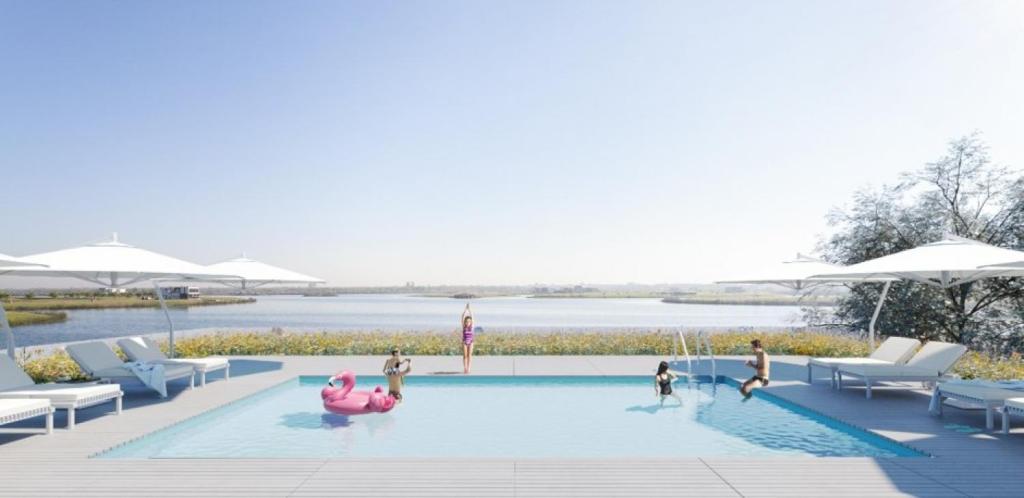
Let’s be more specific. This project has had severe environmental and social consequences in Escobar and the Paraná Delta region. Construction on wetlands has involved the filling of floodplains, artificial land elevation, and the creation of private lagoons, which have drastically altered the region’s hydrological balance. These interventions undermine the wetlands’ natural water absorption capacity and increase flood risks in surrounding areas, especially affecting rural communities and low-income neighborhoods without proper infrastructure. Far from being sustainable, these developments turn living ecosystems into controlled landscapes—tailored to design, subservient to the market.
Simultaneously, the ecological gentrification these ventures bring exerts constant pressure on local populations. Environmental groups and organized neighbors have denounced the illegality of many of these projects, as well as the absence of public consultation and rigorous environmental impact assessments. The result is a form of exclusion disguised as green innovation: a ‘sustainable city’ for the few, built on the silent dispossession of the many. How were these permits granted? I’ll leave that to your imagination, of course.
Art as Ethical Alibi: Institutionalized (and Legitimizing) Greenwashing
This type of urbanism doesn’t survive on economic and political backing alone: it requires symbolic legitimization, an ethical alibi. That’s where MALBA comes in—not just a museum, but a narrative machine that produces sensibility, cosmopolitanism, and performative commitment. It exhibits masterpieces of Latin American modernism, celebrates supposedly engaged artists, promotes inclusive discourses (in one render, you can even spot Diver by Hernán Marina—likely, as with my own copy above my bed, he didn’t know what to do with it either, so he placed it beside the pool). Even supposedly environmentalist artists make their appearance. The contradiction isn’t accidental—it’s operational. As ecosystems are destroyed in the name of progress, curatorial programs about the climate crisis and inclusive discourse are being funded. Let’s recall that figures linked to MALBA include Andrea Giunta (who had nothing to say about the objectifying marriage of the collection’s owner) and Bruzzone’s shrill little screams can still be heard from here at Daniel Leber’s opening (no less paired with Xul Solar, whom I’ll get to shortly).
To me, Judge Bruzzone is a key figure because of his voice—somewhat effeminate; but as a strategic negotiation of the phallogocentrism that characterises the judiciary system and his acknowledged and somehow, unfounded authority in the vernacular art world. His videos guarantee immediate legitimacy and visibility; also other kinds of surveillance. Bruzzone is the perfect guest because he stands at the threshold of the acceptable and the unacceptable, creating an oblique efficacy tied to his discretionary use of his power when it involves his ‘counter-cultural’ friends—especially those linked to the 1990s scene and to a discourse where the word ‘love’ is pronounced like an empty mantra.
This phenomenon doesn’t happen in isolation. A large portion of the local art scene—even those who claim to be critical or dissident—have functioned as cogs in this same machine. Bruzzone’s case, a criminal judge turned outsider collector and later mastermind of Ramona magazine, is poignant. A key figure in the legitimation of “marginal” art and self-professed aesthete of (canonic) deviation turned into architect of that same canon. An aesthetized marginality, turned into curatorship and institutionalized.
Ramona, which styled itself as a critical hub, was later unmasked by loveartnotpeople as what it truly was: a platform for symbolic legitimization—of the very system it claimed to interrogate. In this sense, what Rosalind Krauss called ‘the logic of the expanded field’ seems to have reached a breaking point: there is no longer an outside, because even critique has been absorbed by the institutional apparatus. Rather than disputing territory—as the avant-gardes once did, according to Pierre Bourdieu—many artists now simply inhabit it through irony, commentary, or performative dissent.
Alec Oxenford and Extractive Soft Power
At the same time, figures like Alec Oxenford—tech entrepreneur, collector, and former (flawed) President of the ArteBA Foundation—have consolidated a model of cultural philanthropy that fuses cosmopolitanism, performative ‘efficiency’ and greenwashing. Oxenford, now appointed Argentine ambassador to the U.S. by Javier Milei, embodies the discourse of ‘innovation’ as a substitute for politics (the same discourse once performed, unsuccessfully, by Santi Siri—who now cozies up to Kicillof-style progressivism, proving they’re all the same). The result of the Oxenford–Bruzzone–Costantini triangle is a cultural scene transformed into extractive soft power.
What’s striking is that even many artists who call themselves “ecological” or “environmentalist” have actively participated in this fabrication. Artworks about the climate crisis exhibited in museums financed by real estate developers; performances about water rights sponsored by corporate foundations; installations in sculpture parks inside gated communities built over wetlands. Ecological art, in this framework, is not a practice of resistance but an aesthetic of the symptom: it turns catastrophe into aesthetic opportunity, emergency into portfolio. As Mark Fisher warned, “it is easier to imagine the end of the world than the end of capitalism.” In the Argentine art world, we might say it’s easier to imagine an eco-garden inside a country club than a cultural scene capable of interrupting the logic that produces it. Critique becomes style, sensibility turns into surplus value, and sustainability becomes just another design in the catalog of collapse.
Just as artwashing polished the face of real estate in the 21st century, cultural greenwashing now sanitizes a deeply violent mode of accumulation. Puertos is not an anomaly. It’s a manifesto. A fictitious city built on dead water. A perfect allegory of the Argentine art scene, at a time when art can no longer say “no.”

 Loveartnotpeople.blog
Deja una respuesta