When everything is affection, what remains of conflict?

‘I Want a Project that Includes All My Friends’
In April 2025, Kekena Corvalán launches a new “non-call” for Campamento IX: Fantasía y organización, to be held in Barcelona. Under the motto of an affective curatorship without quotas, without quality, without categories or exclusions (well, it’s in Barcelona!)—“a call that includes all my friends” is the chosen formula—her proposal for an itinerant and horizontal artistic community is reactivated, in which affection replaces competition, and belonging becomes the criterion. This festive and certainly provocative gesture proposes to reinvent the art field from desire and care, beyond any critical institutionality. But what kind of power circulates in this affective community?
Feminist Curator Kekena Corvalán’s curatorial model as emotional governance aligns with “traumatology” and the “administration (through its aestheticization) of the wound.”
Tweet
This post proposes a critical reading of Kekena Corvalán’s curatorial model as a contemporary form of emotional governance, in line with the “traumatology” and the “administration (through its aestheticization) of the wound.” From there, I want to discuss how affectivity can function as a new grammar of exclusion, how desire becomes manageable symbolic capital, and how jouissance—in the Lacanian sense—is expelled from the community horizon, leaving us with a definition of desire that seems motivated by careerism and neoliberal values like ‘the curatorial project,’ etc.

Furthermore, I want to address her “camps” in the tradition or, rather, genealogy of the ‘organized witches’ traced by Silvia Federici in Caliban and the Witch. For Federici, witches were disobedient women who resisted the enclosure of the commons and the disciplining of the productive body at the dawn of capitalism. However, the ‘affective communities’ of Kekena Corvalán, while inspired by those forms of collective life, are no longer located on the margins (in the forest), but in the heart of the State cultural apparatus or bourgeois tourism (Barcelona!). From the stake to the subsidy, from the coven to the subsidized museum catalog or community holiday experience. It is the mutation embodied by Kekena that I am interested in deconstructing here with you.
Kekena’s ‘affective communities’ of collective life are no longer on the margins, but in the heart of the State cultural apparatus or bourgeois tourism
Tweet
Affective Communities
The “affective community,” as proposed by Kekena Corvalán, presents itself as an alternative to the hegemonic devices of contemporary art. It is a curatorial model that privileges listening, desire, horizontality, and collectivity over the canon, competition, or the authorship of the ‘Great Master’ creator. But under its apparent radicalism, what is configured is a form of soft governance, an administration of trauma that does not seek to disrupt the order, but to make its continuity more pleasant. The wound and trauma have long been more mainstream than merit or quality; however, there is a difference in that it is defined through affectivity as a political category in which discomfort is managed and the wound is aestheticized.
Corvalán proposes, in her own words, a ‘curatorship without a cap’: a de-hierarchized, ‘situated’ practice, in which she, as ‘chief curator,’ does not order but accompanies. Her affective community is supposed to be ‘a space of mutual care, where the personal is political and affection is the glue that binds.’ But that affection, far from being neutral, functions as a legitimizing device: it enables access, produces links, distributes visibility. And in that circulation, the material and symbolic limits of the proposal appear. Because to inhabit that community, one must speak its affective language, have the codes, manage the tone. Belonging is no longer played out in the curriculum, but in sensitivity. And like all sensitivity, it also has its regime and someone who controls the regime. Who dares to challenge the regime ‘of love and sensitivity’ without being demonized. I say this from experience. The reaction to that challenge to the traumatological and victimological order of Corvalán is violent. I also say this from experience.
Belonging is no longer played out in the curriculum, but in sensitivity. And like all sensitivity, it also has its regime and someone who controls the regime
Tweet
Curatorial Pastoralism
This is where the notion of pastoralism that Michel Foucault develops in his lectures on governmentality becomes useful. Unlike sovereign power, pastoral power is not exercised over a territory or a law, but over the soul. The pastor—an original figure of Christianity—guides, cares for, and watches over each individual, knows their thoughts, accompanies them, but also normalizes them. He does not impose, he persuades. He does not punish, he redeems. It is a power exercised as love, but functions as control. Isn’t that what we see in the affective deployment of contemporary curatorships? Isn’t the affective community an emotional flock that needs the constant care of someone who knows how to guide?
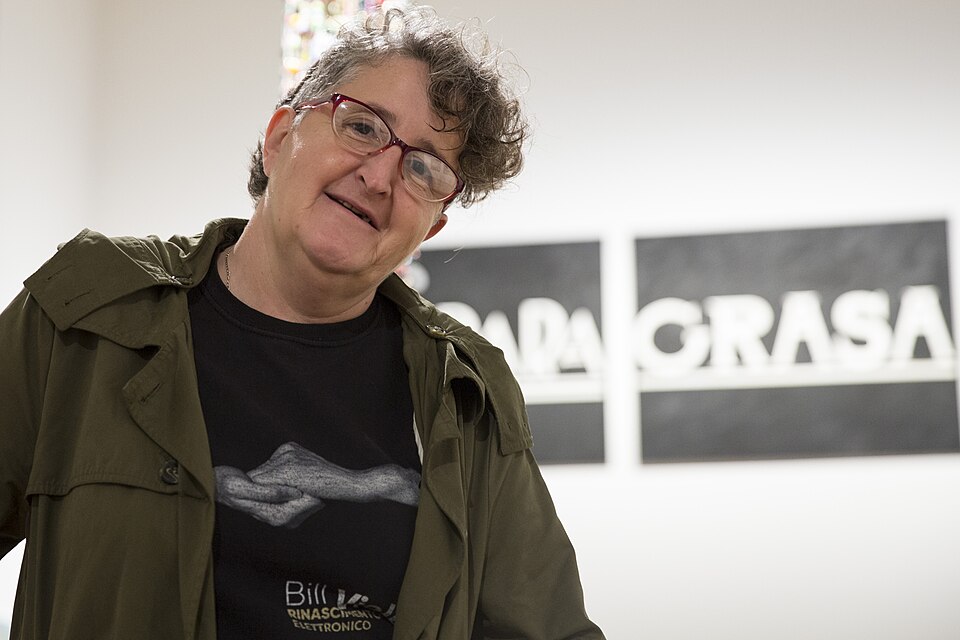
There is something pastoral in this logic: a guide who accompanies her community with tenderness, without a whip but with a horizon. Corvalán herself assumes it when she invokes love as a form of organization, listening as a form of production, and complicity as a curatorial criterion. The figure of the camp—recurrent in her projects—refers to an itinerant, supportive, self-sustaining community, with both mystical and militant resonances. It is not difficult to read there a shift from political discourse to an aesthetic of cult: a space of affective initiation, with its rites, its keywords, its chosen bodies. And in every cult, there are leaders. There must be. How far is this community from a form of faith?
Because there is in this model an absolute confidence in ethical transformation through art. Change, it is said, will come from listening, from friendship, from shared desire. But that change is rarely material. That is a declaration of desire that, in the meantime, is capitalized in a capitalist or statist manner and finds Kekena as a priestess. Does she distribute the profits within the group? It requires time, resources, mobility, emotional availability. Who can afford a trip to an artistic camp in another province or in Barcelona, as proposed in the latest call? Who can dedicate themselves to affectivity as a political praxis without having the minimum material requirements resolved? The affective community, in its practice, has social limits of class, time, emotional stability. And those limits are rarely stated. How does Kekena’s community function with those marginalized within the community, but I do not mean those who fit her definition of marginal, but, for example, those who do not agree with her feminism, do not have the resources, or simply do not recognize the authority of the Athenian ensemble of Amazons she seems to propose.
That is the paradox: a policy that claims to be horizontal but demands conditions that are not within everyone’s reach. An organization that claims to de-hierarchize but whose architecture revolves around a central, charismatic, organizing figure. A network that invokes total inclusion—“a call with all my friends”—but that enunciates inclusion from affection that, sooner or later, becomes institutionalized; not from real openness. And that at the same time actively links with the State—the CCK, provincial museums, public universities—as a platform for visibility and financing. This raises not problems but ethical dilemmas and moves the question of cult, faith, and militancy to the realm of morality. How is that supposed horizontal autonomy reconciled with a vertical state legitimization structure?


 Loveartnotpeople.blog
Deja una respuesta