
The University Under Siege from All Sides

In recent years, academic autonomy has been the target of a dual siege. On the one hand, right-wing governments — such as those of Donald Trump in the United States and Javier Milei in Argentina — have launched direct attacks on public universities: budget cuts, threats to federal funding, attempts to control curricula, and disciplinary actions against students and professors based on ideological grounds. On the other hand, from within the very institutions themselves, certain sectors of progressive academia have transformed the university into a partisan platform, undermining from within the very principles they claim to defend.

This situation cannot be addressed through automatic loyalties. Defending public universities does not mean parroting their slogans or idealizing their internal operations. The criticism of authoritarian attacks by current governments should not blind us to the dogmatic capture, self-indulgence, and elitism embedded within the academic sphere. Just as it is unacceptable for political power to dictate thought, it is equally troubling when those who present themselves as guardians of intellectual freedom speak from partisan ivory towers, more interested in declaring certainties than hosting debate.
The university must be neither a state propaganda machine nor a progressive corporate enclave. Autonomy is not a natural state; it is a struggle
Tweet
This post seeks to reflect on that paradox: how academic freedom, invoked by all sides, is threatened both by those who seek to control it and by those who, from within, reduce it to an ideological tool. The university must be neither a state propaganda machine nor a progressive corporate enclave. Autonomy is not a natural state; it is a struggle — and one that today demands that we rethink our own assumptions.
The United States: Trump, the Return of McCarthyism, and the Weaponization of Federal Funds

For decades, academic freedom in the United States was, as a recent New York Review of Books article wryly put it, “academic” — so widely accepted it hardly needed defending. Today, it finds itself at the center of ideological, legal, and financial conflict. Former President Trump and his allies have cast universities as cultural enemies: hotbeds of “wokeism,” havens for leftist indoctrination, and tolerant of anti-Semitism disguised as pro-Palestinian protest. In the name of neutrality, censorship is being imposed. In the name of legality, massive financial punishments are being deployed.
The case of Columbia University is emblematic. In March 2025, the Department of Education suspended $400 million in federal funds and demanded sweeping reforms: the dismantling of academic departments, the expulsion of students, the elimination of internal disciplinary review processes. Faced with the threat of losing not just those funds but an additional $5 billion, Columbia complied with most of the demands — a dangerous precedent. The university effectively agreed to condition its internal governance in exchange for money. What is eroded is not a policy decision, but the very idea of institutional autonomy.
More troubling still is that this strategy is being replicated. The University of Pennsylvania had $175 million in funding withheld for allowing a transgender woman to compete on the women’s swim team in 2022. There was no legal violation — only ideological punishment. The tool is money, the aim is symbolic discipline. What is being imposed is a canon: what may be taught, who may speak, which bodies are legitimate. Once again, we are witnessing a logic of orthodoxy masquerading as order.
Argentina: Milei, the UBA, and Austerity as Symbolic Discipline
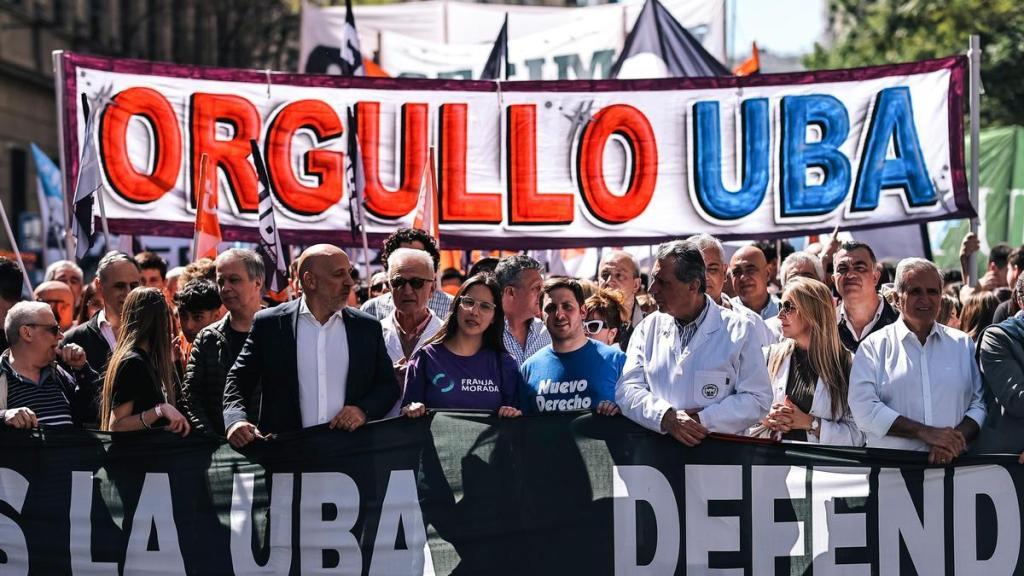
The Argentine case is different in form but similar in essence. While U.S. universities are pressured through ideological and financial blackmail, in Argentina, the government employs structural defunding as a weapon. Javier Milei’s administration has slashed university budgets by at least 30% in real terms, prompting the University of Buenos Aires (UBA) to declare a state of emergency. Construction projects have halted, outreach programs have been suspended, and major university hospitals like the Hospital de Clínicas have reached critical conditions.
While U.S. universities are pressured through ideological and financial blackmail, in Argentina, the government employs structural defunding as a weapon.
Tweet
But beyond the numbers, austerity operates as a message: the state’s withdrawal of support is meant as symbolic punishment. The goal is to impose a new common sense in which public universities are seen as wasteful, ideological, or parasitic. As in the U.S., the intention is normative — to redefine which forms of knowledge deserve funding, which ideologies may be institutionalized, and who gets to speak in the name of education.
The complexity in Argentina lies in the paradox of its public university system. On the one hand, it has historically enabled social mobility, granting access to education and knowledge to those otherwise excluded. On the other, it has become a self-reproducing elite, deeply rooted in Buenos Aires and its cultural codes. Free education, left unexamined, becomes a mechanism of self-perpetuation. The UBA, while it democratizes access, also reinforces a model that is often closed off to dissent, the provinces, the diaspora, and the non-aligned.
Judith Butler and the Ivory Tower: When University Defense Becomes Partisan
In 2022, Judith Butler published a strong statement condemning Trump’s attacks on higher education. It was a timely and necessary intervention — a defense of critical thought, academic freedom, and university diversity programs. Yet her position, like many others from progressive academic elites, was not without problems. While it rightly identified external threats, it entirely overlooked the internal capture of academic discourse by rigid ideological orthodoxies.
Judith Butler — like many figures of global academic prestige — speaks from a position of authority that often fails to recognize its own insulation.
Tweet
Butler — like many figures of global academic prestige — speaks from a position of authority that often fails to recognize its own insulation. From permanent positions, endowed chairs, global conferences, and selective publishing networks, these scholars conflate their worldview with that of the university itself. Defending their ideological stance is framed as defending higher education as such. This identification of self with institution is a major symptom of the current crisis.

This kind of intellectual entitlement — of which Butler is an emblem — often demands institutional protection without accounting for its own forms of exclusion, elitism, and doctrinal closure. It demands autonomy from the state while failing to acknowledge how that autonomy can become a shield for comfort and power. The disconnect between academic discourse and broader society is real, and it cannot be solved by more social justice rhetoric but by genuine practices of openness, listening, and self-critique.
Something similar happened — and very likely related to this — when, after suffering an attack in my home that led to a series of health and legal issues, I requested time to physically recover from the injuries and adjust my medication for PTSD. The International Federation of Theatre Research, where I was serving as a convenor, did not prioritize my request and instead took the opportunity to remove me from the Queer Committee. The justification? Alleged differences with two members of the Executive Committee who, the previous year, had advocated for the participation of a trans performer at the annual conference held in Ghana — just one week after the country’s Supreme Court criminalized homosexuality.
While Alison Campbell from the University of Melbourne and Tracy Davis from Northwestern were busy shielding themselves after a serious lapse in judgment — and retaliating for previous disagreements with me — I was undergoing necessary medical treatment. To this day, I was never given a formal explanation for my removal. That is not academic autonomy. That is McCarthyism. A form of McCarthyism not unlike the one President Trump is currently wielding against Columbia, Harvard, and — oh, surprise — Northwestern.
To this day, I was never given a formal explanation for my removal. That is not academic autonomy.
Tweet
What’s more, those who denounce censorship often fail to see how censorship functions within academia itself — through informal forms of cancellation, peer pressure, and silent exclusion. In the name of diversity, a new homogeneity is established. In the name of critical thought, internal dissent is discouraged. Autonomy is thus threatened not only by the state but also by the ideological weaponization of knowledge from within.
Autonomy Is Not Neutrality — It Is Conflict
For academic autonomy to mean anything today, it must be understood not as a guarantee but as an ongoing battle. The university cannot claim neutrality — neither in the face of political power nor structural inequality — but it must remain a space where pluralism, dissent, and contradiction are not only tolerated but encouraged. Autonomy is not indifference, nor is it hegemony: it is friction.

My own experience bears this out. After publishing a book with Penguin Random House and receiving the Peter Marzio Award in 2020 from the Museum of Fine Arts Houston, I became the target of a systematic campaign by certain feminist sectors linked to CONICET and the Faculty of Philosophy and Letters in Argentina. My satirical blog and independent critiques were used against me; my right to dissent was not defended by the university but rather ignored or punished. International institutions that once celebrated me turned away once my work ceased to serve their ideological alignment.
These cancellations are not anecdotal or personal — they are structural. They reveal how the university, in the name of inclusion, often replicates authoritarian mechanisms of silence and suppression. If criticism cannot be uncomfortable, then it is not criticism. The university must be disturbing to the state, to parties, to itself. Academic freedom cannot exist without risk. If that risk is eliminated — by salons of progressivism or polite liberal consensus — what is being defended is not the university, but its parody.
Conclusion: Defending Autonomy Without Owning It
Now more than ever, a lucid defense of university autonomy is needed. Not a reactionary defense, nor a corporate one, but a defense that is critical, nonpartisan, and transformative. Public universities remain one of the few spaces where societies can still think critically about themselves. But for this to remain true, they must break their pacts of comfort, their ideological reflexes, their inherited privileges.
Public universities remain one of the few spaces where societies can still think critically about themselves. But for this to remain true, they must break their pacts of comfort, their ideological reflexes, their inherited privileges.
Tweet
Autonomy cannot be invoked only to shield from external power while ignoring internal exclusions. Nor can it survive as a hostage of austerity and political exploitation. University autonomy demands institutional courage, epistemological pluralism, and a willingness to take risks. It is not the moral property of anyone — it must be the space where everything can be debated, even the university itself.
Academic freedom is not defended with slogans. It is defended with thought, with conflict, with responsibility. And that means being willing to be uncomfortable — even, and especially, with your own
Tweet
.




 Loveartnotpeople.blog
Deja una respuesta