
Scroll Down for the English Version
A pocas semanas del fallo definitivo de la Corte Suprema argentina sobre la causa Vialidad, Cristina Fernández de Kirchner se encuentra al borde de una condena que podría inhabilitarla y llevarla a prisión.
Tweet
A pocas semanas del fallo definitivo de la Corte Suprema argentina sobre la causa Vialidad, Cristina Fernández de Kirchner se encuentra al borde de una condena que podría inhabilitarla y llevarla a prisión. La decisión, esperada para el 20 de junio, no ocurre en un vacío jurídico sino en un clima político controlado por nuevas fuerzas. Ya no es Mauricio Macri el que administra la escena, sino Javier Milei, que sin embargo conserva a Cristina como un personaje útil: condenada, sí, pero funcional. Mientras tanto, al otro lado del continente, Donald Trump enfrenta acusaciones penales en múltiples jurisdicciones, mientras militariza Los Ángeles para reprimir protestas sociales.
Cristina is no longer the leader of a resistance, but the leftover of an exhausted cycle.
Tweet
Trump desafía abiertamente al sistema que lo juzga. En eso es más político que Cristina. Mientras Trump genera caos, Cristina apenas administra ruinas.
Tweet
El caso Vialidad lleva casi dos décadas de trámite. Cristina fue condenada en 2022 a seis años de prisión e inhabilitación perpetua por administración fraudulenta en perjuicio del Estado, tras haber favorecido de forma sistemática al empresario Lázaro Báez con contratos públicos viales. La Cámara de Casación confirmó la sentencia en 2024, dejando a la Corte Suprema la decisión final. El fallo puede inhabilitarla antes del cierre de listas, afectando directamente el mapa electoral del peronismo y abriendo el camino para la perpetuación relativa del Mileismo.
El fallo puede inhabilitarla antes del cierre de listas, afectando directamente el mapa electoral del peronismo y abriendo el camino para la perpetuación relativa del Mileismo.
Tweet
Los defensores de Cristina argumentan que hubo parcialidad de jueces, irregularidades procesales y vínculos espurios entre el Poder Judicial y el macrismo: cenas en Olivos, jueces jugando al fútbol con Macri, fiscales mediáticos. Pero esa crítica llega tarde. Cristina, en su momento, pudo haber desarmado esa maquinaria. Eligió no hacerlo. Pactó con Macri, demoró. Ahora, ese sistema la está usando como figura para cerrar un ciclo, no como castigo, sino como efecto.
El lawfare, concepto con el que se pretende leer este proceso, no puede ser entendido sin reconocer que en esta etapa no se busca anular a Cristina, sino conservarla. El mileismo la necesita como enemiga autorizada, como personaje digerido del pasado. Una Cristina condenada pero presente es más útil que una Cristina retirada: permite sostener la ficción de que el nuevo gobierno combate a “la casta”, sin tocar a los verdaderos dueños del poder.

La Corte, entonces, no sólo sentencia a una ex presidenta: administra un efecto. El fallo ya está mediáticamente legitimado. La sentencia es el cierre de una operación que se cocina desde hace años, con la pasividad –y a veces complicidad– de la propia Cristina con Macri, lo que ahora queda en evidencia. Y, sin embargo, su condena es también un espejo: no revela su culpa, sino la arquitectura de una justicia que escenifica, que reparte castigos como fichas simbólicas en un tablero invariable.
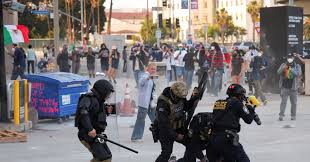
Mientras tanto, en Estados Unidos, Donald Trump enfrenta un escenario radicalmente diferente. Ha sido imputado por múltiples delitos: falsificación de documentos, obstrucción, conspiración electoral y manejo indebido de información clasificada. En paralelo, ordenó el envío de 4.000 soldados a Los Ángeles para reprimir protestas contra redadas migratorias, militarizando una ciudad santuario. El hecho generó una inmediata respuesta institucional.
El gobernador Gavin Newsom denunció la medida como ilegal e inconstitucional. Demandó al gobierno federal por invocar sin justificación la Ley de Insurrección. Mientras tanto, asesores de Trump amenazaron con arrestar a autoridades locales que se opusieran. A diferencia del caso argentino, la respuesta fue veloz y multilateral: demandas, pronunciamientos judiciales, alertas mediáticas. La justicia estadounidense no se acobarda ante el poder presidencial. A pesar de esto, Trump esta operando sobre los estudios de abogados.
La justicia estadounidense no se acobarda ante el poder presidencial. A pesar de esto, Trump opera sobre los estudios de abogados.
Tweet
Y sin embargo, Trump sigue en campaña. Las causas penales avanzan, pero no lo inhabilitan automáticamente. En Estados Unidos, el sistema permite que un ex presidente sea investigado y hasta condenado, sin que eso desactive su posibilidad de competir políticamente. El sistema judicial actúa con independencia, y la discusión sobre su legitimidad se produce en paralelo, no como freno. Aunque esto esta viendo sus limites.
En Argentina, en cambio, la condena de Cristina tiene una fuerza de clausura. No sólo en términos judiciales, sino simbólicos: ordena la escena política, redistribuye el mapa del peronismo, y legitima una nueva moralidad basada en la purga de una figura que ya no representa una amenaza real. Cristina no es la líder de una resistencia, sino el remanente de un ciclo agotado.
La diferencia no está sólo en los plazos ni en los delitos. Está en el modo en que la justicia se articula con el poder político. En EE.UU., la justicia actúa a pesar del poder. En Argentina, el poder usa la justicia para reescribir su relato. Trump desafía al sistema desde dentro. Cristina ya no puede: fue absorbida por la misma máquina que alguna vez controló.
En ambos países, los líderes alegan persecución política. Trump habla de “cacería de brujas”, Cristina de “lawfare”. Ambos explotan la narrativa del mártir, pero con efectos distintos. En EE.UU., la justicia responde con institucionalidad. En Argentina, con cálculo. La Corte Suprema no revisa pruebas ni reinterpreta hechos: sólo decide cuándo y cómo cerrar el ciclo.
La comparación entre ambos sistemas muestra diferencias fundamentales. En EE.UU., la justicia interviene en tiempo real y establece límites concretos. En Argentina, la justicia llega tarde, pero cuando lo hace, lo hace con intención escénica.
Tweet
La pregunta, entonces, no es si Cristina es culpable o no. Es por qué este fallo llega ahora. Y por qué, a diferencia de Trump, su condena tiene el efecto de una desaparición simbólica. El macrismo quiso encarcelarla, pero fue Milei quien entendió cómo usarla. No como enemiga, sino como fetiche. Una figura que ordena, no que desestabiliza.
La comparación entre ambos sistemas muestra diferencias fundamentales. En EE.UU., la justicia interviene en tiempo real y establece límites concretos. En Argentina, la justicia llega tarde, pero cuando lo hace, lo hace con intención escénica. No impone orden: produce narrativa. Cristina condenada es el símbolo perfecto de una democracia sin política.

Al final, la pregunta no es jurídica. Es política y cultural. ¿Cómo construimos justicia en un país donde los fallos llegan cuando ya no hay conflicto, y donde los enemigos se conservan para sostener ficciones? Cristina va a ser condenada, no porque haya pruebas irrefutables, sino porque su figura ya no amenaza a nadie. Su condena ordena el tablero, no la ley.
Mientras tanto, Trump desafía abiertamente al sistema que lo juzga. En eso, curiosamente, sigue siendo más político que Cristina. El poder argentino prefiere castigar que disputar. Y por eso, mientras Trump genera caos, Cristina apenas administra ruinas. La justicia, en ambos casos, revela no tanto la verdad de los hechos, sino la estructura emocional de cada democracia.
Scenic Violence, Fetishistic Lawfare
Just weeks before Argentina’s Supreme Court is set to issue a final ruling in the Vialidad case, Cristina Fernández de Kirchner stands on the brink of a conviction that could disqualify her from public office and—at least symbolically—send her to prison. The decision, expected on June 20th, doesn’t occur in a legal vacuum but within a political landscape controlled by new forces. Mauricio Macri no longer orchestrates the scene; it is now Javier Milei who governs. Yet he keeps Cristina as a useful character: condemned, yes—but functional. Meanwhile, across the continent, Donald Trump faces criminal indictments in multiple jurisdictions while militarizing Los Angeles to suppress social protests.
The Vialidad case has dragged on for nearly two decades. In 2022, Cristina was sentenced to six years in prison and a lifetime ban from holding public office for fraudulent administration to the detriment of the state, after systematically favoring businessman Lázaro Báez with road construction contracts. In 2024, the Court of Cassation upheld the sentence, leaving the Supreme Court with the final word. A ruling could disqualify her before the deadline for electoral lists, directly reshaping the Peronist political map and paving the way for Milei’s relative entrenchment.
Cristina’s defenders argue that the judiciary was biased, that procedural irregularities occurred, and that there were improper ties between the courts and the Macri administration—dinners at the presidential residence, judges playing football with Macri, prosecutors turned media personalities. But this critique comes too late. Cristina had the opportunity to dismantle this machinery. She chose not to. She made deals with Macri. She delayed. Now that very system is using her image to close a political cycle—not as punishment, but as effect.
Lawfare—the term most often invoked to describe this process—cannot be fully understood without recognizing that the aim is no longer to neutralize Cristina, but to preserve her. Milei’s government needs her as an authorized enemy, a digested figure of the past. A condemned yet present Cristina is more functional than a retired one: she helps maintain the fiction that the current government is battling “the caste,” without ever touching the true holders of power.

The Court, then, does not merely sentence a former president—it administers an effect. The verdict has already been legitimized in the media. The ruling simply seals an operation long in the making, made possible by Cristina’s own passivity—and at times, complicity—with Macri, now laid bare. And yet, her conviction is also a mirror: it does not expose her guilt, but the architecture of a judiciary that stages justice, handing out punishments like symbolic tokens on an unchanging board.
Cristina’s own complicity—with Macri, now laid bare. And yet, her conviction is also a mirror: the architecture of a judiciary that stages justice, handing out punishments like symbolic tokens on an unchanging board.
Tweet
Meanwhile, in the United States, Donald Trump faces a radically different scenario. He has been indicted on multiple charges: falsifying documents, obstruction, election conspiracy, and mishandling classified information. At the same time, he ordered 4,000 troops to Los Angeles to crack down on protests against immigration raids, effectively militarizing a sanctuary city. The response was swift and institutional.
Trump ordered 4,000 troops to Los Angeles to crack down on protests against immigration raids, effectively militarizing a sanctuary city. The response was swift and institutional.
Tweet
California Governor Gavin Newsom condemned the move as illegal and unconstitutional, suing the federal government for unjustified invocation of the Insurrection Act. Trump’s advisors, meanwhile, threatened to arrest local officials who resisted. Unlike in Argentina, the response was rapid and multilateral: lawsuits, judicial rulings, media alerts. The U.S. justice system does not flinch in the face of presidential power.
Trump threatened to arrest local officials who resisted him. Unlike in Argentina, the response was rapid and multilateral: lawsuits, judicial rulings, media alerts. The U.S. justice system does not flinch in the face of presidential power.
Tweet
And yet Trump remains on the campaign trail. Criminal proceedings move forward, but they do not automatically disqualify him. In the United States, the legal system allows a former president to be investigated and even convicted without blocking his path to political competition. The judiciary operates independently, and debates over its legitimacy occur in parallel—not as a mechanism of suppression.
In Argentina, by contrast, Cristina’s conviction carries a force of closure. Not only judicial, but symbolic: it resets the political stage, reshapes the Peronist map, and legitimizes a new moral economy based on the purge of a figure who no longer represents a real threat. Cristina is no longer the leader of a resistance, but the leftover of an exhausted cycle.
The difference lies not only in timing or charges, but in the way justice articulates with political power. In the U.S., the judiciary acts despite power. In Argentina, power uses the judiciary to rewrite its own narrative. Trump challenges the system from within. Cristina can no longer do so: she has been absorbed by the very machine she once controlled.
Trump challenges the system from within. Cristina can no longer do so: she has been absorbed by the very machine she once controlled.
Tweet
In both countries, leaders claim political persecution. Trump invokes a “witch hunt,” Cristina calls it “lawfare.” Both exploit the narrative of martyrdom, but with different effects. In the U.S., the justice system responds with institutional rigor. In Argentina, it responds with calculation. The Supreme Court does not review evidence or reinterpret facts: it simply decides when and how to bring the cycle to a close.
The question, then, is not whether Cristina is guilty or not. It’s why this ruling is happening now. And why, unlike Trump, her conviction results in symbolic disappearance. Macri wanted her jailed; Milei understood how to use her—not as an adversary, but as a fetish. A figure that brings order, not disruption.
The comparison between the two systems reveals fundamental differences. In the U.S., justice intervenes in real time and sets clear boundaries. In Argentina, justice arrives late, but when it does, it arrives with scenic intent. It does not impose order—it produces narrative. A convicted Cristina becomes the perfect symbol of a democracy without politics.
In the end, the question is not legal. It is political and cultural. How do we build justice in a country where rulings arrive when conflict has already faded, and where enemies are preserved to sustain collective fictions? Cristina will be convicted—not because of irrefutable evidence, but because her figure no longer threatens anyone. Her conviction resets the board, not the law.
Meanwhile, Trump openly defies the system that prosecutes him. In that, paradoxically, he remains more political than Cristina. Argentine power prefers punishment to contestation. That is why, while Trump generates chaos, Cristina merely manages ruins. In both cases, justice reveals not the truth of facts, but the emotional structure of each democracy.
going on en este momento. Sumate haciendote miembro pago de mi canal de youtube. cliqueá en la imágen

 Loveartnotpeople.blog
Deja una respuesta