
Scroll Down for the English Version
Lo que sucede hoy en Balemyna, Irlanda del Norte, amenaza con generalizarse al resto del Reino Unido. Una turba, incitada por redes sociales, medios de comunicación y un clima de linchamiento, acusa a dos jóvenes rumanos de un intento de secuestro que ellos niegan rotundamente. Poco importa. La maquinaria ya se activó. La verdad judicial no interesa. El espectáculo de la caza sí.
Se desplaza el debate sobre violencia doméstica —la forma más común y brutal de violencia sexual— hacia una fantasía racista de crimen importado. Se reedita el guion clásico: inmigrante igual criminal, extranjero igual amenaza
Tweet

Otra vez, el mismo desvío: se desplaza el debate sobre violencia doméstica —la forma más común y brutal de violencia sexual— hacia una fantasía racista de crimen importado. Se reedita el guion clásico: inmigrante igual criminal, extranjero igual amenaza. Exactamente lo que Milei hizo en el World Economic Forum cuando vinculó homosexualidad con pedofilia. El objetivo es el mismo: desviar el odio, proyectarlo, excitarlo. Y gobernar con él.
En Estados Unidos, mientras tanto, la democracia ha mutado en una dictadura militar sostenida en la retaguardia simbólica de los Marines. Trump no gobierna: modera, como un emperador romano que depende del humor de sus generales. Su cumpleaños fue el escenario de un desfile militar fallido al estilo Putin, una copia grotesca de las fantasías de poder que Milei ya había ensayado en Argentina. Lo inquietante no es el acto, sino la lógica: mostrar fuerza cuando ya no se tiene legitimidad. Disfrazar la descomposición como omnipotencia.

En paralelo, el país arde. Los detenidos en Los Ángeles por razones fisonómicas, raciales, estéticas —más que jurídicas— muestran que el poder de Trump ya no responde a la ley, sino a la óptica. La política se convierte en casting. Y la justicia, en guion. Los medios trumpistas aseguran que el desfile fue un éxito y la oposición, un fracaso, mientras las encuestas marcan un 60% de desaprobación. Récord histórico, tan temprano en una presidencia. La brecha no es sólo ideológica, es ontológica: ya no discutimos ideas, discutimos realidades paralelas.
Tweet
Esta inversión entre ficción y realidad no es una patología. Es una estrategia. Lo que antes se consideraba esquizofrenia —escuchar voces, no distinguir entre lo real y lo proyectado— es hoy forma de gobierno.
Esta inversión entre ficción y realidad no es una patología. Es una estrategia. Lo que antes se consideraba esquizofrenia —escuchar voces, no distinguir entre lo real y lo proyectado— es hoy forma de gobierno. Los algoritmos no necesitan que creas, necesitan que participes. Que compartas. Que odies. Y que no sepas, finalmente, si estás frente a una pantalla o en una trinchera.

Y en este delirio aparece Milei. En visita oficial a Israel, una semana después de que Trump puenteó a Netanyahu para cerrar un acuerdo con Irán. El ataque israelí es una doble respuesta: a Irán y a EE.UU. Pero las redes, los medios, vuelven a elegir el objeto más previsible: demonizar a Irán por atacar civiles mientras el genocidio en Gaza ya dejó de conmover. ¿Qué hacer con la moral cuando todo es performático? ¿Quién empatiza con Israel cuando apoya el exterminio?
Las redes demonizan a Irán por atacar civiles mientras el genocidio en Gaza ya dejó de conmover. ¿Qué hacer con la moral cuando todo es performático? ¿Quién empatiza con Israel cuando apoya el exterminio?
Tweet
Y entonces llega la pregunta final: ¿y si Irán responde con una bomba nuclear? ¿Y si el descabezamiento de su dirigencia, ejecutado por el Mossad con el aval implícito de Patricia Bullrich y Alberto Föhrig, los empuja al abismo? ¿Qué pasa con la radioactividad que Israel ya desató con sus recientes ataques y que podría contaminar todo el Golfo? ¿Y si Trump debe decidir una contraofensiva? ¿Qué queda del mundo si lo decide mal?
¿y si Irán responde con una bomba nuclear? ¿Y si el descabezamiento de su dirigencia, ejecutado por el Mossad los empuja al abismo? ¿Qué pasa con la radioactividad que Israel ya desató?
Tweet
La Pax Americana se desintegra. El orden internacional, si alguna vez existió, ya no tiene centro. China y Putin se alinean con Irán. Los países no alineados —si queda alguno— harán lo mismo. La tercera guerra mundial no será larga. Bastará una detonación para que la radiación nos alcance a todos.

Pero lo verdaderamente perturbador es que ya no sabemos si esto es una advertencia o una serie de Netflix. La esquizofrenización de la política consiste, precisamente, en eso: en no poder distinguir entre la distopía y el boletín de noticias. En vivir en un simulacro, donde las bombas explotan en Gaza pero los trending topics dicen otra cosa.
La esquizofrenización de la política consiste, precisamente, en eso: en no poder distinguir entre la distopía y el boletín de noticias.
Tweet
Lo único real es la transferencia de recursos: de pobres a ricos, de cuerpos racializados a mercados armamentistas, de verdad a algoritmo. Todo lo demás, como el cuero en el baño de Josh, es mensaje. Y sí: quizás también trampa.
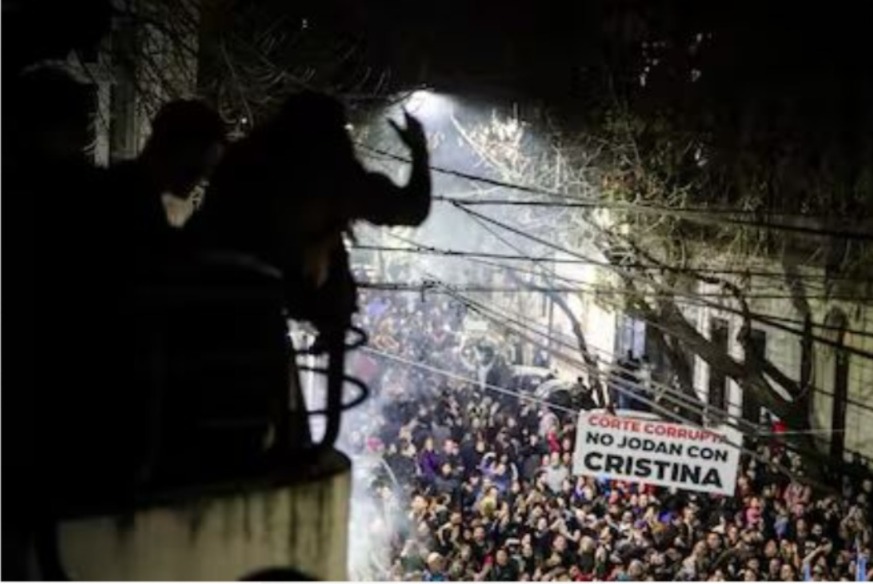
Y mientras todo esto sucede, en Argentina, Cristina Fernández de Kirchner baila en un balcón como una vieja gagá, desfasada no sólo de la música, sino del mundo. En un gesto grotesco que parece sacado de una parodia tardía de sí misma, intenta instalar una épica liviana, como si la historia no hubiera cambiado de canal. Hay algo desesperante en esa escena: la coreografía de una reina sin reino, que se obstina en negar que ya no hay tablero donde mover sus fichas. Su gesto no es sólo narcisismo; es ceguera. Ceguera ante el giro global, ante la radicalización de las derechas, ante la ausencia total de una alternativa política creíble.
Y mientras todo esto sucede, en Argentina, Cristina Fernández de Kirchner baila en un balcón como una vieja gagá, desfasada no sólo de la música, sino del mundo. En un gesto grotesco que parece sacado de una parodia tardía de sí misma
Tweet

La tragedia no es que Cristina esté vieja —eso sería lo de menos—, sino que se haya vuelto funcional a un relato de disolución. Mientras Milei profundiza el vaciamiento institucional y consolida una alianza con lo más oscuro del tablero internacional, ella baila. No interpreta. No interrumpe. No lee. Cree que aún puede jugar, sin advertir que la partida ya no tiene reglas, y que su nombre —en este escenario— no pesa, no molesta, no interesa. Su figura, otrora símbolo de resistencia, hoy opera como distracción: una tía extravagante en una fiesta que ya no la reconoce como anfitriona, sino como chiste.
Milei no es el origen del caos, es su heredero. El producto perfecto de una Argentina que nunca quiso mirar de frente sus fracturas, y que ahora celebra su propia destrucción como si fuera vanguardia. Es en momentos como este cuando el viejo mito del excepcionalismo argentino reaparece, como si el país pudiera mantenerse al margen de la ola fascista global. Pero la historia desmiente esa fantasía: dos instituciones judías fueron voladas durante el menemismo, y cientos de cuerpos quedaron esparcidos en el centro de Buenos Aires. La capital argentina ya fue campo de batalla. Ya supimos lo que era tener terroristas en el poder, ya conocimos la impunidad en tiempo real. Y, sin embargo, aquí estamos otra vez: con una bomba geopolítica a punto de detonar en Medio Oriente, un país paralizado, y la loca —literalmente— bailando.
Y si escribo esto no es sólo por lucidez política, sino porque lo viví en carne propia. Tras el ataque que sufrí en mi propia casa —y del que conservo las cartas, los informes, las pruebas, los efectos físicos, psicológicos y legales— descubrí lo que ya intuía: que la solidaridad en la Argentina no es un derecho, es un privilegio reservado a los que encajan. Nadie —ni el Estado, ni mis colegas, ni mis supuestos compatriotas— se detuvo a preguntar qué había pasado. Lo que hubo fue silencio, prejuicio pastoralista, y un goce sádico: el placer de ver al otro caer, sobre todo si ese otro se atrevió a brillar o a irse. La intervención de las instituciones no trajo reparación, sino más daño: lo que comenzó como un crimen de odio terminó con una acusación infame para taparlo. El extranjero, como siempre, es doblemente culpable: por existir, y por no morir a tiempo. Que yo aún esté lidiando con las consecuencias legales de haber sido agredido en mi hogar, de haber pedido ayuda, de haber dicho la verdad, es apenas una prueba más de que la ficción del Estado de Derecho no resiste ni una gota de diferencia cuando el que denuncia no es legible, domesticado o útil.
Y mientras todo arde, la ruina loca presa baila. Hemos perdido la compustura al mas alto nivel.
Chaos, schizoid politics and the progressive buffoonish argentine former president dances in the balconee of her jail cell
What’s happening today in Balemyna, Northern Ireland, threatens to spread across the UK. A mob, incited by social media, mainstream outlets, and a lynch-mob atmosphere, is accusing two young Romanian men of attempted kidnapping—a charge they deny. But that hardly matters. The machinery is already in motion. Judicial truth is irrelevant. What matters is the spectacle of the hunt.
What’s happening today in Balemyna, Northern Ireland, threatens to spread across the UK. The machinery is already in motion. Judicial truth is irrelevant. What matters is the spectacle of the hunt.
Tweet

Once again, the same deflection: the discussion around domestic violence—the most widespread and brutal form of sexual violence—is replaced by a racist fantasy of imported crime. The old script is reactivated: immigrant equals criminal, foreigner equals threat. Precisely the maneuver Milei deployed at the World Economic Forum when he linked homosexuality to pedophilia. The aim is the same: to redirect hatred, to project it outward, to inflame it. And then to govern through it.
The discussion around domestic violence—the most widespread and brutal form of sexual violence—is replaced by a racist fantasy of imported crime. The old script is reactivated: immigrant equals criminal, foreigner equals threat.
Tweet
Meanwhile, in the United States, democracy has morphed into a military dictatorship propped up by the symbolic rearguard of the Marines. Trump does not govern; he moderates—like a Roman emperor whose power depends on the mood of his generals. His birthday became the stage for a failed military parade à la Putin, a grotesque copy of the power-fantasies Milei had already rehearsed in Argentina. The disturbing part isn’t the act itself, but its logic: perform strength when legitimacy is gone. Dress up decomposition as omnipotence.
At the same time, the country is burning. In Los Angeles, people are being arrested for their physical appearance, their race, their aesthetic—not for anything legal. Trump’s power no longer answers to the law, but to the optics. Politics has become casting; justice, a script. Trumpist media outlets claim the parade was a triumph and the opposition a failure, while polls show a record-high 60% disapproval rating. The breach isn’t ideological—it’s ontological: we’re no longer debating ideas; we’re debating realities.
Trump’s power no longer answers to the law, but to the optics. Politics has become casting; justice, a script. The breach isn’t ideological—it’s ontological: we’re no longer debating ideas; we’re debating realities
Tweet

This inversion between fiction and reality is not a pathology. It’s a strategy. What was once called schizophrenia—hearing voices, blurring the real with the projected—is now a mode of governance. Algorithms don’t need you to believe. They need you to engage. To share. To hate. And, ultimately, to be unable to tell if you’re facing a screen or crouching in a trench.
The political inversion between fiction and reality we are experiencing is not a pathology. What was once called schizophrenia—hearing voices, blurring the real with the projected—is now a mode of governance.
Tweet
And into this delirium steps Milei, on an official visit to Israel just a week after Trump circumvented Netanyahu in an attempt to broker a deal with Iran. The Israeli attack is a double message: to Iran and to the U.S. But once again, the media and social platforms zero in on the most familiar villain, demonising Iran for targeting civilians while the genocide in Gaza barely registers anymore. What do we do with morality when everything is performative? Who empathises with Israel when it supports extermination?
And then comes the ultimate question: what if Iran responds with a nuclear bomb? What if the decapitation of its leadership—executed by Mossad with the implicit backing of Patricia Bullrich and Alberto Föhrig—pushes the country into the abyss? What happens with the radioactive fallout Israel has already unleashed in its recent attacks, which threatens to contaminate the entire Gulf? And what if Trump is the one who has to decide the counteroffensive? What’s left of the world if he gets it wrong?
What do we do with morality when everything is performative? Who empathises with Israel when it supports extermination?
Tweet
The Pax Americana is dissolving. The international order, if it ever truly existed, no longer has a center. China and Putin have aligned with Iran. The non-aligned nations—if any still remain—will likely follow. World War III will not be long. A single detonation will be enough for the radiation to reach all of us.
But what’s most disturbing is that we no longer know if this is a warning or a Netflix series. The schizophrenic condition of politics today lies precisely in this: the inability to distinguish between dystopia and the evening news. We live inside a simulation, where bombs fall in Gaza while trending topics tell another story.
The only thing that remains real is the transfer of wealth: from the poor to the rich, from racialized bodies to arms markets, from truth to algorithm. Everything else—like the leather underwear in Josh’s bathroom—is a message. And yes, perhaps also a trap.
The schizophrenic condition of politics today lies precisely in this: the inability to distinguish between dystopia and the evening news. We live inside a simulation, where bombs fall in Gaza while trending topics tell another story.
Tweet
And while all this unfolds, in Argentina, Cristina Fernández de Kirchner dances on a balcony like a senile clown, out of sync not just with the music, but with the world. In a grotesque gesture that seems pulled from a late parody of herself, she attempts to summon a cheap form of epic, as if history hadn’t already switched channels. There’s something deeply despairing in that image: the choreography of a queen without a kingdom, obstinately refusing to see that there’s no longer a board on which to move her pieces. Her gesture is not just narcissism—it’s blindness. Blindness in the face of a global shift, of the radicalisation of the far right, of the total absence of a credible political alternative.
And while all this unfolds, in Argentina, Cristina Fernández de Kirchner dances on a balcony like a senile clown, out of sync not just with the music, but with the world.
Tweet
The tragedy is not that Cristina is old—that would be the least of it—but that she has become functional to a narrative of dissolution. While Milei accelerates institutional collapse and forges alliances with the darkest elements of the international order, she dances. She doesn’t interpret, doesn’t interrupt, doesn’t read. She still believes she can play, failing to realise the game has no rules anymore, and that her name—in this scenario—no longer carries weight, threat, or interest. Once a symbol of resistance, she now serves as distraction: an extravagant aunt at a party that no longer recognises her as host, but as comic relief.
Milei is not the origin of the chaos—he is its heir. The perfect product of an Argentina that never wanted to confront its fractures, and that now celebrates its own destruction as if it were vanguard. In moments like this, the myth of Argentine exceptionalism resurfaces, as if the country could somehow remain untouched by the global fascist wave. But history dismantles that fantasy: two Jewish institutions were bombed during the Menem administration, and hundreds of bodies were scattered across downtown Buenos Aires. The Argentine capital has already been a battlefield. We’ve already seen what it means to have terrorists in power. We’ve already known impunity in real time. And yet here we are again—with a geopolitical bomb about to go off in the Middle East, a country paralysed, and the madwoman—literally—dancing.
Argentine exceptionalism resurfaces, as if the country could somehow remain untouched by the global fascist wave. The Argentine capital has already been a battlefield. We’ve already seen what it means to have terrorists in power.
Tweet
And if I write this, it’s not just out of political lucidity—it’s because I lived it. After being attacked in my own home—and I still have the letters, the reports, the evidence, the physical and legal consequences—I learned what I had long suspected: that solidarity in Argentina is not a right, but a privilege reserved for those who conform. No one—not the state, not my colleagues, not my supposed compatriots—paused to ask what had happened. What I encountered was silence, pastoralist prejudice, and sadistic delight: the pleasure of watching someone fall, especially if that someone dared to shine or to leave. Institutional intervention brought not justice, but further harm: what began as a hate crime ended in a slanderous accusation meant to cover it up. The foreigner, as always, is doubly guilty: for existing, and for not dying quietly. That I am still entangled in the legal aftermath of having been assaulted in my home, of asking for help, of telling the truth, is just further proof that the fiction of the rule of law collapses when the person asking for protection is not legible, domesticated, or useful.
And while the world burns, ruin dances.



 Loveartnotpeople.blog
Deja una respuesta