
En la parte inferior está la versión en Español
Johannes Vermeer’s works defer meaning, displace origin, and disrupt presence. They do not offer truths, but traces—of silences. The renovated gallery at the Frick stages a delay.
Tweet
Johannes Vermeer’s works are full of signs, but they do not signify. They defer meaning, displace origin, and disrupt presence. They do not offer truths, but traces—of silences. The renovated gallery at the Frick understands this. It does not stage a spectacle. It stages a delay. A hesitation. A space in which looking becomes a form of thinking, and where the painting does not answer the viewer but addresses them obliquely.
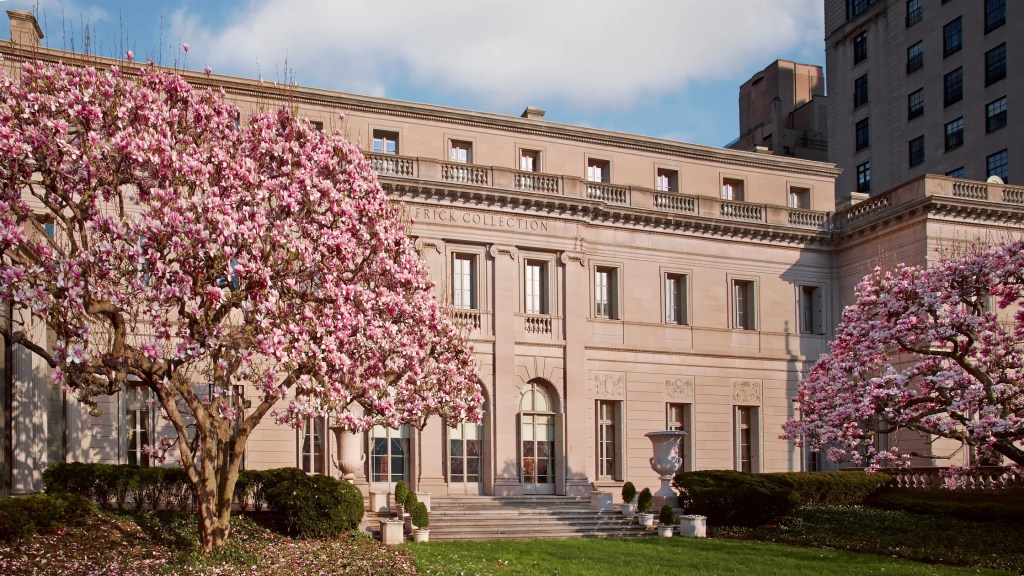
The renovated West Gallery, in which three of Johannes Vermeer’s masterpieces are now displayed, serves less as an exhibition space than as a threshold—between the optical and the luminous.
Tweet
The reinstallation of Vermeer’s works at the Frick Collection is not just a curatorial event; it is a reawakening of vision. The recently renovated West Gallery, in which three of Johannes Vermeer’s masterpieces are now displayed, serves less as an exhibition space than as a threshold—between the optical and the luminous, between painting as document and painting as event. This architectural intervention is not neutral. The subtle shifts in wall configuration and ceiling height reorient not only the body of the visitor but the epistemology of the gaze itself. The space, washed in diffuse daylight and purposefully lacking dramatic spotlights, becomes a site of enveloping visibility rather than assertive illumination. We are not being told where to look; instead, we are asked to dwell, to hesitate, to see otherwise.
The three paintings on display are not arranged chronologically, nor into a teleological narrative. They inhabit the space and invite us to rethink vision in Western art, rejecting reducing Vermeer’s gaze to the mechanical camera obscura.
Tweet
It is within this newly restructured mise-en-scène that Vermeer’s works assume a temporality that is not just pictorial but ontological. The three paintings on display—Mistress and Maid (c. 1667), Officer and Laughing Girl (c. 1657), and Lady Writing a Letter with Her Maid (c. 1670)—are not arranged chronologically, nor are they forced into any teleological narrative. They simply inhabit the space. In doing so, they invite us to rethink the legacy of vision in Western art, especially the tired repetition of theories that reduce Vermeer’s gaze to the mechanical logic of the camera obscura. This is not a show about optics. It is a show about light—not light as a measurable fact, but as an irreducible presence, a spectral condition that makes visibility possible while always withdrawing from it.
The camera obscura, in particular, has served as a convenient explanation for Vermeer’s capacity to render space with uncanny accuracy. But his genius lies in his orchestration of the phenomenological possibilities of painting.
Tweet
Much has been written about the supposed photographic quality of Vermeer’s paintings. From Lawrence Gowing to David Hockney, the artist’s precision has often been linked to optical instruments and proto-photographic devices. The camera obscura, in particular, has served as a convenient explanation for Vermeer’s capacity to render space with uncanny accuracy and intimacy. But what such interpretations fail to see—precisely because they assume that seeing is a matter of representing—is that Vermeer’s genius lies not in his documentation of the real but in his orchestration of its phenomenological possibility. What Vermeer paints is not what is seen, but what seeing feels like before it becomes knowledge. He does not capture the world as it is, but as it is about to become. In this sense, Vermeer is less a realist than a metaphysician of light.
Jacques Derrida’s reflections on the gaze offer a necessary counterpoint to the optical reductionism that has plagued Vermeer studies. In The Truth in Painting, Derrida suggests that the gaze is always haunted by a double movement: it is both a gift and a wound, an opening and a cut. To look at a painting is not simply to receive its image, but to be subjected to its structuring absence—its frame, its threshold, its silence. Vermeer’s interiors are not containers of narrative but sites of deferred presence. They resist completion. They do not ask us to identify with the figures depicted, nor to reconstruct the scene as a frozen moment in time. Instead, they expose the very act of looking as a trembling, an oscillation between proximity and distance.
To look at a painting is not simply to receive its image, but to be subjected to its structuring absence—its frame, its threshold, its silence. Vermeer’s interiors are not containers of narrative but sites of deferred presence.
Tweet
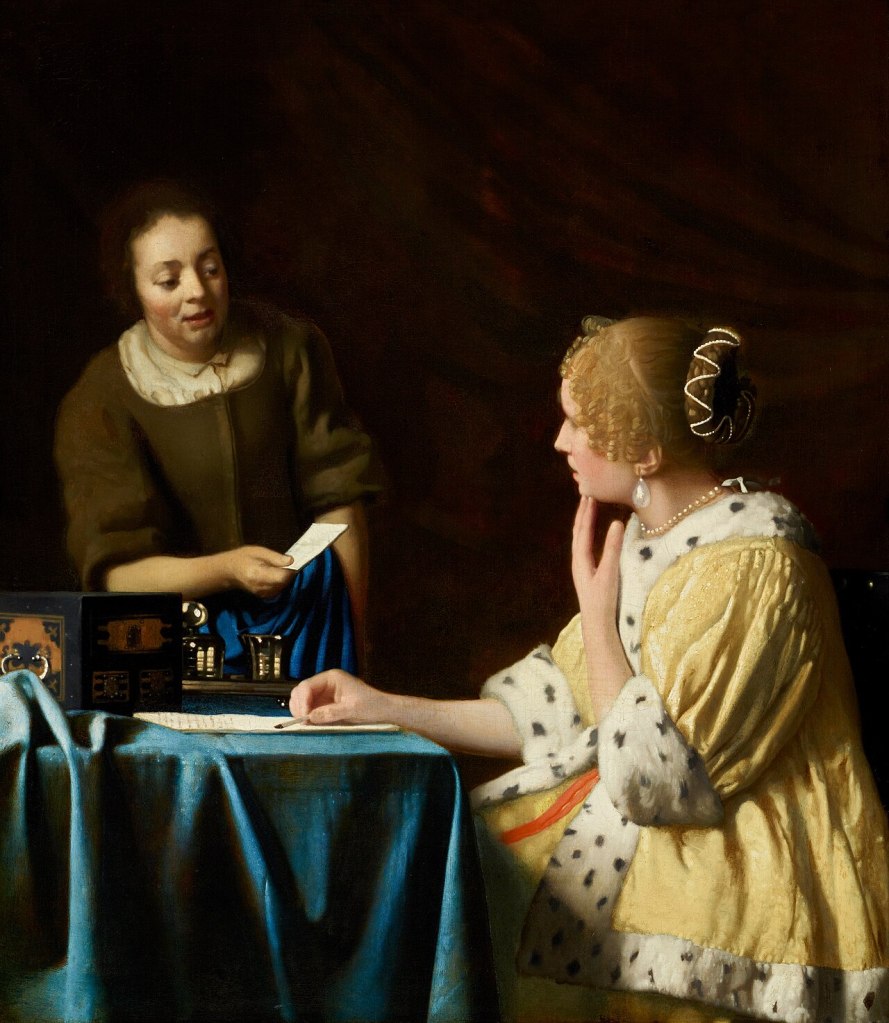
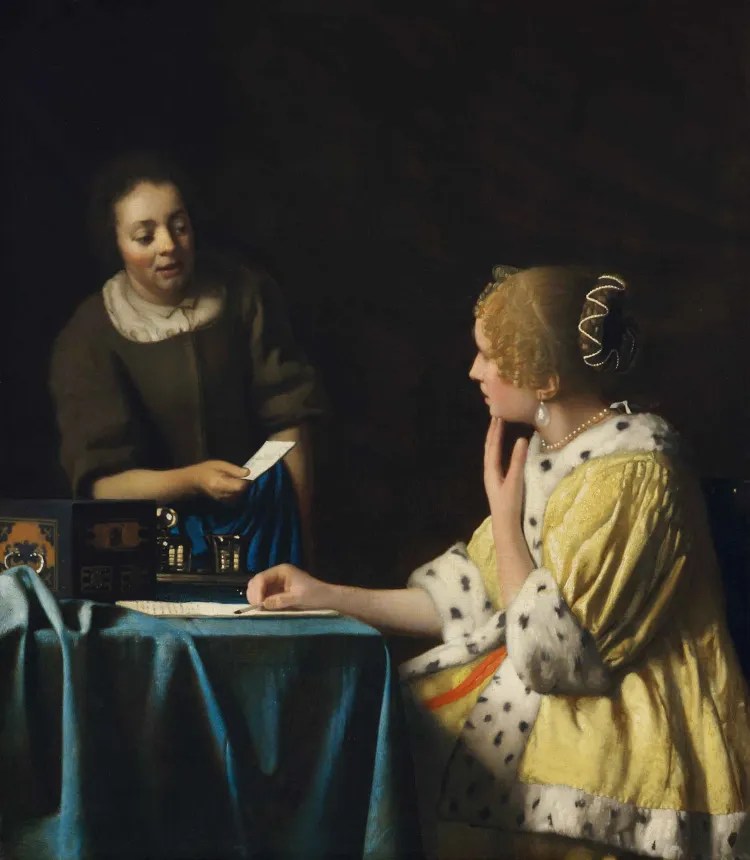
Take Mistress and Maid, one of the most enigmatic works in the Frick’s permanent collection. At first glance, it presents a familiar domestic moment: a well-dressed woman pauses from her writing as her maid hands her a letter. The scene is still, composed, luminous. But the light that bathes the two figures does not belong to the room. It is not sourced from the window, which is not even visible. Rather, it seems to seep into the space from an indeterminate elsewhere, illuminating the women’s faces with a softness that cannot be traced to any optical system. This is not the logical light of geometrical perspective; it is the luminous presence of something ungraspable—a time that is not yet, or already past. The mistress’s expression is unreadable: surprise, apprehension, joy, dread? The maid, too, is caught in a gesture that neither begins nor ends. It is a painting of suspended intention. The letter, like the gaze, interrupts rather than communicates. In this sense, the painting stages the very structure of deferred meaning that Derrida attributes to writing: it is a trace, a promise, a fragment of an absent whole.
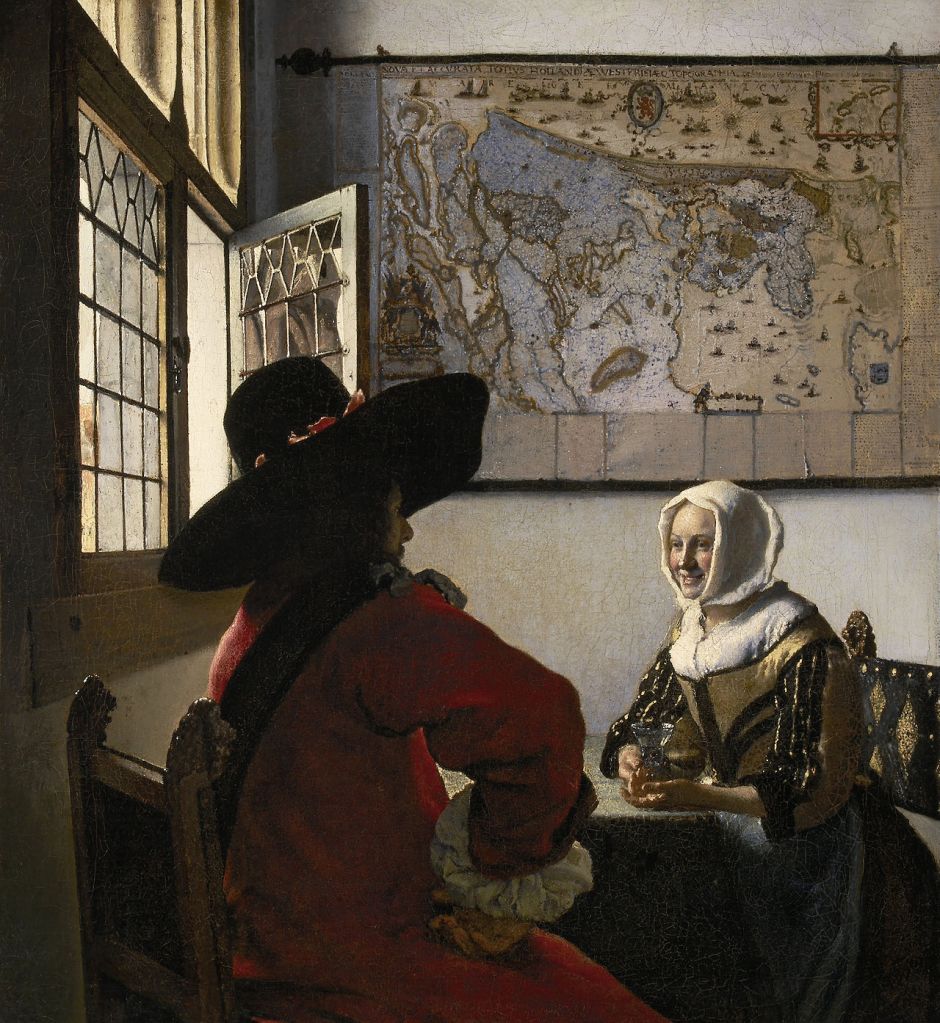
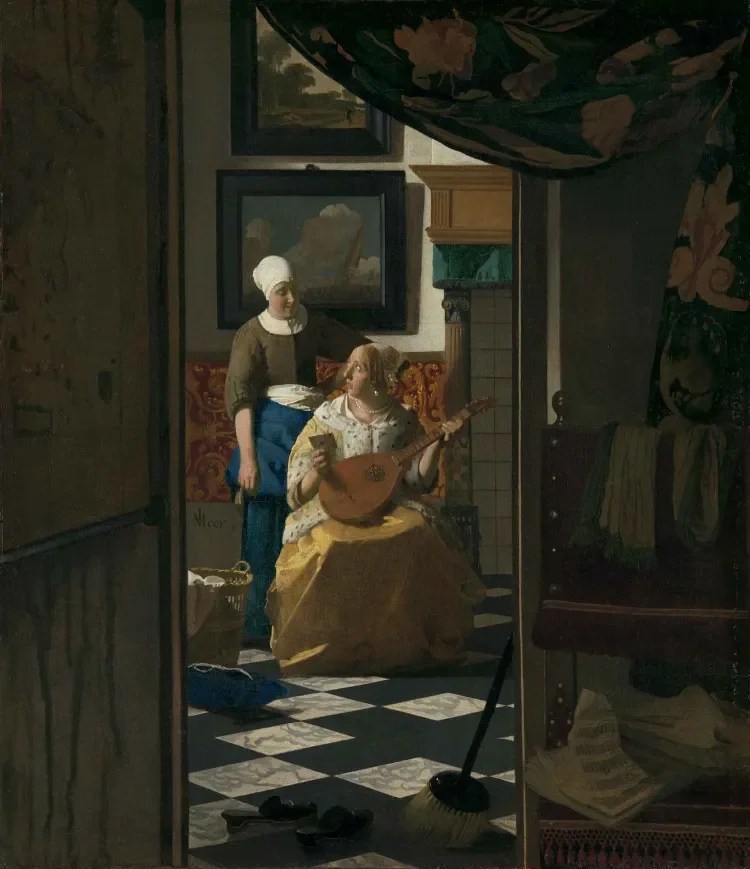
Similarly, Officer and Laughing Girl offers no stable narrative. A soldier, seated with his back to us, leans toward a young woman who appears to laugh, or perhaps smile politely. The ambiguity of her expression is matched by the strangeness of the spatial arrangement: the man’s red coat dominates the foreground, but the room behind him expands in impossible proportion. This is often cited as evidence of optical distortion via camera obscura, yet such an interpretation misses the point. What matters is not the perspectival anomaly, but the affective imbalance it creates. The viewer is positioned awkwardly, almost intrusively, as if overhearing something private. The gaze, here, is not neutral. It is gendered, militarised, and asymmetrical. And yet, the woman’s gaze is not passive. She looks out, not at the officer, but beyond him, toward a space we cannot access. Her smile is a cipher. The luminous quality of the room—especially the yellow tones of the sunlight on the wall—resists being reduced to optical realism. It glows with a kind of ethical instability: are we witnesses, voyeurs, or participants?
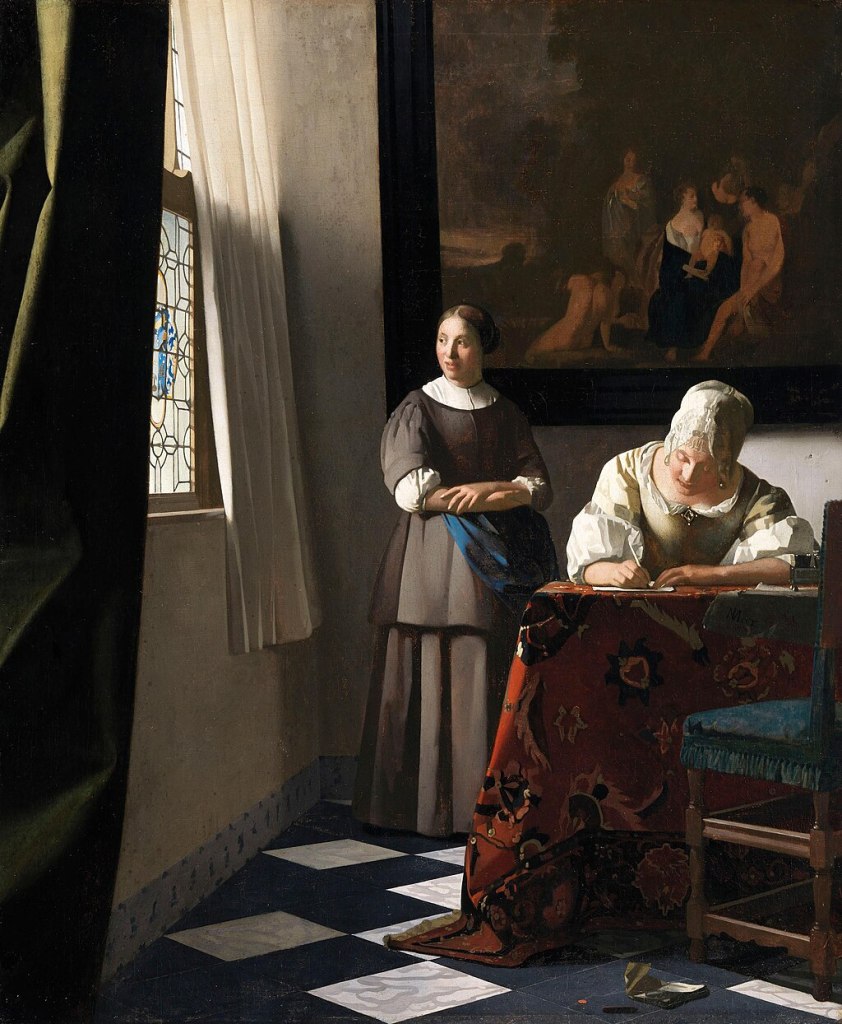
Lady Writing a Letter with Her Maid, on loan from the National Gallery of Ireland, deepens these questions. Here, too, we find a woman of means, attended by a servant. But the mood is different: the maid stands stiffly, arms crossed, looking toward the window with a gaze that suggests boredom, distance, or silent protest. The lady, absorbed in her letter, is unaware—or perhaps too aware—of the other woman’s presence. The tension between them is palpable. Light streams in from the left, but again, it is not merely illumination. It creates zones of intimacy and estrangement. The letter, the act of writing, becomes a metaphor for the painting itself: both are acts of deferred communication, of absence made present. The gaze here is doubled: the viewer’s gaze at the lady, the maid’s gaze out the window. But neither gaze resolves; they echo each other in their asymmetry. And the painting, like the others, refuses closure.
It is precisely this refusal that the renovated gallery now honors. The space is not a white cube, but a habitat of thought. The architectural changes—the softened edges, the greater verticality, the absence of heavy ornamentation—create a kind of liminal zone, where paintings become environments rather than images. The light in the room is neither theatrical nor neutral; it is atmospheric, relational. This is where Derrida’s distinction between optical and luminous light becomes crucial. Optical light is the light of mastery, of surveillance, of capture. It belongs to the logic of photography, of the lens, of linear perspective. Luminous light, by contrast, is the light of passage, of emergence, of becoming. It does not reveal; it offers. It does not fix; it invites.
The persistent myth of the camera obscura is predicated on the fantasy of control. It suggests that Vermeer’s genius was mechanical, that his vision was prosthetic. But this fantasy is not only reductive; it is deeply ideological. It assumes that vision is a matter of technology rather than of experience, of reproduction rather than creation. In doing so, it erases the affective, ethical, and temporal dimensions of painting. Vermeer, however, resists such erasure. His works are not simulations of reality but constructions of its possibility. They ask us not what we see, but how we see—and what we lose in doing so.
Reducing Vermeer’s to the prosthetic camera obscura is not only reductive; it is deeply ideological. It assumes that vision is a matter of technology rather than of experience, of reproduction rather than creation.
Tweet
In an age saturated with digital images, where vision has become instrumental and instantaneous, Vermeer’s paintings offer something far more radical: slowness, ambiguity, and the luminous opacity of the everyday. The Frick’s installation, in its architectural and curatorial restraint, makes this possible. It returns Vermeer not to history, but to the question of what it means to see—and to be seen.
This is not nostalgia. It is not about beauty, harmony, or perfection. It is about the fragile ethics of the gaze. The paintings do not soothe; they unsettle. They do not show us who we are; they remind us of who we are not yet. In this sense, the exhibition is not a retrospective but a proposition. And Vermeer, that most elusive of painters, returns not as a master of optics but as a philosopher of light.
Un Retorno Luminoso: Vermeer en la Renovada Frick Collection
Las obras de Johannes Vermeer están llenas de signos, pero no significan. Difieren el sentido, desplazan el origen y alteran la presencia. No ofrecen verdades, sino huellas y silencios. La galería renovada de la Frick lo entiende. No monta un espectáculo. Monta una postergada duda. Un espacio en el que mirar se convierte en una forma de pensar, y donde la pintura no responde al espectador sino que lo interpela oblicuamente.
El nuevo espacio en la Frick con las tres pinturas de Johannes Vermeer han sido convertidos en una forma de pensar el arte de manera oblicua.
Tweet
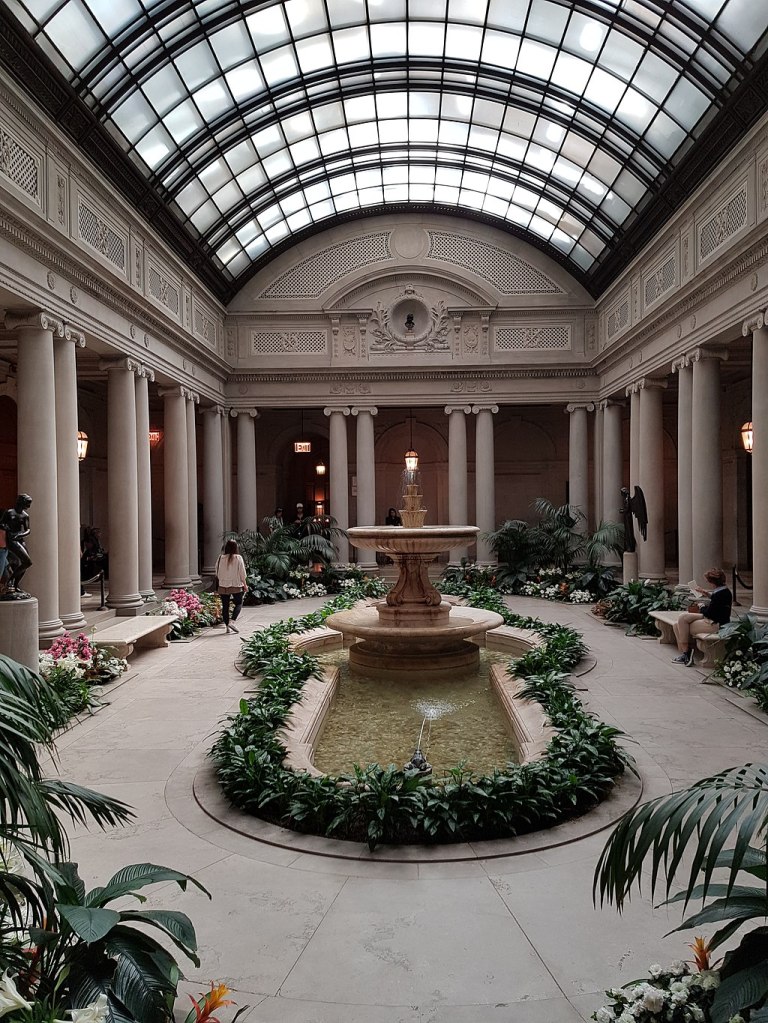
La reinstalación de las obras de Vermeer en la Frick Collection no es un simple acontecimiento curatorial; es un despertar de la visión. La recientemente renovada Galería Oeste, donde ahora se exhiben tres de sus obras maestras, funciona menos como un espacio expositivo que como un umbral: entre lo óptico y lo luminoso, entre la pintura como documento y la pintura como acontecimiento. Esta intervención arquitectónica no es neutra. Los sutiles cambios en la configuración de las paredes y la altura del techo reorientan no solo el cuerpo del visitante, sino la epistemología misma de la mirada. El espacio, bañado en luz diurna difusa y deliberadamente carente de focos dramáticos, se convierte en un lugar de visibilidad inmersiva más que de iluminación focalizada. No se nos indica dónde mirar; se nos pide habitar, demorarnos, ver de otro modo.
La reinstalación de las obras de Vermeer en la Frick es un despertar de la visión per se. La renovada Galería Oeste, donde ahora se exhiben tres de sus obras maestras, funciona como un umbral: entre lo óptico y lo luminoso.
Tweet
Es dentro de esta nueva mise-en-scène reestructurada que las obras de Vermeer asumen una temporalidad que no es solo pictórica, sino ontológica. Las tres pinturas expuestas—Señora y joven mujer (c. 1667), Oficial y muchacha riendo (c. 1657) y Dama escribiendo una carta con su joven mujer (c. 1670)—no están organizadas cronológicamente ni forzadas dentro de una narrativa teleológica. Simplemente habitan el espacio. Al hacerlo, nos invitan a repensar el legado de la visión en el arte occidental, especialmente la gastada repetición de teorías que reducen la mirada de Vermeer a la lógica mecánica de la cámara oscura. Esta no es una muestra sobre óptica. Es una muestra sobre la luz: no la luz como hecho mensurable, sino como presencia irreductible, una condición espectral que hace posible la visibilidad mientras se retrae constantemente de ella.
La muestra de Vermeer no aborda lo óptico. Es una muestra sobre la luz: no la luz como hecho mensurable, sino como presencia irreductible,
Tweet
Mucho se ha escrito sobre la supuesta cualidad fotográfica de las pinturas de Vermeer. Desde Lawrence Gowing hasta David Hockney, su precisión ha sido vinculada a instrumentos ópticos y dispositivos pre fotográficos. La cámara oscura, en particular, ha servido como explicación conveniente por su capacidad de representar el espacio con gran precisión. Pero esas interpretaciones fallan en ver—precisamente porque asumen que ver es representar—que su genio no reside en documentar lo real, sino en orquestar su posibilidad fenomenológica. Vermeer no pinta lo que se ve, sino lo que se siente al ver antes de que se convierta en conocimiento. No captura el mundo tal como es, sino tal como está a punto de ser. En este sentido, es menos un realista que un metafísico de la luz.
Vermeer no pinta lo que se ve, sino lo que se siente al ver. No captura el mundo tal como es, sino tal como está a punto de ser. En este sentido, es menos un realista que un metafísico de la luz.
Tweet
El pensamiento del filósofo francés Jacques Derrida ofrece un contrapunto necesario al reduccionismo óptico que ha plagado los estudios sobre Vermeer. En La verdad en pintura, Derrida sugiere que la mirada está siempre acechada por un doble movimiento: es tanto un regalo como una herida, una apertura y un corte. Mirar una pintura no es simplemente recibir su imagen, sino ser sometido a su ausencia estructurante: su marco, su umbral, su silencio. Los interiores de Vermeer no son contenedores de narrativas, sino sitios de presencia diferida. Resisten la conclusión. No nos piden identificarnos con las figuras retratadas ni reconstruir la escena como un instante congelado en el tiempo. Más bien, exponen el acto mismo de mirar como un temblor, una oscilación entre la proximidad y la distancia.
Mirar una pintura no es simplemente recibir su imagen, sino ser sometido a su ausencia estructurante: su silencio. Los interiores de Vermeer no son contenedores de narrativas, sino sitios de presencia diferida.
Tweet
Tomemos Señora y doncella, una de las obras más enigmáticas de la colección permanente de la Frick. A primera vista, presenta una escena doméstica familiar: una mujer elegantemente vestida para de escribir mientras su criada le entrega una carta. La escena es serena, compuesta, luminosa. Pero la luz que baña a las dos figuras no proviene del cuarto. No se origina en la ventana, que ni siquiera es visible. Más bien, parece filtrarse en el espacio desde un lugar indeterminado, iluminando los rostros con una suavidad que no se puede atribuir a ningún sistema óptico. No es la luz lógica de la perspectiva geométrica, sino la presencia luminosa de algo inasible—un tiempo que no es todavía, o que ya ha pasado. La expresión es ilegible: ¿sorpresa, temor, alegría, angustia? La mucama está tambien atrapada en un gesto que ni empieza ni termina. Es una pintura de intención suspendida. La carta, como la mirada, interrumpe en lugar de comunicar. En ese sentido, la pintura escenifica la estructura misma del sentido diferido que Derrida atribuye a la escritura: es una huella, una promesa, un fragmento de un todo ausente.
Del mismo modo, Oficial y muchacha riendo no ofrece una narrativa estable. Un soldado, sentado de espaldas al espectador, se inclina hacia una joven que parece reír, o tal vez sonreír con cortesía. La ambigüedad de su expresión se refleja en la extrañeza de la disposición espacial: el abrigo rojo del hombre domina el primer plano, pero el espacio detrás de él se expande de manera imposible. Esto se cita a menudo como evidencia de distorsión óptica mediante cámara oscura, pero tal interpretación pierde el punto. Lo importante no es la anomalía perspectival, sino el desequilibrio afectivo que crea. El espectador está colocado de forma incómoda, casi intrusiva, como si escuchara algo privado. La mirada, aquí, no es neutral. Es asimétrica. Y sin embargo, la mirada de la mujer no es pasiva. No mira al oficial, sino más allá de él, hacia un espacio al que no podemos acceder. Su sonrisa es un enigma. La cualidad luminosa del cuarto—especialmente los tonos amarillos de la luz solar sobre la pared—resiste ser reducida a algo óptico. Brilla con una inestabilidad ética: ¿somos testigos, voyeurs o participantes?
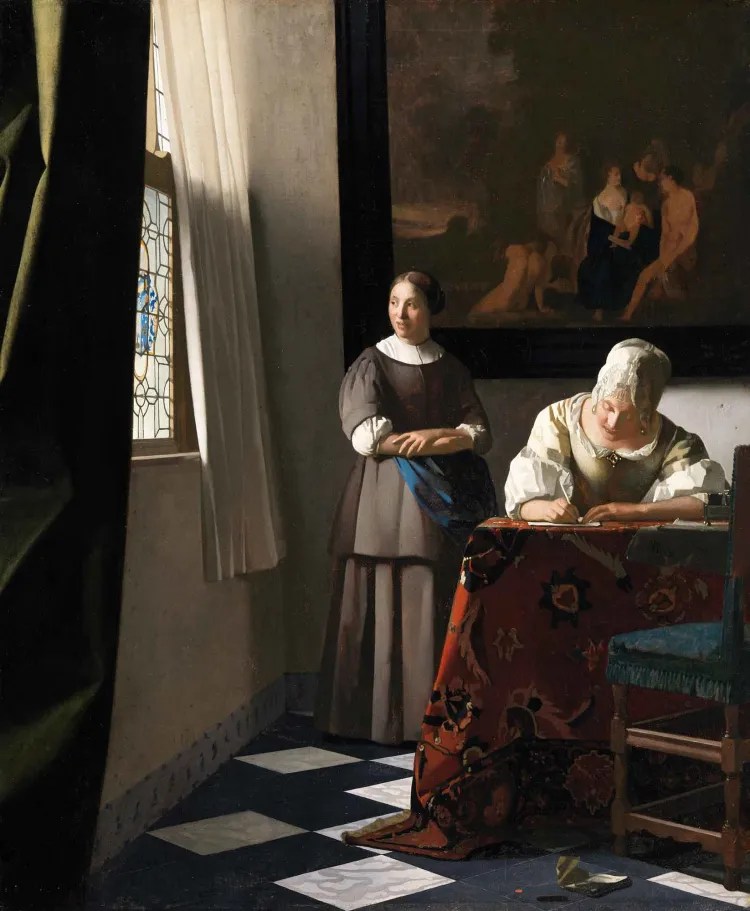
Dama escribiendo una carta con su criada, prestada por la National Gallery of Ireland, profundiza estas preguntas. Aquí también encontramos a una mujer acomodada, asistida por una sirvienta. Pero el ánimo es distinto: la criada está rígida, con los brazos cruzados, mirando hacia la ventana con una expresión que sugiere aburrimiento, distancia o protesta silenciosa. La dama, absorta en su carta, ignora a la otra mujer. La tensión entre ambas es palpable. La luz entra desde la izquierda, pero una vez más, no es simple iluminación. Crea zonas de intimidad y de extrañamiento. La carta, el acto de escribir, se convierte en metáfora de la propia pintura: ambos son actos de comunicación diferida, de ausencia hecha presente. La mirada aquí es doble: la del espectador hacia la dama, y la de la criada hacia la ventana. Pero ninguna se resuelve; se repiten en su asimetría. Y la pintura, como las demás, rehúsa cerrarse.
Es precisamente ese rechazo lo que ahora celebra la galería renovada. El espacio no es un cubo blanco, sino un hábitat de pensamiento. Los cambios arquitectónicos—los bordes suavizados, la mayor verticalidad, la ausencia de ornamentación pesada—crean una zona liminal, donde las pinturas se convierten en entornos más que en imágenes. La luz en la sala no es ni teatral ni neutra; es atmosférica, relacional. Aquí es donde la distinción entre luz óptica y luz luminosa se vuelve crucial. La luz óptica es la de la apropiación, de la vigilancia, del control. Pertenece a la lógica de la fotografía, del lente, de la perspectiva lineal. La luz luminosa, en cambio, es la luz del pasaje, de la emergencia, del devenir. No revela; ofrece. No fija; invita.
La luz en la nueva sala de la Frick no es ni teatral ni neutra; es atmosférica y relacional. Aquí es donde la distinción entre luz óptica y luz luminosa se vuelve crucial para entender al Vermeer filosofo.
Tweet
El mito persistente de la cámara oscura está basado en la fantasía del control. Sugiere que el genio de Vermeer era mecánico, que su visión era protésica. Pero esa fantasía no solo es reductiva; es profundamente ideológica. Asume que la visión es cuestión de tecnología y no de experiencia, de reproducción y no de creación. Al hacerlo, borra las dimensiones afectivas, éticas y temporales de la pintura. Vermeer este borramiento. Sus obras no son simulaciones de la realidad, sino construcciones de su posibilidad. No nos preguntan qué vemos, sino cómo vemos—y qué perdemos al hacerlo.
Las obras de Vermeer no son simulaciones de la realidad, sino construcciones de su posibilidad. No nos preguntan qué vemos, sino cómo vemos—y qué perdemos al hacerlo.
Tweet
En una época saturada de imágenes digitales, donde la visión se ha vuelto instrumental e instantánea, las pinturas de Vermeer ofrecen algo mucho más radical: un proceso de desaceleración opaca de lo cotidiano a través de la transformación de la luz en luminosidad. La instalación de la Frick, en su contexto arquitectónico y curatorial, hace esto posible ya que la curación es temática y la renovación de la sala es liberadora no indicativa. La muestra es relevante porque repone a Vermeer en la tradición del peintre philosophe y la pregunta que su pintura se hace es: qué significa ver y ser visto.
La muestra en la Frick del Upper East Side importa porque repone a Vermeer en la tradición del peintre philosophe y la pregunta que su pintura se hace es: qué significa ver y ser visto.
Tweet
A Vermeer le importa poco la belleza, la armonía o la perfección. Lo que le importa es la ética de la mirada. Las pinturas no consuelan; inquietan. No nos muestran quiénes somos; nos recuerdan quiénes aún no somos. En ese sentido, la exposición no es una retrospectiva, sino una serie de preguntas maravillosamente formuladas. Y Vermeer, el más escurridizo de los pintores, regresa no como maestro de la óptica, sino como filósofo de la luz.
A Vermeer le importa poco la belleza, la armonía o la perfección. Lo que le importa es la ética de la mirada. Las pinturas no consuelan; inquietan. No nos muestran quiénes somos; nos recuerdan quiénes aún no somos.
Tweet
hacer click en la imagen para sumarse como socio de mi canal de youtube para hacer los cursos para miembros pagos. Nuevos cursos: la estetica de la sombra, renacimiento italiano intensivo y la bidimensionalidad.




 Loveartnotpeople.blog
Deja una respuesta