
DEBAJO ESTÁ LA VERSIÓN EN ESPAÑOL
The Violated Louvre
In How Not to Become Subhuman —yesterday’s video (see here) — I spoke about how contemporary bureaucracy has monopolised the gaze. We live under an optical regime where the State, the algorithm, and capital observe without ever being seen. The Freedom of Information Act —passed in the United States in 1966 and in the United Kingdom in 2000— was, at its inception, an attempt to invert that regime: to return the gaze to the citizen.
In How Not to Become Subhuman, I spoke about how contemporary bureaucracy has monopolised the gaze. We live under an optical regime where the State and capital observe without ever being seen. The Freedom of Information Act has been an attempt to invert that regime: to return the gaze to the citizen. Or not?
Tweet
The FOIA rests on a radically democratic premise: knowledge produced or held by the State belongs to everyone. It is a law about access, but also about transparency —the right to know how the common good is administered. In spirit, it institutionalises an ethics of looking: an affirmation that to see —to know, to inquire, to access— is itself a political act.

That ethic, however, now faces an unexpected adversary: the global art system. Where the FOIA opens archives, contemporary art tends to seal them beneath new forms of opacity —narrative, curation, simulacrum. If the right to information once guaranteed institutional visibility, today’s cultural policies—dominated by private foundations and ministries captured by the language of marketing—replace truth with storytelling, evidence with spectacle, transparency with aura.
Where the FOIA opens archives, contemporary art tends to seal them beneath new forms of opacity —narrative, curation, simulacrum.
Tweet
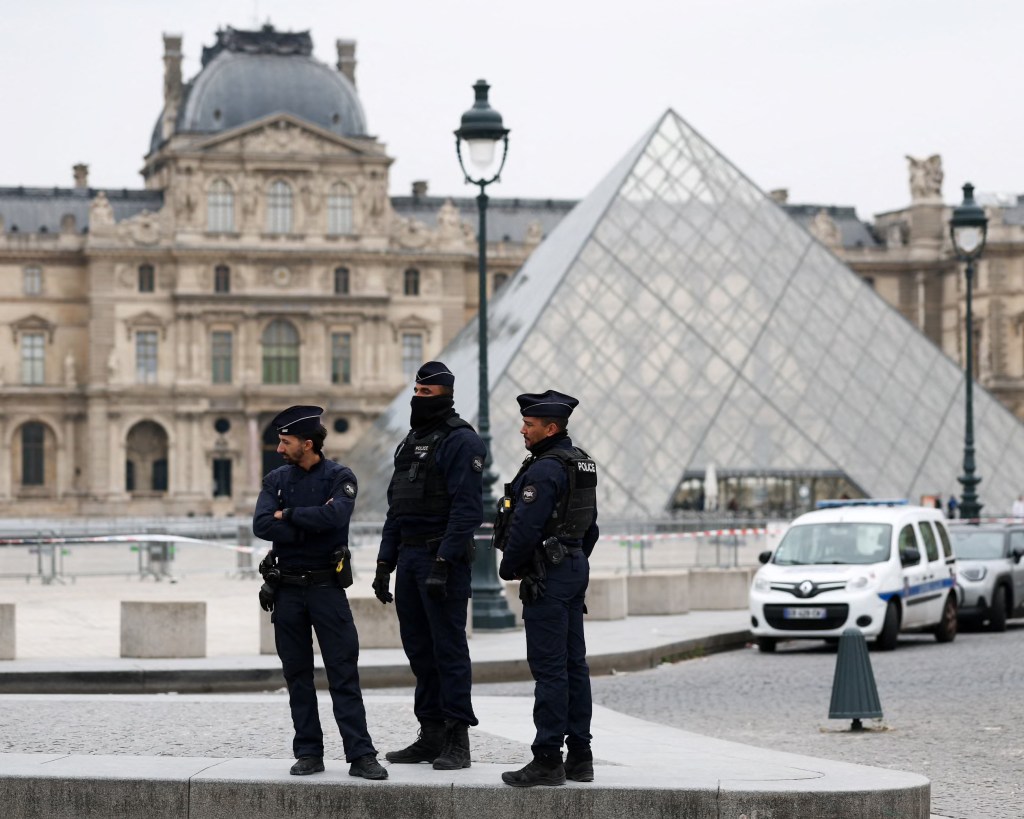
The theft of the Louvre and Argentina’s pavilion at the Venice Biennale are symptoms of that displacement. Both mark the moment when culture ceases to be a public sphere and becomes instead a stage set for power. The violated Louvre —in the most literal sense— is not merely a loss of patrimony: it is an assault on the symbolic body of the French nation-state, a masculine, rational, colonial body that for centuries represented its dominion through the museum. The Venice Biennale, by contrast, incarnates its postmodern simulacrum: a global space where art can be “political” only insofar as its politics remain representational and domesticated. Critique is permitted only when it is spoken from within the device.
The violated Louvre —in the most literal sense— is an assault on the symbolic body of the French nation-state, a masculine, colonial body that for centuries represented its dominion through the museum. The Venice Biennale, by contrast, incarnates its postmodern simulacrum where critique is only permitted as simulacrum.
Tweet
The Museum and the History of Opacity
The modern museum was born alongside the European nation-state and its colonial expansion. The Louvre, the British Museum, and Vienna’s Kunsthistorisches Museum were, each in its own way, imperial machines of legitimisation. To exhibit was to dominate: every object torn from Egypt, Greece, or Benin served as material proof of Europe’s civilising power.
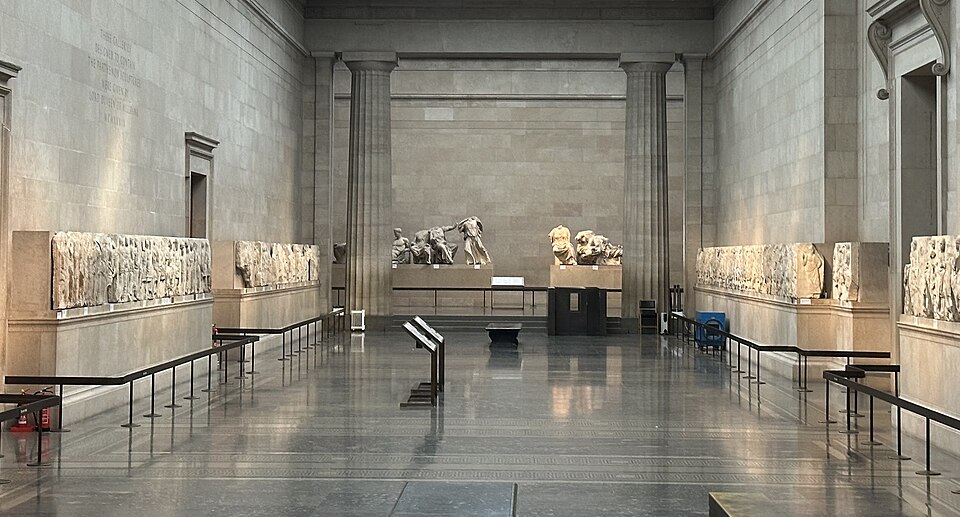
In Britain, the Elgin Marbles transported from Athens transformed plunder into aesthetic narrative. In Germany, the Pergamon Altar converted archaeological loot into a monument of national identity. In France, the Venus de Milo became an emblem of universal beauty, erasing the violence of her appropriation. Museology thus emerged as a politics of concealment: turning horror into form.
The “horror” those museums veiled was not only the material dispossession of colonised peoples; it was the constitutive violence of modernity itself —exploitation, slavery, genocide. Joseph Conrad understood it when he wrote Heart of Darkness: behind every scientific or commercial expedition lay an economy of horror. Roger Casement, the Irish diplomat and activist, confirmed it in his reports on the Congo and the Putumayo, where he documented the corporate barbarism of the rubber trade that Europe preferred not to see. The museum, in that sense, was the aesthetic counterpart of the system Conrad and Casement exposed: temples of plunder turned into pedagogies of innocence.

Today, under the dominion of private foundations and financial capitalism, that smoke screen persists under new names. The rhetoric of heritage has been replaced by that of inclusion and innovation, but the mechanism remains the same: what is shown serves to conceal the structural conflict beneath. Contemporary culture thus functions as the antithesis of the FOIA: it does not reveal information; it aestheticises it. It does not open archives; it floodlights them falsely. The theft of the Louvre, therefore, is less a crime than a symbolic act of declassification—a forced entry into the myth’s interior.
Contemporary culture thus functions as the antithesis of the Freedom of Information Act: it does not reveal information; it aestheticises it. It does not open archives; it floodlights them falsely.
Tweet
Ireland and Material Transparency
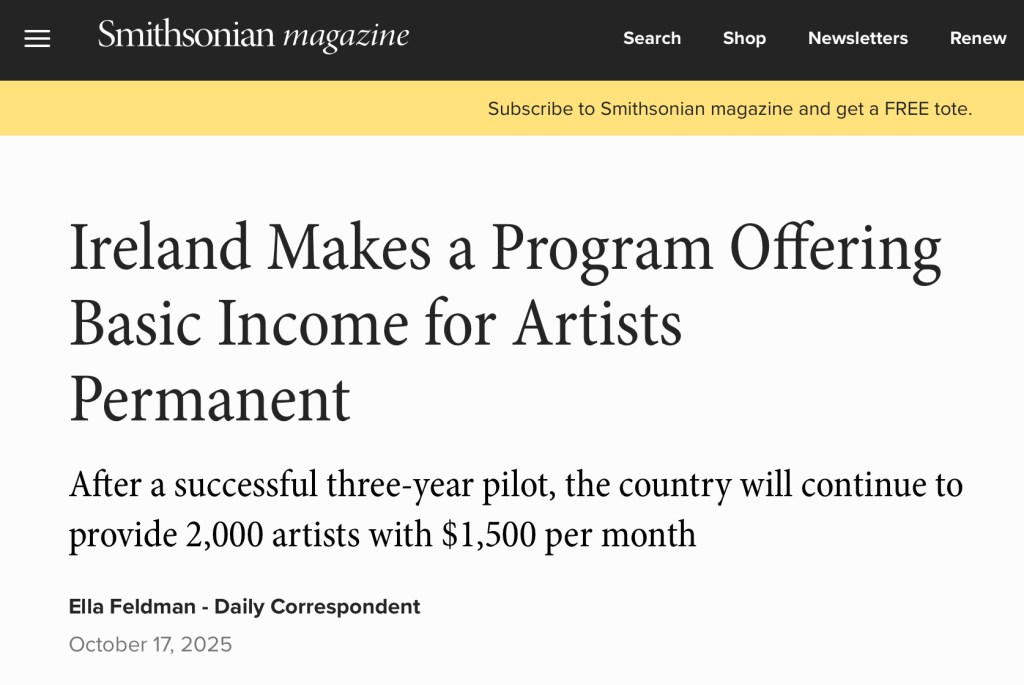
Against this global machinery of opacity, the Irish model emerges as a modest yet radical gesture of reclaiming the public. In 2022, Ireland launched the Basic Income for the Arts, a state programme granting €325 per week to over 2,000 artists and cultural workers, chosen by lottery. Yesterday, the Irish government decided to make it permanent. The measure carries symbolic force far beyond its economic scale: the State does not buy artworks or commission monuments; it funds time—the very condition of creation. It restores the artistic practice to the public economy and, at least partially, breaks its dependence on private patronage.
Against this global machinery of opacity, the Irish model emerges as a modest yet radical gesture of reclaiming the public. In 2022, launched the Basic Income for the Arts, a state programme granting €325 per week to over 2,000 artists, chosen by lottery. Yesterday, the Irish government decided to make it permanent.
Tweet

Unlike Buenos Aires’ “Mecenazgo Law” —which disguises tax exemptions as cultural altruism— the Irish model states its terms openly. There are no invisible donors, no fiscal operations dressed as philanthropy. It is, quite literally, a policy of material transparency: the State shows how and whom it supports. That economic clarity translates into a new social visibility for art: by liberating creation from the market, Ireland redefines culture as a public service rather than a spectacle for the wealthy. What is at stake goes deeper than subsidy: it is the restoration of the right to see. The FOIA guarantees access to administrative information; the basic income extends that logic into the symbolic realm, allowing time and imagination—those unquantifiable forms of knowledge—to circulate once again within the commons.
That economic clarity translates into a new social visibility for art: by liberating creation from the market, Ireland redefines culture as a public service rather than a spectacle for the wealthy.
Tweet
How Not to Become Subhuman and Culture: Art as Access to Sensitive Information
If the FOIA safeguards access to data and documents, art at its highest dimension safeguards access to the sensible—to that which cannot be translated into bureaucratic language or statistics. Art does not produce information; it produces forms of access. Yet under the regime of the global market, that access has been interrupted. Works have become financial assets, artists content providers, and the gaze—that space between seeing and being seen—a field of surveillance and marketing.
Art does not produce information; it produces forms of access. Yet under the regime of the global market, that access has been interrupted. Works have become financial assets, artists content providers, and the gaze—that space between seeing and being seen—a field of surveillance and marketing.
Tweet

Privatised art no longer translates what is hidden; it airbrushes it. It replaces revelation with curatorial discourse or postmodern irony. In doing so, it loses its epistemic function: the capacity to articulate what institutions cannot or will not say. Hence, a cultural policy that ensures the material conditions for creation—such as Ireland’s—is not merely economic relief but an epistemic gesture: it allows lived experience to become translatable once more into a common language. Aesthetic knowledge, like legal or scientific knowledge, is a public good. Its circulation must be protected from capital with the same conviction with which we defend the freedom of the press or the right of access to archives.
Internalising Decolonisation as Resistance
Ultimately, the Freedom of Information Act and art share a single principle: to see is to act politically. While the colonial museum turned vision into property, and the private foundation converted it into marketing, the FOIA redefines vision as a right. The artist, when not subordinated to the economy of the simulacrum, occupies the same position as the citizen confronting the State: that of the one who insists on looking where one is not supposed to look. Ireland understood this through a simple gesture—to pay for the time to look—while France guards its ruins and Argentina exports its self-destruction. In a world saturated with images, the true luxury once again becomes transparency: the possibility of seeing without mediation, without simulacrum, without permission. The right to see —in art, in politics, in life— is not merely an aesthetic question. It is the final redoubt of freedom.
Ultimately, the Freedom of Information Act and art share a single principle: to see is to act politically. While the colonial museum turned vision into property, and the private foundation converted it into marketing, the FOIA redefines vision as a right.
Tweet
© Rodrigo Cañete 2025
Irlanda vs Argentina: La violación anal de la Francia Republicana, la vocación de esclavitud de la elite cultural del Cono Sur y la tercera via Celta (ESP)
El Louvre Violado
En How Not to Become Subhuman, el video de ayer, se hablaba de cómo la burocracia contemporánea ha monopolizado la mirada. Vivimos bajo un régimen óptico donde el Estado, el algoritmo y el capital observan sin ser vistos. La Freedom of Information Act —esa ley que en 1966 en Estados Unidos y en 2000 en el Reino Unido instituyó el derecho ciudadano a acceder a la información pública— fue, en su momento, un intento de invertir ese régimen: devolver la mirada al ciudadano.
La FOIA parte de una idea radicalmente democrática: el conocimiento producido o custodiado por el Estado pertenece a todos. Es una ley sobre el acceso, pero también sobre la transparencia, es decir, sobre el derecho a saber cómo se administra lo común. En su espíritu, el FOIA es la institucionalización de una ética del mirar: una afirmación de que ver —saber, conocer, acceder— es un acto político.
Esa ética, sin embargo, hoy se enfrenta a un adversario inesperado: el sistema del arte contemporáneo. Allí donde la FOIA abre archivos, el arte global tiende a cerrarlos bajo nuevas formas de opacidad: relato, curaduría, simulacro. Si el derecho a la información garantizaba la visibilidad de las instituciones, las políticas culturales contemporáneas —dominadas por fundaciones privadas y ministerios capturados por el lenguaje del marketing— sustituyen la verdad por storytelling, la prueba por espectáculo, la transparencia por aura.
El robo del Louvre y el envío argentino a la Bienal de Venecia son síntomas de ese desplazamiento. Ambos eventos marcan el punto donde la cultura ya no se entiende como esfera pública sino como escenografía del poder. El Louvre violado —en el sentido más literal del término— no es solo una pérdida patrimonial: es una violación al cuerpo simbólico del Estado-Nación francés, un cuerpo masculino, racional, colonial, que por siglos representó su dominio a través del museo. La Bienal de Venecia, en cambio, encarna su simulacro: un espacio global donde el arte solo puede ser político en tanto representación domesticada de lo político. La crítica es permitida siempre que se pronuncie desde dentro del dispositivo.
El museo y la historia de la opacidad
El museo moderno nació junto con los Estados nacionales europeos y su expansión colonial. El Louvre, el British Museum y el Kunsthistorisches Museum de Viena fueron, cada uno a su modo, máquinas de legitimación imperial. Exhibir era dominar: cada pieza arrancada de Egipto, Grecia o Benín funcionaba como prueba material del poder civilizador de Europa. En Inglaterra, los mármoles de Elgin trasladados desde Atenas transformaron el saqueo en relato estético. En Alemania, el Altar de Pérgamo convertía el botín arqueológico en monumento de identidad nacional. En Francia, la Venus de Milo se transformó en emblema de la belleza universal, borrando las violencias de su apropiación. La museología nació, así, como política del encubrimiento: convertir el horror en forma.
El “horror” que esos museos velaban no era solo el despojo material de los pueblos colonizados; era la violencia constitutiva del proyecto moderno: la explotación, la esclavitud, el genocidio. Joseph Conrad lo comprendió al escribir El corazón de las tinieblas: detrás de cada expedición científica o comercial había una economía del horror. Roger Casement, diplomático y activista irlandés, lo confirmó en sus informes sobre el Congo y el Putumayo, donde documentó la barbarie empresarial del caucho que Europa prefería no ver. Los museos fueron, en ese sentido, la versión estética del mismo sistema que Conrad y Casement denunciaron: templos del saqueo convertidos en pedagogías de la inocencia.

Hoy, bajo el dominio de las fundaciones privadas y el capitalismo financiero, esa cortina de humo persiste con nuevos nombres. La retórica del patrimonio fue reemplazada por la de la inclusión y la innovación. Pero el mecanismo es idéntico: lo que se muestra sirve para ocultar el conflicto estructural. En ese sentido, la cultura contemporánea funciona como la antítesis del FOIA: no revela la información, la estetiza; no abre los archivos, los ilumina falsamente. El robo del Louvre, por eso, más que un delito, es un acto de desclasificación simbólica: un acceso forzado al interior del mito.
Irlanda y la transparencia material
Frente a esa maquinaria global de opacidad, el modelo irlandés aparece como un gesto mínimo pero radical de reapropiación de lo público. En 2022, Irlanda lanzó el Basic Income for the Arts, un programa estatal que otorga 325 euros semanales a más de 2.000 artistas y trabajadores culturales, seleccionados por sorteo. En 2025, el gobierno decidió hacerlo permanente. La medida tiene una fuerza simbólica desproporcionada respecto de su escala económica: el Estado no compra obras ni encarga monumentos; financia el tiempo, es decir, la condición misma de la creación. Es una política que devuelve a la práctica artística su lugar en la economía pública y rompe, aunque sea parcialmente, la dependencia del mecenazgo privado.
A diferencia de la “ley de mecenazgo” argentina —que disfraza desgravaciones impositivas de altruismo cultural—, el modelo irlandés declara abiertamente sus términos. No hay donantes invisibles ni operaciones fiscales travestidas de filantropía. Es, literalmente, una política de transparencia material: el Estado muestra cómo y a quién sostiene. Esa claridad económica se traduce en una nueva visibilidad social del arte: al liberar la creación del mercado, Irlanda redefine la cultura como un servicio público, no como un espectáculo para millonarios.
Lo que se juega ahí es más profundo que un subsidio: es una restitución del derecho a ver. El FOIA garantiza el acceso a la información administrativa; el ingreso básico amplía esa lógica al terreno simbólico, permitiendo que el tiempo y la imaginación —esas formas de conocimiento no cuantificables— vuelvan a circular en lo común.

How Not to Become Subhuman y la Cultura: El arte como acceso a la información sensible
Si la FOIA protege el acceso a los datos y documentos, el arte, en su dimensión más alta, protege el acceso a lo sensible: aquello que no puede traducirse en lenguaje burocrático ni en estadística. El arte no produce información: produce formas de acceso. Pero bajo el régimen del mercado global, ese acceso se interrumpe. Las obras se convierten en activos, los artistas en proveedores de contenido, y la mirada —ese espacio entre quien ve y lo visto— en territorio de vigilancia y marketing.
El arte privatizado ya no traduce lo oculto: lo maquilla. Lo sustituye por discurso curatorial o por ironía posmoderna. Pierde así su función epistémica: la capacidad de revelar aquello que las instituciones no pueden o no quieren decir. Por eso, una política cultural que garantice condiciones materiales para la creación —como la irlandesa— no es solo un alivio económico, sino un gesto epistémico: permite que la experiencia vuelva a ser traducible en lenguaje común.
El conocimiento estético, como el jurídico o el científico, es también un bien público. Su circulación debe estar protegida del capital con la misma convicción con la que se protege la libertad de prensa o el acceso a los archivos.
Internalización de la Decolonización como Resistencia
En última instancia, la Freedom of Information Act y el arte comparten un mismo principio: ver es un acto político. Mientras el museo colonial convirtió la visión en propiedad y la fundación privada la convirtió en marketing, el FOIA la redefine como derecho. El artista, cuando no está subordinado a la economía del simulacro, ocupa ese mismo lugar que el ciudadano ante el Estado: el lugar de quien exige mirar donde no se debe mirar. Irlanda lo entendió con un gesto simple —pagar por el tiempo de mirar—, mientras Francia custodia ruinas y Argentina exporta su autodestrucción.
En un mundo saturado de imágenes, el verdadero lujo vuelve a ser la transparencia: la posibilidad de ver sin mediación, sin simulacro, sin permiso. El derecho a ver —en el arte, en la política, en la vida— no es solo una cuestión estética. Es el último reducto de la libertad.
© Rodrigo Cañete 2025
 Loveartnotpeople.blog
Deja una respuesta