Scroll Down for the English Version
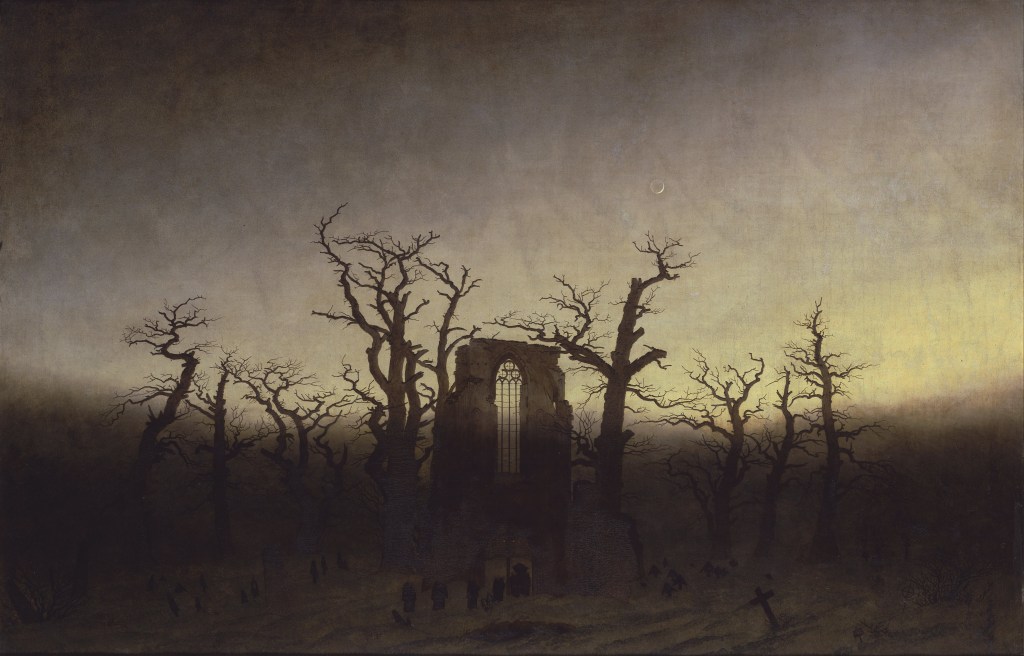
Lo que venimos trabajando en el curso de arte del paisaje en mi canal de YouTube para miembros pagos coloca a Simon Schama en el centro de nuestro debate de estas semanas. Para él, la “ontologización” del bosque alemán no fue una metáfora literaria, sino un procedimiento histórico por el cual un motivo paisajístico pasó a funcionar como fundamento de identidad. En el romanticismo tardío, el Wald dejó de ser un conjunto de árboles y se volvió una escena repetible de “profundidad histórica” y “autenticidad” nacional. Por eso Friedrich podía pintar robles secos como columnas góticas naturales en Abtei im Eichwald, y lograr que la ruina medieval pareciera continuidad orgánica del paisaje. En esa lógica, la nación no “usa” el bosque: la nación parece emerger del bosque. Esa inversión es peligrosa porque naturaliza la historia. Lo político se presenta como destino geográfico, y lo cultural se presenta como naturaleza.
El problema no es amar el territorio, sino convertirlo en esencia: cuando el paisaje se vuelve destino, la política se disfraza de naturaleza.
Tweet

Ahí está la advertencia. El paisaje empieza a operar como esencia. Cuando el territorio se vuelve esencia, la política puede vestirse de “defensa natural” y justificar exclusión, purificación, expulsión o conquista sin presentarse como ideología, sino como necesidad. Ese es el punto duro que Schama reconstruye cuando conecta la relectura romántica de los relatos de Tácito, la escena heroica de Arminio, la retórica de arraigo cultural en Fichte, el antiurbanismo conservador del siglo XIX y, finalmente, la radicalización nazi del Blut und Boden. En ese recorrido, el bosque deja de ser fondo. Se vuelve argumento.
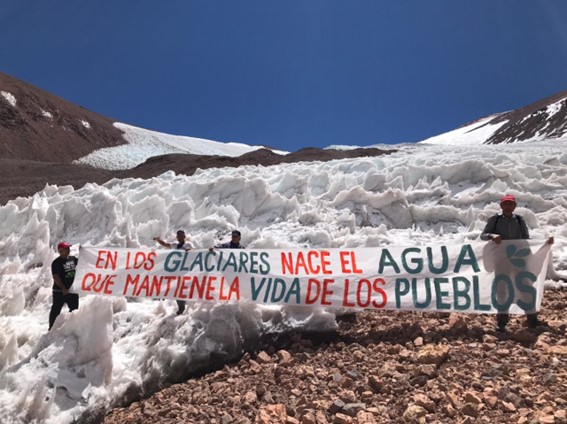
En Alemania el bosque fue ontologizado como identidad; en la Argentina actual el glaciar corre el riesgo inverso: volverse simple variable regulatoria para destrabar inversión.
Tweet
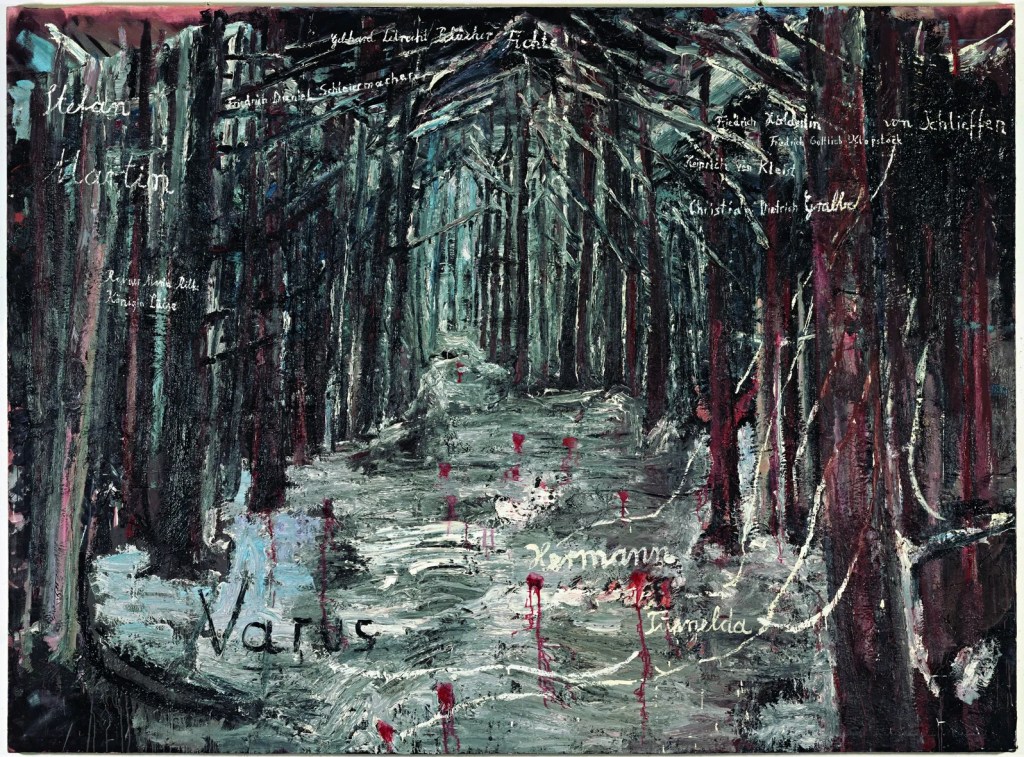
Por eso Anselm Kiefer es crucial. Kiefer entra al bosque sabiendo que el bosque está contaminado. No intenta rescatar la inocencia romántica; intenta atravesar el archivo de violencia que la tradición depositó en ese motivo. En Occupations (1969) se fotografía realizando el saludo nazi en paisajes europeos: no “representa” el nazismo, sino que reintroduce el gesto en el espacio visible para impedir el cierre. En Varus (1976), el sendero se hunde en un bosque oscuro de troncos negros que no promete salida: ese “camino” es la imagen literal del Holzweg como clausura. El paisaje ya no consuela. Pesa. Lo que antes era interioridad sublime ahora es memoria como carga.
Cambiar “ambiente periglacial” por “geoforma periglacial” no es un tecnicismo neutro: es reducir el perímetro de protección y redefinir quién decide sobre el agua.
Tweet

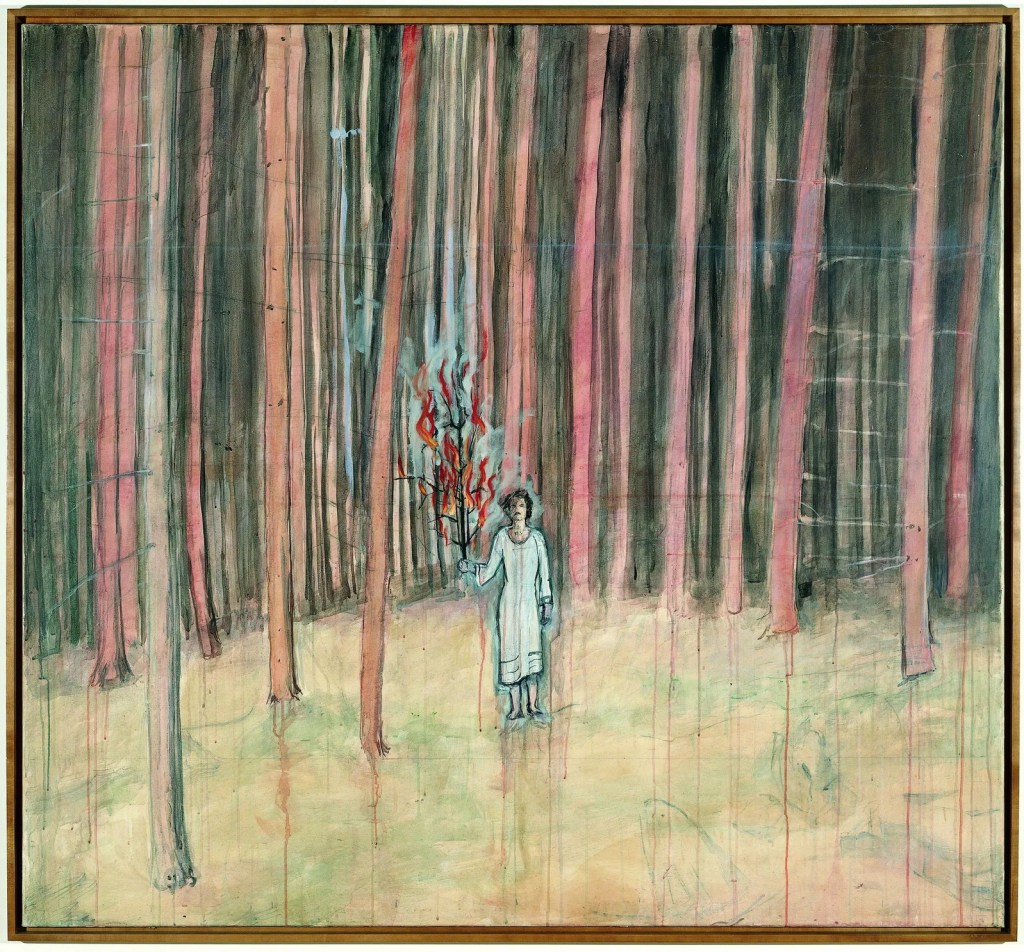
Schama insiste en que Kiefer no celebra el mito del bosque, lo quema. Pero el fuego tiene doble sentido cultural: destruye y purifica. Kiefer quiere arruinar el mito, pero al mismo tiempo lo vuelve monumental bajo la forma de ruina. El bosque deja de ser heroico, pero no deja de ser central. La crítica no borra el motivo: lo vuelve oscuro, pesado, casi sublime en su negatividad. Eso es lo que hace que Kiefer sea complejo: no dice “olvidemos el bosque”, dice “no podemos escapar del bosque”.Y cuando el símbolo nacional por excelencia se enferma, se derrumba la fantasía de una naturaleza garante de continuidad moral. El mito se encuentra con la biología. Y pierde.
El falso dilema “minería sí o no” oculta la pregunta decisiva: cómo, bajo qué estándares y quién controla el impacto sobre el recurso hídrico estratégico.
Tweet
Ahora bien, lo que está ocurriendo hoy en Argentina con la reforma de la Ley de Glaciares no es la repetición de ese proceso alemán. Es su inversión. En Alemania, el peligro era la sacralización ontológica del territorio como esencia nacional. En Argentina, el peligro es la desontologización del territorio: tratarlo como un conjunto de variables regulables para destrabar inversión, con el agua como externalidad y no como infraestructura estratégica.
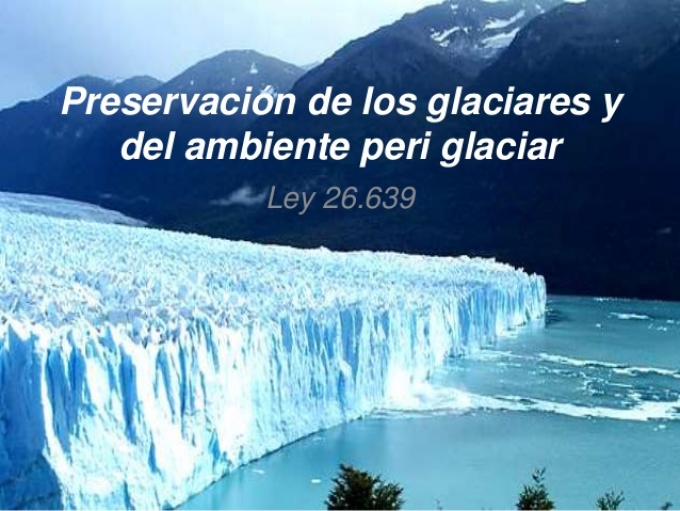
Para que esto sea inteligible, hay que decir qué decía la ley vigente y qué cambia en la práctica. La Ley de Glaciares (2010) no se limitaba a “proteger hielo”. Definía a los glaciares y al ambiente periglacial como reservas estratégicas de recursos hídricos y establecía presupuestos mínimos de protección. El punto clave era el perímetro: el glaciar no existe aislado; depende de su entorno, de su cuenca, de condiciones geomorfológicas que sostienen su función hídrica. Por eso el inventario nacional (IANIGLA) era una herramienta central: marcar presencia, extensión y entorno para evitar que la protección se redujera a un núcleo mínimo y el resto quedara disponible.

En el debate parlamentario y periodístico actual, lo más decisivo no es la frase tranquilizadora “los glaciares siguen protegidos”, sino el modo en que se estrecha la categoría de protección y se desplaza capacidad de definición hacia las provincias. El cambio de “ambiente periglacial” por “geoforma periglacial”, tal como se lo está explicando públicamente, funciona como reducción del perímetro protegido: donde antes había un paraguas amplio, ahora habría un recorte más acotado, y por lo tanto más fácil de excluir del inventario si un estudio sostiene que no hay función hídrica efectiva o que no se compromete el recurso. Dicho sin eufemismos: el diseño permite que áreas antes alcanzadas puedan ser “liberadas” para actividades como la minería si se logra probar, bajo el nuevo esquema, que no afectan el agua.
Ley de Glaciares. Ni esencia mística ni mercancía pura: el territorio es memoria, límite y soberanía material a largo plazo.
Tweet
El debate “peronista” reconoce que el impulso principal proviene de provincias mineras, con proyectos acumulados —en particular en San Juan, con foco en cobre— que necesitan modificar el alcance de la ley para avanzar. Se reconoce también que la media sanción se construye con votos peronistas provinciales: se mencionan como figuras clave a Lucía Corpacci (Catamarca) y Sergio Uñac (San Juan), dirigentes cercanos al centro político nacional pero atados a compromisos económicos locales con sectores extractivos. Ese dato es central porque rompe la narrativa fácil “libertarios pro-minería vs peronistas anti-minería”. El peronismo es, también, un sistema territorial. Y la política territorial suele ser más extractiva que el discurso nacional.

La palabra “federalismo” puede encubrir algo distinto. Las provincias son dueñas de sus recursos, sí, pero cuando la definición de perímetros hídricos y de inventarios queda fragmentada en jurisdicciones con incentivos inmediatos, el país puede perder capacidad de planificación común. No es un problema ideológico abstracto. Por eso el ejemplo del río Atuel es pertinente. Un río que atraviesa dos provincias muestra que el agua no respeta slogans de soberanía provincial. Si una jurisdicción controla el curso superior, puede secar o dañar a la otra. Ese conflicto histórico ilustra por qué desplazar la decisión al nivel provincial no siempre es “federalismo”; puede ser un “sálvese quien pueda”.
El periodismo argentino de izquierda y derecha pero, sobretodo, el progresismo se manifiesta no “contra la minería” en bloque; suenan críticos de la desregulación total y del modelo “todo o nada”. Eso no es incoherencia: es la posición típica de progresismo institucional que acepta extractivismo bajo condiciones, pero denuncia captura, opacidad y desprotección. El punto débil de esa postura, es que el agua aparece como nota al pie. Y no debería. El agua es el núcleo. En un contexto global de crisis climática, el glaciar no es un paisaje lindo: es infraestructura hídrica de larguísimo plazo, y por eso es un objeto estratégico.
Acá se vuelve inevitable nombrar el contexto geopolítico, sin convertir este post en panfleto: la discusión sobre glaciares y cobre ocurre en un momento en que el tablero global empuja a acelerar extracción de minerales “críticos”, y eso reordena alianzas, inversiones y reformas regulatorias. En ese marco, Argentina puede transformarse en plataforma de valorización extractiva, y el debate “técnico” sobre categorías periglaciales funciona como llave legal de acceso.
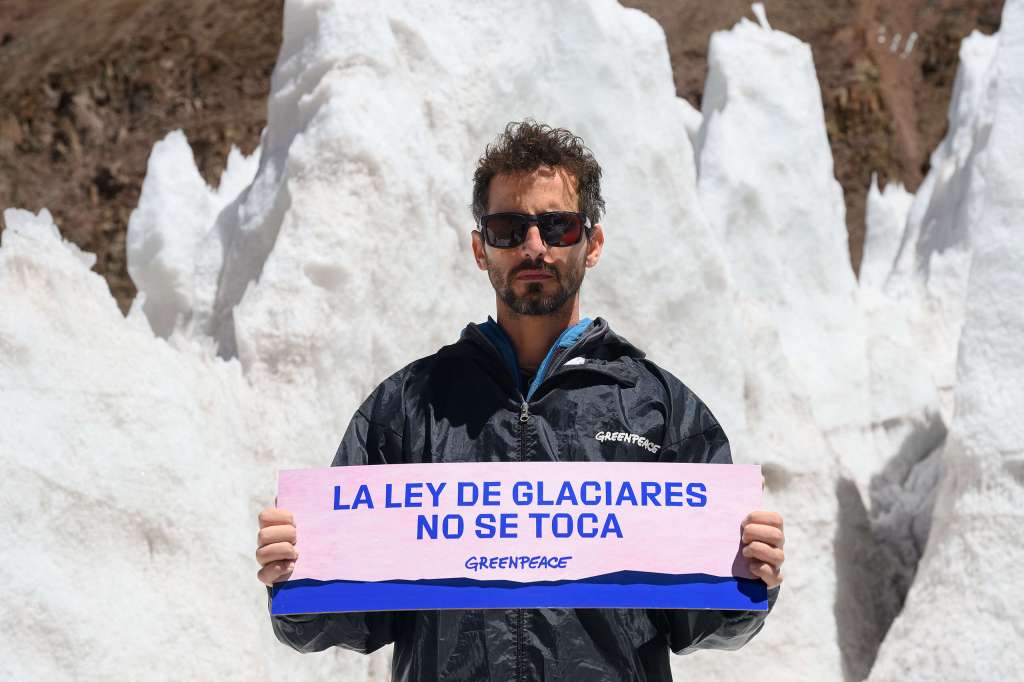
La escena de la protesta de Greenpeace en el Congreso y la desproporcionada represión, sumada a la agresión al camarógrafo tercerizado, no es un detalle lateral. Es el mismo dispositivo en otra escala: fungibilidad. Si el territorio se vuelve un activo intercambiable, el trabajo se vuelve un servicio tercerizable e intercambiable. Si el país se organiza para facilitar enajenación o explotación acelerada del suelo, necesita también una fuerza laboral flexible, precarizada, sin capacidad de conflicto sostenido, y necesita además una administración del orden público que normalice la violencia como método de gestión de protesta. La desprotección ambiental y la desprotección laboral no avanzan “juntas por casualidad”; avanzan juntas porque pertenecen a la misma racionalidad de desregulación.
En síntesis, Schama nos enseña que el peligro comienza cuando el paisaje se convierte en destino, cuando el territorio se vuelve esencia y la política se disfraza de naturaleza. El presente argentino muestra otro peligro: cuando el paisaje se convierte únicamente en activo, cuando el territorio se vacía de densidad ecológica e histórica y se vuelve un objeto de transacción y de “destrabe” regulatorio. Ni esencia mística ni mercancía pura.
El territorio es memoria, recurso, conflicto y límite. Y cuando se lo redefine exclusivamente en clave productiva, lo que se pierde no es solo paisaje. Se pierde soberanía material, es decir, la capacidad efectiva de una sociedad de decidir a largo plazo sobre su agua, su suelo, sus condiciones de vida y su reproducción ecológica, en lugar de delegar esas decisiones a la combinación de urgencias fiscales, presiones provinciales, ciclos electorales y hambre de inversión.
Eso es lo que está en juego.
Aquellos que se quieran sumar como miembros a mi Canal de YouTube y acceder a este material premium hagan click en el siguiente link. Únete a este canal
https://www.youtube.com/channel/UC8VlXkKPD8xnqVdpUn3-ZIw/join
© Rodrigo Cañete, 2026. Todos los derechos reservados. Este texto forma parte del curso “Paisajes: del Romanticismo a Anselm Kiefer” y no puede ser reproducido, distribuido ni transmitido, total o parcialmente, por ningún medio, sin autorización expresa del autor.
Message from Javier Milei and the Feudalized Peronism to Simon Schama: Landscape Is Never Innocent, but Neither Is It Sacred
What we have been developing in my Landscape Art course on my YouTube channel for paying members places Simon Schama at the center of our debate over the past weeks. For him, the “ontologization” of the German forest was not a literary metaphor, but a historical procedure through which a landscape motif came to function as a foundation of identity. In late Romanticism, the Wald ceased to be merely a collection of trees and became a repeatable scene of “historical depth” and “national authenticity.” That is why Friedrich could paint dried oaks as natural Gothic columns in Abtei im Eichwald, making the medieval ruin appear as an organic continuity of the landscape. In that logic, the nation does not “use” the forest: the nation seems to emerge from the forest. That inversion is dangerous because it naturalizes history. The political presents itself as geographic destiny, and the cultural presents itself as nature.
The problem is not loving the territory, but turning it into an essence: when landscape becomes destiny, politics disguises itself as nature.
Tweet
In Germany, the forest was ontologized as identity; in today’s Argentina, the glacier risks the opposite: becoming a mere regulatory variable to unlock investment.
Tweet
There lies the warning. Landscape begins to operate as essence. When territory becomes essence, politics can dress itself as “natural defense” and justify exclusion, purification, expulsion, or conquest without presenting itself as ideology, but rather as necessity. That is the hard point Schama reconstructs when he connects the Romantic rereading of Tacitus, the heroic scene of Arminius, Fichte’s rhetoric of cultural rootedness, nineteenth-century conservative anti-urbanism, and ultimately the Nazi radicalization of Blut und Boden. In that trajectory, the forest ceases to be background. It becomes argument.
This is why Kiefer is crucial. Kiefer enters the forest knowing it is contaminated. He does not attempt to rescue Romantic innocence; he attempts to pass through the archive of violence that tradition deposited in that motif. In Occupations (1969), he photographs himself performing the Nazi salute in European landscapes: he does not “represent” Nazism; he reintroduces the gesture into visible space to prevent closure. In Varus (1976), the path sinks into a dark forest of blackened trunks that promises no exit: that “road” is the literal image of the Holzweg as dead end. The landscape no longer consoles. It weighs. What was once sublime interiority is now memory as burden.
Changing “periglacial environment” to “periglacial geoform” is not a neutral technicality: it reduces the scope of protection and redefines who decides over water.
Tweet
Schama insists that Kiefer does not celebrate the myth of the forest; he burns it. But fire has a double cultural meaning: it destroys and it purifies. Kiefer wants to ruin the myth, yet at the same time he monumentalizes it in the form of ruin. The forest ceases to be heroic, but it does not cease to be central. Critique does not erase the motif; it renders it dark, heavy, almost sublime in its negativity. That is what makes Kiefer complex: he does not say “let us forget the forest,” he says “we cannot escape the forest.” And when the quintessential national symbol becomes diseased, the fantasy of nature as guarantor of moral continuity collapses. The myth encounters biology. And it loses.
The false dilemma “mining: yes or no” hides the decisive question: how, under what standards, and who controls the impact on strategic water resources.
Tweet
What is happening today in Argentina with the reform of the Glacier Law is not a repetition of the German process. It is its inversion. In Germany, the danger lay in the ontological sacralization of territory as national essence. In Argentina, the danger lies in the de-ontologization of territory: treating it as a set of adjustable variables to unlock investment, with water reduced to an externality rather than recognized as strategic infrastructure.

To make this intelligible, one must recall what the original law established and what changes in practice. The Glacier Law (2010) did not merely “protect ice.” It defined glaciers and the periglacial environment as strategic reserves of water resources and established minimum standards of protection. The key issue was the perimeter: a glacier does not exist in isolation; it depends on its surrounding environment, its watershed, and geomorphological conditions that sustain its hydrological function. That is why the national inventory (IANIGLA) was central: to map presence, extension, and context, preventing protection from being reduced to a minimal core while leaving surrounding areas available.
Neither mystical essence nor pure commodity: territory is memory, limit, and long-term material sovereignty.
Tweet
In the current parliamentary and media debate, what is decisive is not the reassuring phrase “glaciers remain protected,” but the narrowing of the protection category and the transfer of definitional capacity to the provinces. The shift from “periglacial environment” to “periglacial geoform,” as publicly explained, functions as a reduction of the protected perimeter: where once there was a broad umbrella, there is now a more restricted scope, easier to exclude from the inventory if a study claims that no effective hydrological function is present or that the water resource is not compromised. Put plainly: the design allows areas previously covered to be “released” for activities such as mining if, under the new framework, they can be shown not to affect water.
The so-called “Peronist debate” acknowledges that the main impulse comes from mining provinces with accumulated projects—particularly in San Juan, focused on copper—that require modifying the law’s scope in order to move forward. It is also acknowledged that the Senate’s half-approval was built with provincial Peronist votes: Lucía Corpacci (Catamarca) and Sergio Uñac (San Juan) are mentioned as key figures, leaders close to the national political center yet bound to local economic commitments with extractive sectors. This fact is central because it breaks the simplistic narrative of “libertarians pro-mining vs. Peronists anti-mining.” Peronism is also a territorial system, and territorial politics often proves more extractivist than national rhetoric.‘
The word “federalism” can conceal something else. Provinces may own their resources, but when the definition of hydrological perimeters and inventories is fragmented across jurisdictions with immediate incentives, the country may lose the capacity for common planning. This is not an abstract ideological issue. The example of the Atuel River is pertinent. A river that crosses two provinces demonstrates that water does not obey slogans of provincial sovereignty. If one jurisdiction controls the upper course, it can dry or damage the other. That historical conflict illustrates why shifting decisions to the provincial level is not always “federalism”; it can become “every province for itself.”
Argentine journalism—left and right, but especially progressive outlets—does not position itself “against mining” as a bloc; rather, it sounds critical of total deregulation and of the “all or nothing” model. That is not incoherence; it is the typical stance of institutional progressivism, which accepts extractivism under conditions but denounces capture, opacity, and deregulation. The weak point of that position is that water appears as a footnote. It should not. Water is the core. In a context of global climate crisis, a glacier is not a picturesque landscape; it is long-term hydrological infrastructure, and therefore a strategic object.
The geopolitical context cannot be ignored without turning this into propaganda. The discussion of glaciers and copper unfolds at a moment when the global landscape pushes for accelerated extraction of “critical” minerals, reshaping alliances, investments, and regulatory reforms. In that framework, Argentina risks becoming a platform for extractive valorization, and the “technical” debate over periglacial categories functions as a legal key of access.

The Greenpeace protest and the repression, along with the aggression against a subcontracted cameraman, are not marginal details. They are the same device at another scale: fungibility. If territory becomes an interchangeable asset, labor becomes a subcontractable and replaceable service. If the country reorganizes itself to facilitate accelerated alienation or exploitation of land, it also requires a flexible, precarious workforce with limited capacity for sustained conflict, and a public order apparatus that normalizes violence as a method of protest management. Environmental deregulation and labor deregulation do not advance together by coincidence; they belong to the same rationality of deregulation.
If I were to condense the argument without losing density, I would put it this way: Schama teaches us that danger begins when landscape becomes destiny, when territory becomes essence and politics disguises itself as nature. The Argentine present reveals another danger: when landscape becomes merely an asset, when territory is emptied of ecological and historical density and turned into an object of transaction and regulatory “unlocking.”
Neither mystical essence nor pure commodity.
Territory is memory, resource, conflict, and limit. When it is redefined exclusively in productive terms, what is lost is not only landscape. What is lost is material sovereignty: the effective capacity of a society to decide, in the long term, about its water, its soil, its living conditions, and its ecological reproduction, rather than delegating those decisions to the combined pressures of fiscal urgency, provincial bargaining, electoral cycles, and investment appetites.
That is what is at stake.
Those who wish to join as members of my YouTube channel and access this premium material can click the following link:
https://www.youtube.com/channel/UC8VlXkKPD8xnqVdpUn3-ZIw/join
© Rodrigo Cañete, 2026. All rights reserved. This text is part of the course Landscapes: From Romanticism to Anselm Kiefer and may not be reproduced, distributed, or transmitted, in whole or in part, by any means, without the express authorization of the author.



 Loveartnotpeople.bloG
Deja una respuesta