
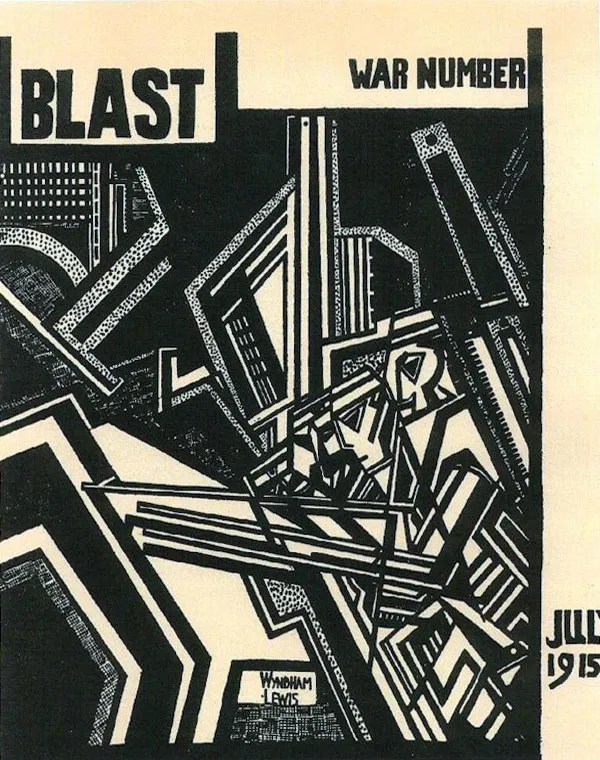
En 1914 Wyndham Lewis publica en el primer número de Blast una declaración que parece estética pero que es en realidad una filosofía de la acción: el vórtice no es el movimiento sino el punto de máxima energía en el centro del movimiento. No la velocidad sino la estructura de la velocidad. No el caos sino el principio que organiza el caos desde adentro. Lewis está respondiendo a los futuristas italianos, que habían hecho de la velocidad y de la destrucción valores estéticos en sí mismos, pero su respuesta va mucho más lejos que una disputa de escuelas. Lo que Lewis está formulando es una teoría de la inteligencia como concentración: el artista no se deja llevar por la corriente de la vida moderna sino que se instala en el centro de esa corriente y desde ahí la gobierna. El Vorticista no es esclavo del movimiento. Es su amo. Y esa distinción entre dejarse llevar por una fuerza y dominarla desde su centro geométrico es una de las formulaciones más precisas y más perturbadoras que produce toda la vanguardia europea de este período, precisamente porque no se agota en el arte.
El Vorticista no es esclavo del movimiento. Es su amo. Y esa distinción entre dejarse llevar por una fuerza y dominarla desde su centro geométrico es una de las formulaciones más precisas y más perturbadoras que produce toda la vanguardia europea de este período, precisamente porque no se agota en el arte.
Tweet
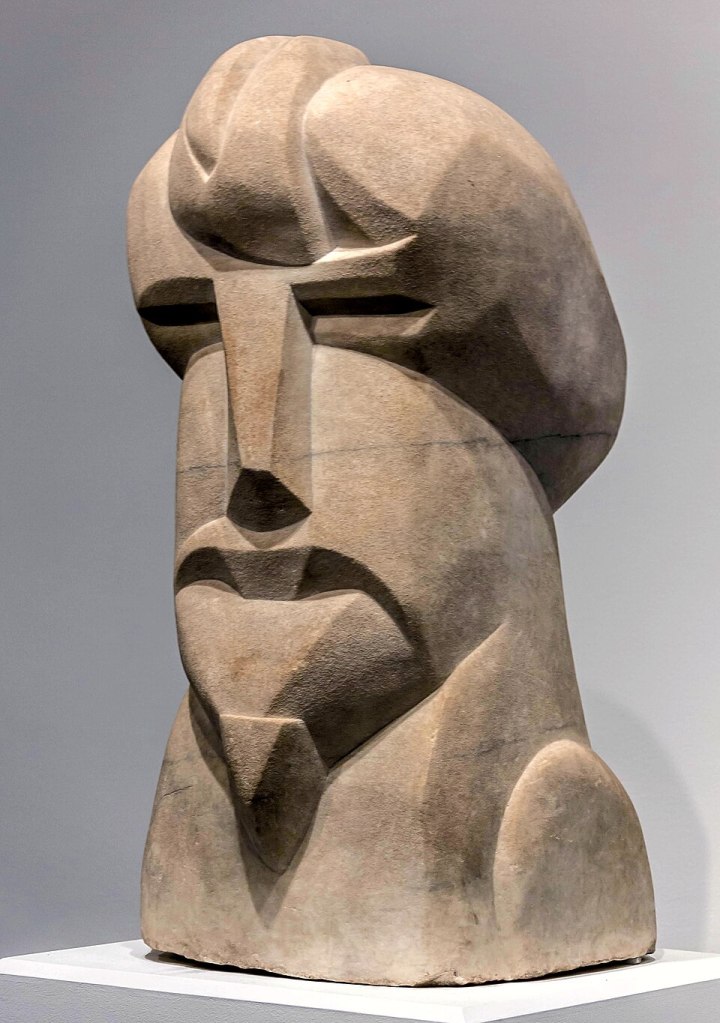
Gaudier-Brzeska lleva esa formulación hasta su consecuencia más extrema y lo hace desde el lugar más improbable: una trinchera en el frente occidental en 1915. Escribe que sus opiniones sobre la escultura permanecen absolutamente iguales, que toma el máuser de un enemigo muerto, que su forma le produce una imagen poderosa de brutalidad, y que talla en la culata un diseño a través del cual intenta expresar un orden de sentimiento más suave. Pero enfatiza que su diseño logra su efecto exactamente igual que el arma lo había logrado: desde una composición muy simple de líneas y planos. Lo que Gaudier-Brzeska está demostrando con ese experimento escalofriante es que una teoría total de la forma no tiene afuera. El arma que mata y el objeto que expresa un sentimiento operan con la misma lógica: superficies, planos, la disposición de masas en relación. La destrucción y la creación son instancias de la misma energía formal. Esta indiferencia no es insensibilidad moral: es la consecuencia extrema de haber construido un sistema que absorbe todo, incluso su propia negación.
La destrucción y la creación son instancias de la misma energía formal. Esta indiferencia no es insensibilidad moral: es la consecuencia extrema de haber construido un sistema que absorbe todo, incluso su propia negación.
Tweet
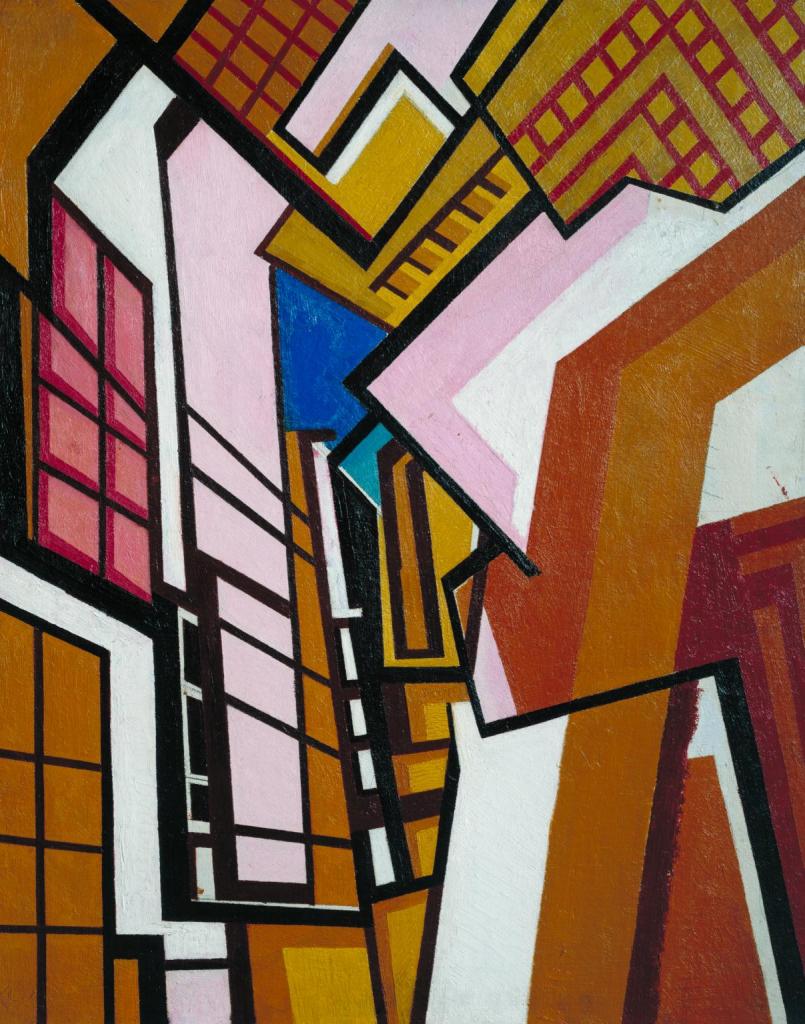
Meidner llega al mismo problema desde el otro lado. No desde la abstracción vorticista sino desde la exigencia de pintar la metrópolis concreta, la Grossstadt berlinesa de 1913, con toda su violencia óptica y su angularidad brutal. Lo que Meidner diagnostica con una precisión extraordinaria es que los modelos perceptivos heredados —el impresionismo, la perspectiva tradicional, la suavidad tonal de la pintura de paisaje— son literalmente incapaces de procesar la experiencia visual de la ciudad industrial. Una calle no es un campo de trigo. Una calle te bombardea con filas sibilantes de ventanas y vigas de luz que bailan entre vehículos, con masas amorfas de color que se mueven y se disuelven. Para pintar eso hay que construir nuevas herramientas perceptivas, no importar las de otro contexto. Y aquí Meidner hace algo que es importante no perder de vista: rechaza explícitamente el primitivismo como solución. No somos negros, dice, no somos cristianos de la Alta Edad Media. Somos habitantes de Berlín en 1913 y tenemos que pintar nuestro propio mundo con las herramientas que ese mundo exige. La respuesta al agotamiento de un sistema visual no es apropiarse de la otredad de otra cultura: es construir desde adentro de la experiencia propia.
Una calle te bombardea con filas sibilantes de ventanas y vigas de luz que bailan entre vehículos, con masas amorfas de color que se mueven y se disuelven. Para pintar eso hay que construir nuevas herramientas perceptivas, no importar las de otro contexto.
Tweet
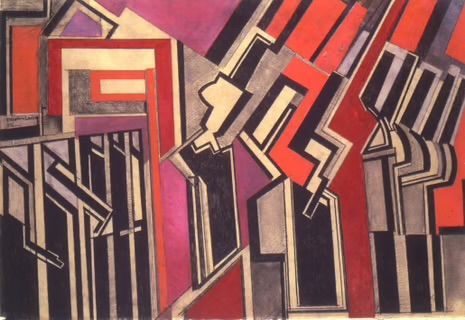
Lo que conecta a estos tres autores y lo que los hace urgentemente contemporáneos es que los tres están pensando el mismo problema: qué ocurre cuando una inteligencia —artística, técnica, sistémica— se vuelve tan totalmente coherente consigo misma que deja de tener afuera, que absorbe todo lo que toca incluyendo su propia negación. Lewis lo llama el vórtice y lo celebra. Gaudier-Brzeska lo demuestra con el máuser tallado desde las trincheras y muere antes de poder evaluar sus consecuencias. Meidner lo diagnostica como un problema perceptivo y exige nuevas herramientas. Pero los tres están describiendo una misma estructura: la de un sistema que opera con una lógica interna tan poderosa que las categorías de dentro y afuera, de creación y destrucción, de arte y arma, empiezan a perder su capacidad de distinguir. Esa estructura no es solo estética. Es la estructura del poder técnico moderno. Y cuando miramos lo que ocurre hoy con sistemas de inteligencia artificial aplicados a contextos políticos concretos, la genealogía que Lewis, Gaudier-Brzeska y Meidner inauguran en 1914 se vuelve imposible de ignorar.
Palantir es una empresa de análisis de datos e inteligencia artificial fundada por Peter Thiel y Alex Karp que provee sus sistemas a gobiernos, fuerzas armadas y agencias de seguridad en todo el mundo. Su nombre viene de las piedras videntes de Tolkien, los objetos que permiten ver a distancia pero que en la narrativa del autor están irremediablemente ligados al poder corrupto. Esa elección no es inocente. Cuando Palantir opera en un contexto como el de la Argentina de hoy —un país con una historia reciente de desaparición forzada de personas, de uso sistemático de la inteligencia estatal contra la población civil, de archivos secretos que tardaron décadas en abrirse— lo que instala no es solo una herramienta técnica sino una lógica vorticista en el sentido más preciso del término: un sistema de inteligencia que no tiene afuera, que absorbe datos de fuentes heterogéneas, que construye patrones y predicciones con una coherencia interna que no rinde cuentas a ningún criterio externo a su propia eficacia. La pregunta que Meidner le hacía a la pintura —¿con qué herramientas perceptivas procesamos una realidad que desborda los modelos heredados?— se convierte en una pregunta política de primera urgencia: ¿con qué marcos legales, éticos e institucionales procesamos un sistema que ve todo, que no olvida nada y que no tiene que explicar su lógica a nadie? El experimento del máuser de Gaudier-Brzeska tenía al menos la honestidad de ser un experimento individual, visible, trazable. Un algoritmo de Palantir desplegado sobre la población argentina no tiene esa transparencia. Tiene solo su coherencia interna y la eficacia que esa coherencia produce. Y cuando esa eficacia se aplica no a la guerra entre estados sino a la gestión de poblaciones civiles en un Estado de derecho formalmente democrático, la distinción entre el arma y el objeto tallado —entre el instrumento de destrucción y el instrumento de expresión— se vuelve tan tenue como la que Gaudier-Brzeska disolvió en las trincheras, con la diferencia de que nadie está tallando nada más suave en la culata.
Cuando Palantir opera en un contexto como el de la Argentina de hoy —un país con una historia reciente de desaparición forzada de personas, de uso sistemático de la inteligencia estatal contra la población civil, de archivos secretos que tardaron décadas en abrirse— lo que instala no es solo una herramienta técnica sino una lógica vorticista en el sentido más preciso
Tweet
El caso de Belfast de hoy hace visible la otra cara del mismo problema. Cuando un video falso circula en redes sociales afirmando que el autor de un ataque con cuchillo contra niños era un solicitante de asilo musulmán, y cuando ese video es amplificado por algoritmos diseñados para maximizar el engagement —es decir, para maximizar la respuesta emocional independientemente de su veracidad— lo que ocurre no es un error del sistema sino el sistema funcionando exactamente como fue diseñado. Los disturbios que siguieron, los ataques a mezquitas y a hoteles que alojan refugiados, la violencia racial en las calles de Belfast y de otras ciudades británicas, no son el producto de la desinformación en un sentido ingenuo. Son el producto de una lógica vorticista aplicada a la gestión de la atención humana: un sistema que ha encontrado el punto de máxima energía en el centro del cuerpo social y que lo explota con la misma indiferencia formal con que Gaudier-Brzeska analizaba el máuser. El algoritmo no odia. El algoritmo no tiene opiniones sobre el Islam ni sobre los refugiados ni sobre Belfast. El algoritmo tiene una métrica de optimización y esa métrica descubrió hace tiempo que el odio racial genera más engagement que la moderación, que el miedo genera más clics que la tranquilidad, que la indignación mantiene al usuario más tiempo en la plataforma que la información verificada. Lewis diría que eso es el vórtice en acción: una inteligencia que no es esclava del movimiento sino su amo. Lo que Lewis no podía ver desde 1914 es que cuando esa lógica se escala a miles de millones de usuarios simultáneos, el amo y el esclavo se vuelven indistinguibles, y lo que queda es solo la energía girando sobre sí misma, produciendo sus efectos con la precisión indiferente de una máquina que no tiene adentro ni afuera, solo la coherencia implacable de su propia operación.
La violencia en Belfast de estos días hace visible que cuando un video circula en redes sociales afirmando que el autor de un ataque con cuchillo contra niños era un solicitante de asilo musulmán, y cuando ese video es amplificado por algoritmos diseñados para maximizar el engagement lo que ocurre no es un error sino el sistema funcionando como fue diseñado.
Tweet
THE FORM IN THE EYE OF THE HURRICANE: LEWIS, GAUDIER-BRZESKA, MEIDNER AND THE PROBLEM OF INTELLIGENCE THAT HAS NO OUTSIDE
In 1914 Wyndham Lewis publishes in the first issue of Blast a declaration that appears aesthetic but is in reality a philosophy of action: the vortex is not movement but the point of maximum energy at the center of movement. Not speed but the structure of speed. Not chaos but the principle that organizes chaos from within. Lewis is responding to the Italian Futurists, who had made speed and destruction aesthetic values in themselves, but his response goes far beyond a dispute between schools. What Lewis is formulating is a theory of intelligence as concentration: the artist does not let himself be carried along by the current of modern life but installs himself at the center of that current and from there governs it. The Vorticist is not the slave of movement. He is its master. And that distinction between being swept along by a force and dominating it from its geometric center is one of the most precise and most disturbing formulations produced by the entire European avant-garde of this period, precisely because it does not exhaust itself in art.
In 1914 Wyndham Lewis publishes in the first issue of Blast a declaration that appears aesthetic but is in reality a philosophy of action: the vortex is not movement but the point of maximum energy at the center of movement. Not speed but the structure of speed. Not chaos but the principle that organizes chaos from within.
Tweet
Gaudier-Brzeska carries that formulation to its most extreme consequence and does so from the most improbable place: a trench on the Western Front in 1915. He writes that his views on sculpture remain absolutely the same, that he takes a Mauser from a dead enemy, that its shape overwhelms him with a powerful image of brutality, and that he carves into the butt a design through which he tries to express a gentler order of feeling. But he emphasizes that his design achieves its effect in exactly the same way the weapon had achieved its own: from a very simple composition of lines and planes. What Gaudier-Brzeska is demonstrating with that chilling experiment is that a total theory of form has no outside. The weapon that kills and the object that expresses a gentler feeling operate with the same logic: surfaces, planes, the arrangement of masses in relation. Destruction and creation are instances of the same formal energy. This indifference is not moral insensitivity: it is the extreme consequence of having built a system that absorbs everything, including its own negation.
Meidner arrives at the same problem from the other side. Not from Vorticist abstraction but from the demand to paint the concrete metropolis, the Berlin Grossstadt of 1913, with all its optical violence and brutal angularity. What Meidner diagnoses with extraordinary precision is that the inherited perceptual models —Impressionism, traditional perspective, the tonal softness of landscape painting— are literally incapable of processing the visual experience of the industrial city. A street is not a wheat field. A street bombards you with sizzling rows of windows and beams of light dancing among vehicles, with amorphous masses of color that move and dissolve. To paint that you have to build new perceptual tools, not import them from another context. And here Meidner does something that is important not to overlook: he explicitly rejects primitivism as a solution. We are not Negroes, he says, we are not Christians of the early Middle Ages. We are inhabitants of Berlin in 1913 and we have to paint our own world with the tools that world demands. The answer to the exhaustion of one visual system is not to appropriate the otherness of another culture: it is to build from within one’s own experience.
Meidner arrives at the same problem from the other side. Not from Vorticist abstraction but from the demand to paint the concrete metropolis, the Berlin Grossstadt of 1913, with all its optical violence and brutal angularity.
Tweet
What connects these three authors and what makes them urgently contemporary is that all three are thinking the same problem: what happens when an intelligence —artistic, technical, systemic— becomes so totally coherent with itself that it ceases to have an outside, that it absorbs everything it touches including its own negation. Lewis calls it the vortex and celebrates it. Gaudier-Brzeska demonstrates it with the carved Mauser from the trenches and dies before he can evaluate its consequences. Meidner diagnoses it as a perceptual problem and demands new tools. But all three are describing the same structure: that of a system operating with an internal logic so powerful that the categories of inside and outside, of creation and destruction, of art and weapon, begin to lose their capacity to distinguish. That structure is not only aesthetic. It is the structure of modern technical power. And when we look at what happens today with artificial intelligence systems applied to concrete political contexts, the genealogy that Lewis, Gaudier-Brzeska and Meidner inaugurate in 1914 becomes impossible to ignore.
Palantir is a data analysis and artificial intelligence company founded by Peter Thiel and Alex Karp that provides its systems to governments, armed forces and security agencies around the world. Its name comes from Tolkien’s seeing-stones, objects that allow sight at a distance but that in the author’s narrative are irremediably linked to corrupting power. That choice is not innocent. When Palantir operates in a context like Argentina today —a country with a recent history of forced disappearance of persons, of systematic use of state intelligence against the civilian population, of secret files that took decades to open— what it installs is not only a technical tool but a Vorticist logic in the most precise sense of the term: an intelligence system that has no outside, that absorbs data from heterogeneous sources, that constructs patterns and predictions with an internal coherence that answers to no criterion external to its own efficacy. The question Meidner asked of painting —with what perceptual tools do we process a reality that overflows inherited models?— becomes a political question of first urgency: with what legal, ethical and institutional frameworks do we process a system that sees everything, forgets nothing and does not have to explain its logic to anyone? Gaudier-Brzeska’s Mauser experiment had at least the honesty of being an individual, visible, traceable experiment. A Palantir algorithm deployed over the Argentine population does not have that transparency. It has only its internal coherence and the efficacy that coherence produces. And when that efficacy is applied not to war between states but to the management of civilian populations in a formally democratic state under the rule of law, the distinction between the weapon and the carved object —between the instrument of destruction and the instrument of expression— becomes as thin as the one Gaudier-Brzeska dissolved in the trenches, with the difference that no one is carving anything gentler into the butt.
When Palantir operates in a context like Argentina today —a country with a recent history of forced disappearance of persons, of systematic use of state intelligence against the civilian population, of secret files that took decades to open— what it installs is not only a technical tool but a Vorticist logic: an intelligence system that has no outside,
Tweet
The case of Belfast in the summer of 2024 makes visible the other face of the same problem. When a false video circulates on social media claiming that the perpetrator of a knife attack against children was a Muslim asylum seeker, and when that video is amplified by algorithms designed to maximize engagement —that is, to maximize emotional response regardless of its veracity— what occurs is not a system error but the system functioning exactly as it was designed. The riots that followed, the attacks on mosques and hotels housing refugees, the racial violence in the streets of Belfast and other British cities, are not the product of disinformation in a naive sense. They are the product of a Vorticist logic applied to the management of human attention: a system that has found the point of maximum energy at the center of the social body and exploits it with the same formal indifference with which Gaudier-Brzeska analyzed the Mauser. The algorithm does not hate. The algorithm has no opinions about Islam or refugees or Belfast. The algorithm has an optimization metric and that metric discovered long ago that racial hatred generates more engagement than moderation, that fear generates more clicks than calm, that outrage keeps the user on the platform longer than verified information. Lewis would say that is the vortex in action: an intelligence that is not the slave of movement but its master. What Lewis could not see from 1914 is that when that logic is scaled to billions of simultaneous users, master and slave become indistinguishable, and what remains is only the energy spinning on itself, producing its effects with the indifferent precision of a machine that has neither inside nor outside, only the implacable coherence of its own operation.
The algorithm does not hate. The algorithm has no opinions about Islam or refugees or Belfast. The algorithm has an optimization metric and that metric discovered long ago that racial hatred generates more engagement than moderation, that fear generates more clicks than calm, that outrage keeps the user on the platform longer than verified information.
Tweet



 Loveartnotpeople.bloG
Deja una respuesta